


By Mahesan Niranjan –

Prof. Mahesan Niranjan
[Previous diaries can be seen here: Part I, Part II, Part III, Part IV(a) and Part IV(b).]
Sunday 16th November: Katunayake. I engage the taxi driver in conversation to know the state of the country. Cost of living, this new government may not be able to deliver everything they promised etc., ending with a strong claim “but these guys don’t steal, sir.”: “මෙගොල්ලන් හොරකන් කරන්නෙ නෑ සර්”. He made it strong, using the suffix “nam / nang නම් නං”, that phonological twist in Sinhala, giving emphasis or drawing attention to something unique.
Did he say “මෙගොල්ලන් නම් හොරකන් කරන්නෙ නෑ සර්”, [others steal, these guys don’t] or “මෙගොල්ලන් හොරකන් නම් කරන්නෙ නෑ සර්” [theft definitely is not on the list of any wrongdoings] or was it” මෙගොල්ලන් හොරකන් කරන්නෙ නම් නෑ සර්”? [emphasis more on the act of theft], I do not recall. The message is clear on what he thought of previous governments. One might say he is scraping the bottom of the barrel to justify the vote he cast in 2024, but more likely he sees an opportunity not to be squandered.
Monday 17th: I visit a private university, my first to one. When private universities started in early eighties, I was strongly opposed to it, being a proud product of free education. They have mushroomed these days, with franchises and off-shore campuses by UK and Australian universities. Internationalization is a fashionable topic in UK universities; glossy brochures claiming identical standards as the home university, to be achieved by emailed power point slides and exam papers synchronising teaching and assessment. Were you to cast doubt on quality, UK universities have invented layers of quality assurance processes to gain your confidence. Private education seems here to stay, I acknowledge. My nostalgia cannot wish it away.
Tuesday 18th: A workshop at the University of Colombo on Computational Biology. During my secondary schooling in Sri Lanka, I hated biology. You had to sketch roots and leaves, and memorise Latin terms. I also disliked statistics which was taught at the most boring end of its distribution, of tossing dies and shuffling cards. Now, I teach how statistical inference applies to biological data! In planning the workshop, I had asked a local colleague to help design a hands-on practical session, She and her student had done a fantastic job using AlphaFold, the system that predicts three dimensional structures of proteins from amino-acid sequences. The young graduate assistant had great insights into the different aspects of a significant scientific breakthroughs of our times.
Wednesday 19th: Morning train to Peradeniya for a conference on Data Science and Artificial Intelligence, at which I was a speaker. A nice mixed group: local academics, students, overseas participants. Late afternoon, I become an amateur tour guide to the participants. A highly enjoyable walk through the beautiful campus. I had several anecdotes to tell from my own life on campus four decades ago, and my parents’ time there in the fifties: the huge trees under which I used to sit, meditating or day dreaming; the gender imbalance in Engineering on the left bank of the river; the political left to be found more on the left of the river; the times of Sir Ivor Jennings as vice chancellor; the plaque declaring the university to be `more open than usual’; my visit last year when I took a class in the open air theatre, though not to standards of Sarachchandra’s Maname (ම්නමේ).
After the walk, I invite the group to a restaurant for a cold beer. Being too close to campus they are no longer allowed to serve alcohol. We settle for ginger beer. Some in the group are amused to read cream soda in the menu. How do you get cream into soda, they ask. Just like having Yorkshire pudding, which doesn’t look anything like pudding, I explain.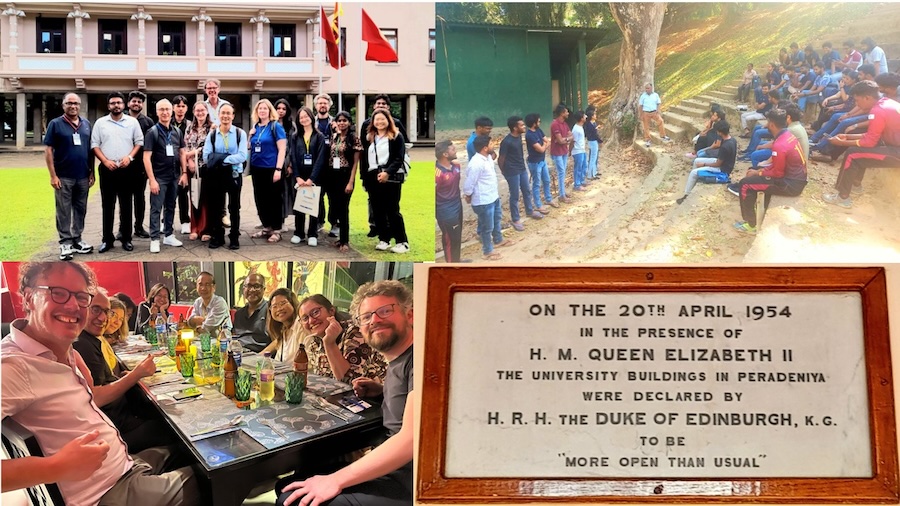
Thursday 20th, Friday 21st: Conference days, more talks, chairing sessions and a conference dinner. In the session I chaired, I tried to encourage people, especially students, to ask questions. No response. I make an offer. If a student asks a question and the speaker responds “that is a good question”, I shall buy them a book on artificial intelligence. Still no response. Perhaps in our strongly hierarchical society, asking a question risks being interpreted as challenging authority.
Saturday 22nd: I run another workshop. To be efficient, I do the same topic as in Colombo, inviting my Colombo friend and her student to join me, and introduced them to the conference organisers at Peradeniya. I am pleased at coming from 6000 miles away and introducing Sri Lankan academics who are based 100 miles apart to each other. In my visits, I meet fine scholars in Sri Lankan universities, often as pockets of isolated excellence. Maybe there is scope to build critical mass in some topics by closer collaborations, I wonder. Not for me to say, as I do not know all the local constraints.
Sunday 23rd: A rest day. I take a long walk. This time in the direction of the village Mahakanda. At Hindagala, I see a sign to a temple and climb up the mountain road. Beautifully placed under the protection of a rock. Some nice old paintings on the wall too. It is right next to campus but I have never noticed it during my student days. A bus back, narrowly missing the downpour.
Monday 24th to Wednesday 26th: I make progress with some collaborative projects. A student wishes to start an MPhil programme which I agree to collaborate on.
It rains a lot in the afternoons.
Thursday 27th: There is a conference in the Medical faculty at which two of my engineering friends were speakers. They drag me along. Some strange looks at the venue took me by surprise for a moment. I then learn that my brother had just given a keynote talk there, online from the UK. How come this guy talked online in the morning and turns up physically to have tea, people might have wondered. Tintin to the rescue: reference to Thomson and Thompson explain away the confusion.
On our way back, rain is very heavy.
Thursday 27th late afternoon: I look from the second floor balcony of my accommodation and find the river level has risen a bit. The summer house on the bank of the river seems flooded. The hight I am at gives me a bit of confidence. A mighty river you may be, but you are not going to rise this high, I say to the Mahaweli Ganga. From a tweet I gather the Kotmale reservoir upstream might spill, which registers a bit of warning in my mind. I take a short nap. Wake up late in the night to find power has gone down.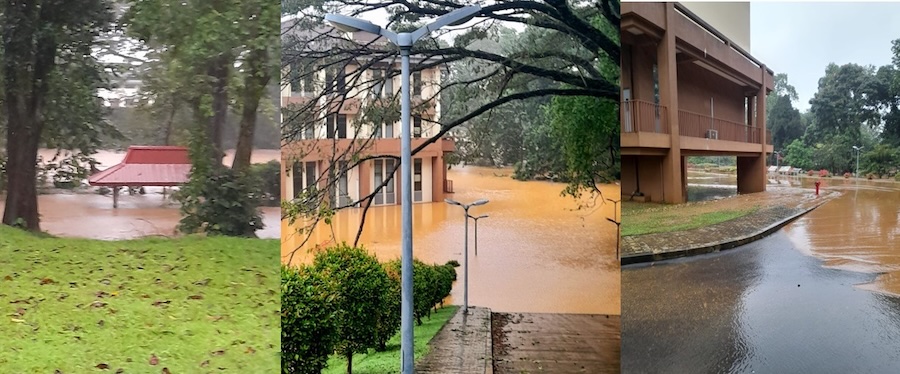
Friday 28th 01:00 AM: The security guard knocks on the door. The river level is rising and there is water in the basement car park. I sense tension in his voice. He has waded through a few inches of water already. We knock on all doors, checking for occupants, evacuate the building and go into the faculty which was on higher ground.
There were about 100 people in the Faculty building, students evacuated from two low-lying halls of residence and a group of school children and their teachers stranded while returning from a field trip. Three members of staff who lived nearby were helping to organize things a little. Their energy and commitment were phenomenal. Some students were stuck on the third floor of a building nearby (Panideniya) and water had risen to the second. The staff were trying to find a way of rescuing them. An army team with a boat was on the other side of a landslide which had to be cleared to get through. They managed to do it and, everyone was pulled to safety by early afternoon.
I struggled to get some sleep as furniture in lecture rooms is not designed for that, though as a student in those very rooms, I remember managing it at times.
A friend saw a post I made on facebook and connected me with his lecturer colleagues in the Faculty, who were immensely nice in looking after me. They were great company to talk to, admirable in the work they did to support stranded students, and brought me some breakfast, blankets and tooth paste, and found a spare room for me in the hostel next door.
Friday 28th (night): A good night’s sleep in Akbar Hall – my home in the academic years of 1978 and 1982. A rich mixture of intense scholarship, carefree friendships, drama clubs and occasional protest marches. The hostel needs urgent refurbishment.
Saturday 29th: It is clear I cannot catch my flight back to the UK on the 30th. Electricity and water have not been restored to Peradeniya. Akbar Hall was running out of water and food. The cafeteria guy says he has some gas and supplies, but won’t be able to get new stock any time soon. Someone from Kandy manages to drive through to meet the school kids. The school teacher arranges with him to take me to Kandy. A great help from someone I only met that night. The damage, passing the Gannoruwa and Getambe area, was frightening. It seemed water had risen some 11m that night.
I find a hotel near the lake. There seems chaos at the lobby with several guests wanting to leave at short notice and several arriving at the same time. The manager recognises me from a previous stay. I get a room.
Sunday 30 – Tuesday 2nd: I stay put in the hotel. I know under the circumstances of post-flood days it is risky to drink water. But mercifully the hotel has a good stock of Lion lager. I rebook my flight and email my graduate students moving my meetings online. “It is WFH,” I say in the note to them.
You know, in language, words do not mean much in isolation. The meanings they carry is heavily modulated by context: the semantics of what you wish to say and the constraints imposed by the grammar. It is the realization of this, and the ability to capture context in computational models, that forms the basis of recent advances in artificial intelligence: those natural language processing tools with which students cheat at coursework and most emails start boringly, expressing the wish they find you in momentary good health.
“It is WFH,” I say to my students. “Work from home”. But in my present context, “Home” gets a different — endearing — meaning. To deal with the emotion it evoked, I needed a second bottle.
Between online meetings, I take long walks around the lake.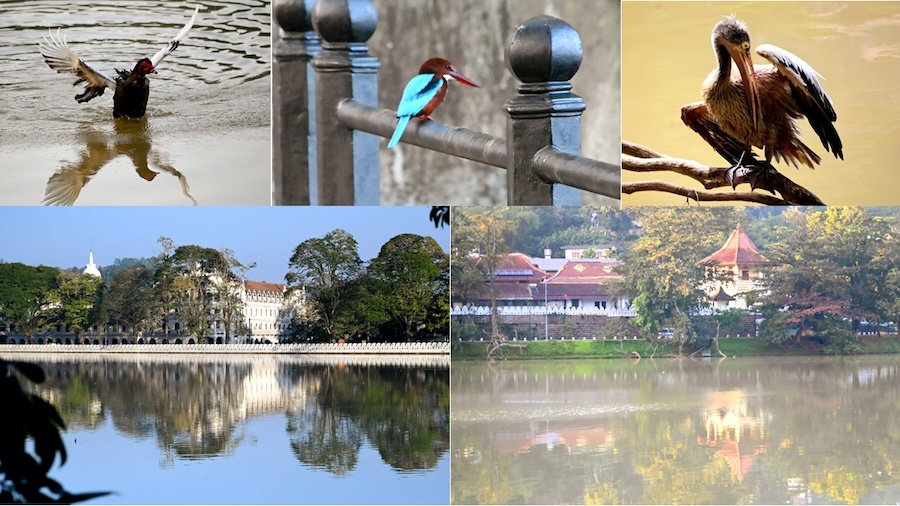
I try to stay in touch with news. Recovery efforts are happening competently. A disaster relief fund has been set up by the government with a committee appointed to oversea it. In my circle of friends there is sharp criticism of the composition of the committee: Why is it all rich businessmen? Why is it all men? There is also criticism that much of the warning and government circulars on disaster relief were only in Sinhala. Despite the joy I achieved when the present government came to power, for several reasons including the (හොරකන් කරන්නෙ නෑ), this last point is of concern. President Anura Kumara Dissanayake (AKD) was on television. He spoke in Sinhala. Not an impromptu speech but a prepared one. Unlike AKD’s usual eloquent speeches, he read from script, which he could easily have had translated and put as subtitles. There was a definite need for warnings and disaster notices in Tamil, too, as a lot of the landslides happened in the hill country with a good number of Tamils in tea estates. Is this a blind spot that has got entrenched, I wondered.
“Banda, you have won!”
I shout at the television, referring to our Oxford educated former Prime Minister, SWRD Bandaranayake, who replaced English with Sinhala as Sri Lanka’s official language. Moving away from English may itself not have been an issue. Anti-colonial sentiments were strong. My late father used to joke about his pride in choosing to study Sanskrit at university as our dead language in place of Latin, the white man’s dead language. But Banda sowed the seeds of racism into it by announcing a 24-hour time limit he was going to do it in, something amplified by every one of his successors for electoral gains, AKD’s win in 2024 being the first exception to this.
Anyone with doubts then of Oxford education not producing good prime ministers, had it confirmed when Johnson and Sunak came in the scene in the UK!
That blind spot is disturbing. I myself have learnt some Sinhala. Enough to get from A to B in a tuk without getting lost. But I struggle with formal official letters, and at times with AKD’s eloquent speeches, too.
Associative memory takes me back in time, 1978, Polgahawela station. I was returning from my first term in campus. There was an announcement to the effect that a ticket from Badulla to Thalaimannar has been found and the owner should collect it from the station counter. It was in Sinhala, repeated ten minutes later. There was high probability that the one who lost the ticket would be a Tamil speaker. There was a lot of repatriation from Tea estates to India of Tamils, who, living under semi-slavery conditions, kept the Sri Lankan economy afloat: “Ceylon Tea”, the catchphrase you have all heard. Around the time of our independence, we disenfranchised them, and then via the Srima-Shashtri Pact sent a good fraction of them to India: from Badulla to Thalaimannar by train; then by ferry to Rameswaram. Our ungrateful and shameful act of betrayal, worse than any inequality that might explain the violent uprisings in 1971, 1989 and the 30-year war in the North.
At Polgahawela, I went to the station master’s office and asked if I could make that announcement in Tamil. He did not hide his amusement but agreed and instructed the clerk to give me the microphone. Within two minutes of my announcement in Tamil, an elderly woman came and collected her lost ticket.
Almost half a century later, sipping my Lion lager, I recall that incident and think the linguistic blind spot in the system has now got so entrenched, that even this new government is unable to get it right.
Wednesday 3rd: I get the hotel to organise a car to travel to my friends’ place in Colombo. The usual highway was still not clear and we drive through Kurunegala. Again, frightening scenes of landslides mostly in the Galagedara area. Judging by the number of slips, the volume of earth that had come down and the diameters of the large tress that had fallen, it was really impressive they had cleared it in such a short time. Poor infrastructure, an unfortunate climate disaster, but the resilience of the people helping rapid recovery.
The shock though was too intense to pause for photographs.
I engage the driver in conversation. He speaks very little English, so we spoke in Sinhala. He echoes the sentiments I heard in the ride from the airport: “හොරකන් නම් කරන්නෙ නෑ.” He has wo children. The older is about to sit her first public exam, which he regrets has now been postponed.
Then he said something of intrigue. The kids were studying in the English medium! That would give more job opportunities, and maybe even help send them abroad, he claimed. So, it is not the upper strata of society that is after English medium education as I had often thought. It is reaching further down. I had to consciously stop myself from saying it aloud:
“Banda, have you really won?”
Wednesday 3rd (Colombo): In the evening my friends take me to a posh club for dinner. A club where golf is played. A belated birthday dinner which helps recover from the trauma.
Thursday 4th: Fly back to UK, determined to visit Sri Lanka more, stay longer and make myself useful in small ways.
Agnos / January 1, 2026
Thanks for sharing your experiences of the floods and landslides in SL. On the language issue, AKD and NPP should be more mindful; if resources are the problem, they can try to use modern technologies efficiently. It will go a long way in easing anxieties and fears.
/
nutley / January 1, 2026
A very well-written piece from Prof. M.N.
“Then he said something of intrigue. The kids were studying in the English medium! That would give more job opportunities, and maybe even help send them abroad, he claimed. So, it is not the upper strata of society that is after English medium education “
This brings up two questions. First, even the “lower strata” have realized that what is dished out in schools free of charge isn’t really an education. To get a leg up over the others, one must have English, which comes with its own package of attitudes, especially after migration. I know parents who are upset at the clothing choices of their children, and their refusal to kowtow to the local hamuduruwo.
The other thing is that an English education costs money. If people can afford to pay, why do they not pay some reasonable amount to government schools and Universities? That would improve standards greatly. It isn’t Banda but C.W.W. Kannangara who lost, I think.
/
LankaScot / January 1, 2026
Hello Old nutley,
It was back in the mid to late 60s that we told our parents that the choices we made were ours, not theirs. Of course we said that we would listen to advice but ultimately it was our lives and if we made wrong choices – so be it. I wanted to be a Paleontologist back then, but was constrained by lack of Courses, so I ended up doing Physics and Electronics.
I teach my young Nieces and Nephews (Grandchildren effectively) English 2 or 3 times a week. From this I gather that their English Teachers are sadly lacking in knowledge of English Idioms and what modern conversational English is nowadays. My attitude is to get the Children Talking and Communicating between themselves fluently in English and then we’ll cover the niceties of Grammar. I could not help but notice that they are very proficient at copying the text of the Course Books into their Workbooks, however they are not so good at reading it back to you. They are improving slowly given how idiosyncratic English spelling and pronunciation are.
Best regards
/
SJ / January 1, 2026
oc
Any school education costs money, if the aim is to succeed in examinations.
Private tuition rules OK!
/
leelagemalli / January 2, 2026
Nutley and LS and all,
“If people can afford to pay, why do they not pay some reasonable amount to government schools and Universities? That would improve standards greatly. It isn’t Banda but C.W.W. Kannangara who lost, I think..”
–
The mentality must alter if anything is to be learnt correctly. I believe that in addition to the poor pay provided to government school instructors, additional money should be invested in teacher training programs. Teachers, along with their European counterparts and other nations such as Singapore and Malaysia, are among the most vulnerable groups to stress-related health issues. They are not only well compensated, but also well-trained. According to several educational experts in Germany, schoolteachers are the most vulnerable to early health issues (e.g Burn-out syndrome and heart diseases).
I believe that government school instructors are still inadequately equipped to meet the demands of modern teaching approaches. SRLANKENS in general continue to overate their high school literacy rates, although most schoolteachers are not advanced enough. Also, to become an assistant lecturer at a local university, one does not necessary need to obtain a PhD. That is what recently visiting academics from India told me in October.
/
leelagemalli / January 1, 2026
Without a question, the Professor has produced a thoughtful paper. This sent me back to my youth (2 decades) in my own country.
Not only is corruption rampant, but various other problems have a significant, irreversible impact on Sri Lanka’s ability to fulfill its economic goals. Above all, their attitudes, which are instilled in them from a young age, distinguish Sri Lankans. Hatred, jealousy, and spitefulness are common in their lives, even if they bear the banner “we are Sinhala Buddhists” on their foreheads. Even Sri Lankan Christians and Hindus are no better, and Sri Lankan Muslims are somewhat confined in Lankan culture, unable to express their beliefs and ideas properly. A true social and political revolution is required to effect significant change.
/
leelagemalli / January 1, 2026
OC, NV, LS, SJ, HT,WW, Chiv and all,
.
Wishing you all a healthy and prosperous New Year 2026!.
–
https://www.youtube.com/watch?v=oX7L4quxeBk
–
We, the Sri Lankans, must go on after being devastated by another national calamity, the recent dragon flood catastrophe, which injured and killed almost 1000 or more people while also victimizing and displacing millions from their homes.
Not the biggest, but to today’s rulers as Kindergarten performers, it has become the largest ever calamity in their lie-led dream world. Overall, the last 15 months under the NPP government have resulted in little more development than the previous government had made for the country. However, it has become a stagnant and filthy BAIRA lake, since society is constantly inundated by Sinhala trash, which does not make any citizen happy or sober.
/
old codger / January 2, 2026
Thank you LM.
/
leelagemalli / January 1, 2026
Prof. Niranjana,
thank you for reminding us of our memories of our own country. Like myself, several students were forced to flee the nation during Sri Lanka’s conflict from 1989 to 1992. I believe that lanken issues are not as simple as they appear to the ordinary person since they are deeply ingrained in the psyche of individuals, regardless of ethnicity, religion, or other characteristics.
More focused on classes than castes and creeds.
The white paper(DAWALA PATHRIKAWA), which was completely rejected by Jeppos some four decades ago, has now become the rulers, and blaming Bandas or others is irrelevant. If “Dawala Pathrikawa” had been given the green light, things would have altered dramatically in terms of English language competency.
–
https://www.youtube.com/watch?v=QcihkqGM0pk
–
Today, so-called ministers like as Sunil Handunetti and Vijatha Herath have demonstrated their shortcomings in public, even if they continue to deceive the gallery. The most significant impediment to any forward advances was JVP philosophy at the time. TODAY, THE SAME JEPPOS are advocating for Indianization and any liberal principles that they were fiercely opposed to in the past.
I believe that people’s attitudes must alter dramatically if we are to attain our true aims.
/
Jit / January 2, 2026
“….Anyone with doubts then of Oxford education not producing good prime ministers, had it confirmed when Johnson and Sunak came in the scene in the UK!….”
–
Lol…That is the cream of your lovely article Mahesan! This is something I’ve believed since my teenage years – individuals are individuals and their true nature isn’t shaped by their family, alma mater, caste, creed, or ethnicity. Not only Banda but look at all other SL leaders since 1948. Most came from elite families, prestigious schools, and top universities. Yet isn’t it eye‑watering, to see the scale of the damage they’ve done, and continue to do?? Only a few weeks ago I questioned in a CT comment how many world‑class rogues have emerged from these “elite” class of castes and families across South Asia, Sri Lanka included. You’d need a calculator with at least ten digits to tally them.
–
Now I go back to your first column and underline “but these guys don’t steal, sir.”: “මෙගොල්ලන් හොරකන් කරන්නෙ නෑ සර්”.
How a peasant boy who grew up on the knife‑edge of poverty, Thambuththegama Central school being the highest place he could afford to study at, is now doing his best with his team to transit the country to a cleaner and developed state from the rotten cesspit our ‘elites’ were ruining just a few months ago?? That will re-write our history one day I believe!
/
Lester / January 2, 2026
Why are these elderly Jaffna people hung up over “Sinhala-Only?” This was in 1956. Nowadays, with a smartphone, you can study any language for 24 hours (for free) at your comfort. Not only languages, but almost anything else, both legal and illegal (=dark web). There is no longer a need to attend some school by an Anglo-Missionary to learn English. Times have changed!
/