

By Shyama Basnayake –

Shyama Basnayake
“I shall not pass away, Evil One, until my bhikkhus and bhikkhunis, laymen and laywomen, have become true disciples — wise, disciplined, skilled, learned, preserving the Dhamma.” — Mahāparinibbāna Sutta
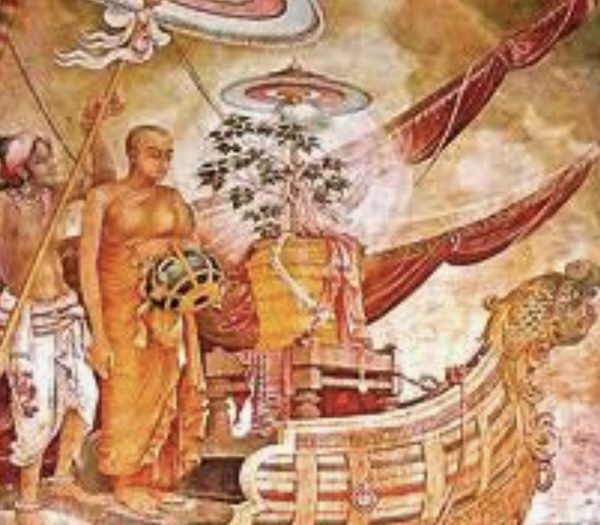
More than two thousand years ago, Sanghamitta Theri arrived in Sri Lanka bearing a sapling from the original Bodhi tree under which the Buddha attained enlightenment. But she did not bring only a sacred tree. She brought lineage, continuity, memory, and the Bhikkhuni Sasana itself; the order that recognised women as full participants in the Buddhist path to liberation.
Today, the Sri Maha Bodhi stands at the centre of Sri Lankan Buddhist civilisation. Kings protected it. Pilgrims worship it. The nation rallied around it. Entire ideas of Sinhala Buddhist identity came to root themselves around its presence on this island. And yet hidden within this sacred story lies a contradiction Sri Lankan society has still not fully confronted:
One of the holiest symbols of Sinhala Buddhist civilisation arrived through female spiritual authority, while the living spiritual authority of women gradually became marginalised, contested, and erased.
The Buddha himself recognised women as capable of enlightenment. The Therigatha — among the oldest surviving collections of women’s literature in the world — preserves the voices of enlightened Buddhist nuns speaking with philosophical clarity, confidence, and authority.
In the Soma Sutta, when Mara attempts to diminish Bhikkhuni Soma by invoking her womanhood, she replies:
“What does womanhood matter at all when the mind is concentrated well?”
The point is unmistakable. Spiritual liberation is not determined by gender.
The arrival of Sanghamitta Theri and the establishment of the Bhikkhuni Sasana in Sri Lanka were not side notes to Buddhist history. They were civilisational events. The Sri Maha Bodhi and the Bhikkhuni order emerged from the same sacred historical moment. One became the most protected religious symbol in the country. The other gradually lost legitimacy within the very institution that claimed guardianship over Buddhism.
This symbolism has become impossible to ignore in the wake of the arrest of the Atamasthanadhipathi of Anuradhapura over allegations involving the sexual abuse of a minor. Legally, the courts will decide guilt. But morally and politically, the crisis has already unfolded in public view. The disturbing allegations, the reluctance of the authorities and powerful actors to confront them directly, and the visible anxiety around protecting institutional prestige created the unmistakable impression that hierarchy itself was being defended before justice, truth, or even the dignity of a child.
The Atamasthanadhipathi is not merely a monk. He is among the highest custodians of the Sri Maha Bodhi — the sacred inheritance brought to Sri Lanka by Sanghamitta Theri herself. The irony is devastating.
The civilisation that inherited one of its holiest symbols through a woman monk spent centuries questioning the legitimacy of living women renunciants, while consolidating sacred authority within an entirely male Sangha establishment. And now, one of the highest guardians of that sacred inheritance stands accused of violence against a girl.
This is not merely a scandal. It is a civilisational contradiction.
What is equally disturbing is the visible hesitation among political actors to confront the issue directly. The instinct to protect institutional prestige before confronting moral collapse brings shame upon the very idea of Dharmadweepa itself. If political leaders truly care about Buddhism, then they must stop treating criticism and accountability as threats to the Sasana.
The Buddha did not teach avoidance. He taught seeing reality clearly — “yathābhūta ñāṇadassana” — knowledge and vision of things as they truly are.
What protects Buddhism is not political patronage, institutional immunity, or the prestige of hierarchy, but the presence of individuals who genuinely embody the Dhamma through practice, wisdom, and moral clarity.
History repeatedly shows that when power becomes insulated from accountability, corruption grows beneath the surface. The global outrage surrounding the Jeffrey Epstein scandal revealed how wealthy and influential networks can protect abuse for years while institutions look away. Religious institutions are not immune from the same danger.
Power corrupts religious institutions just as it corrupts political ones. When hierarchy becomes untouchable, accountability weakens. When prestige becomes sacred, criticism becomes taboo. When robes become shields instead of disciplines, Buddhism itself suffers. The Buddha himself warned that the decline of the Sasana would come from degeneration within, when the appearance of the Dhamma survives while its ethical substance weakens.
Sri Lanka must begin asking uncomfortable questions: Should immense Buddhist influence continue to remain concentrated within prestigious hierarchies simply because they inherit ritual authority and institutional status? Or should moral legitimacy belong to those who genuinely embody the Dhamma? The modern Sangha establishment — deeply intertwined with prestige, political patronage, and institutional power — is not necessarily identical to the ethical and spiritual vision of the Sangha found in the Buddha’s teachings. Of course, institutional structures may be necessary for preserving and organising the Sasana. But their purpose should be to serve the Dhamma, not to evolve into untouchable power structures concerned primarily with preserving their own authority.
The deeper tragedy is that the decline of institutional discipline appears to have unfolded alongside the historical marginalisation of women within the Buddhist order itself. Even today, bhikkhunis in Sri Lanka continue to face varying degrees of exclusion, resistance, and challenges to their legitimacy despite the fact that Sri Lanka once became one of the most important centres of the Bhikkhuni lineage in the Buddhist world.
Part of this tension lies in the long-standing controversy surrounding the Ashtagarudhamma — the Eight Heavy Rules said to permanently subordinate nuns beneath monks regardless of age or spiritual attainment. The first of these rules states that even a nun ordained for one hundred years must bow to a monk ordained that very day. For anyone who have encountered the profundity and moral clarity of the Buddha’s teachings, the contradiction between such rigid institutional subordination and the broader spirit of the Dhamma remains difficult to ignore.
Many Buddhist scholars and monastics have questioned whether these rules truly reflect the Buddha’s original attitude toward women, or whether they emerged later through institutional and historical developments. Buddhist scholar and bhikkhuni Ven. Tathaaloka Theri has argued that aspects of the Garudhamma narrative appear historically inconsistent and institutionally constructed, while renowned Theravāda monk and academic Ven. Dr. Bhikkhu Analayo has suggested that certain passages relating to women’s subordination bear signs of later interpolation into the Vinaya tradition. Sri Lankan Buddhist scholar Dr. Hema Goonatilake has similarly documented the historically central role played by bhikkhunis in preserving and transmitting Buddhism in Sri Lanka, raising important questions about how female spiritual authority gradually disappeared from institutional legitimacy and historical memory. In her work on Buddhist women in ancient Sri Lanka, Dr. Goonatilake reflects on how “her story” was gradually replaced by “history” itself — a striking observation on the erasure of women from the centre of Buddhist civilisational memory. If these critiques hold weight, then the implications are profound.
Because it would suggest that the decline of the Bhikkhuni order was not merely accidental, but part of a broader historical process through which female spiritual authority became gradually restricted, subordinated, and erased.
The chronicles themselves quietly reflect this shift. As the eminent scholar G.P. Malalasekera observed, the Dipavamsa preserves bhikkhuni lineages with remarkable detail that it strongly supports the long-standing scholarly suggestion that the text may have originated from within the female monastic communities themselves. If true, this would make the Dipavamsa one of the earliest known historical chronicles associated with women Buddhist authorship anywhere in the world.
And yet this extraordinary historical possibility remains almost entirely absent from mainstream Sri Lankan historical consciousness. Instead, later chronicles such as the Mahavamsa increasingly consolidate historical and spiritual authority around kingship and male monastic institutions, while the vivid presence of spiritually accomplished women fades into the margins of recorded history.
It raises an uncomfortable question: Did Sri Lankan Buddhist civilisation gradually preserve the sacred feminine only symbolically while erasing female spiritual authority institutionally?
History suggests this pattern would not be unusual.
Across cultures and religions, spiritually powerful women have repeatedly been marginalised once institutions consolidate authority. The Inquisition or the ‘witch-burning’ in the medieval period is one example. Christian mystic Marguerite Porete was executed in Paris in 1310 after refusing to renounce her spiritual writings. Joan of Arc was condemned for heresy and executed before later being canonised centuries afterward. Female spiritual authority is often tolerated only temporarily before institutions attempt to absorb, subordinate, or erase it.
Again and again, women survive as symbols while disappearing as institutions.
The Sri Maha Bodhi continues to be protected with immense institutional power and reverence. Yet the Bhikkhuni Sasana — born from the same historical moment — continues to struggle for equal legitimacy within the same religious civilisation. One was protected by hierarchy. The other was delegitimised by hierarchy.
And now, the institution that claimed exclusive guardianship over Buddhism faces a profound crisis of credibility from within its own structures. The uneasy and often deeply unequal relationship between the male monastic establishment and women in Sri Lankan society has long existed beneath the surface — from the historical marginalisation of bhikkhunis to broader questions of authority, legitimacy, discipline, and control over female bodies and spiritual agency. In many ways, this case feels like a disturbing manifestation of those unresolved contradictions.
If Buddhism in Sri Lanka is to remain alive in any meaningful sense, preserving temples and relics alone will not be enough. The Dhamma cannot survive through prestige without discipline. It cannot survive through hierarchy without accountability. And it cannot survive while denying women the same spiritual respect the Buddha himself gave them.
Because women were never outside the sacred order. They helped carry it here.
*The writer is a political activist and independent researcher whose work focuses on women, politics, culture, and institutional power in Sri Lanka.
CChampa / May 16, 2026
“This symbolism has become impossible to ignore in the wake of the arrest of the Atamasthanadhipathi of Anuradhapura…”
.
On the contrary, the 71-year old disgraceful monk, who is still in saffron-robe, was not arrested. He is in hospital and not in jail. This is a glaring proof that the victimized minor would not get justice.
According to a Tweet, 20 senior lawyers are appearing for the pdf-file monk, which is proof that the monk is misusing his Buddhist monastic title and charity money. As usual, only the Child Protection Authority is appearing for the victim.
In another disturbing trend, the monks who were arrested at the airport in possession of illegal drugs were urged to “voluntarily disrobe” by a Deputy Chief Prelate. Why voluntary? They should have been expelled from monkhood the moment they were arrested.
The two incidents involving a saffron-robed pdf-file and saffron-robed drug smugglers have tainted Sangha Sasana and also an injustice to the majority disciplined monks who dedicated their lives to protect Buddhism in Sri Lanka. Monkhood is not a legally binding title. It is a Buddhist monastic-binding title which is subject to the highest order of discipline. The unjustified reluctance in expelling the monk culprits from monkhood warrants suspicion of their political affiliation.
/
Jit / May 17, 2026
Pheeewww…I cannot believe this comment came out from Champa’s keyboard…. 🤔😮
/
old codger / May 16, 2026
“And now, one of the highest guardians of that sacred inheritance stands accused of violence against a girl.”
Are we sure that this is the first time it happened, or just the first time the culprit got caught?
As with the Catholic Church, everyone knows that this sort of thing has been going on for generations. The Catholic Church too tried to to put its reputation over the rights of victims, but failed. The Buddhist establishment too will discover that religious lies don’t work in this 21st century. Religions must change with time while keeping core teachings intact. The Sangha cannot be allowed to recruit minors to temples while other minors of the same age are not even allowed to work. Two sets of rules for two sets of children?
/
Jit / May 17, 2026
“… The Buddhist establishment too will discover that religious lies don’t work in this 21st century…..”
Their lies will keep thriving OC, because Sri Lankan Buddhists are so clueless of the real teachings of Gauthama Buddha.
“…Religions must change with time while keeping core teachings intact….”
They sure have changed – unfortunately to hoodwink the naive followers to do the ritual side blindly and piously but NOT to enlighten them with the core teachings.
/
LankaScot / May 17, 2026
Hello OC,
It is not just the Churches that are used by Perverts to gain access to Young Children. We all knew of “Creepy” characters in the Boy Scouts and Youth Clubs. Thomas Hamilton who massacred the School Children at Dunblane was one of those. Rumour has it that he was reported many times but never charged due to his connections e.g. MP Michael Forsyth and other Politicians.
– https://www.independent.co.uk/life-style/the-life-and-death-of-thomas-watt-hamilton-1342517.html
Some aspects of Hamilton’s Crime are still being suppressed even though a Redacted Version of the Report was released –
https://www.theguardian.com/uk/2003/feb/14/ukguns.scotland
So Sri Lanka is not alone in covering up the Paedophile Crimes. I have, like you, mentioned the Catholic Church’s long record in covering up such Crimes.
Best regards
/
Nathan / May 16, 2026
If we are to go by the way of life of enunciated by Lord Buddha not many would qualify to be Buddhists.
/
SJ / May 17, 2026
Cannot such things be said of followers of every other religion?
/
leelagemalli / May 17, 2026
Readers,
Crimes and misconduct committed within religious institutions ; whether by churches, mosques, temples or kovils; should be treated with the same seriousness as any other offence.
–
No religious figure or institution should be considered above the law. In Sri Lanka, there are growing calls for separate systems or courts for Buddhist monks, but I believe accountability should remain equal for everyone under one legal system. Unfortunately, senior religious authorities who should guide and discipline the clergy have remained largely silent for decades. If not today, when would wake up from their long slumber ?
–
It is especially disappointing to see some monks involved in vandalism and political unrest during student protests and the Aragalaya movement. Monks voluntarily enter monkhood to uphold ethical and moral values, and society naturally expects them to set a positive example. Respect for religion should not mean immunity from responsibility, and preserving the dignity of monkhood requires proper accountability when those standards are violated.
/
Lester / May 17, 2026
The Sangha is an elite institution. Statistically, every such institution will admit a few members who don’t belong. I know one girl who went to Cambridge for maths. She dropped out in the 2nd year.
The author calls it a “civilizational contradiction.” Not quite. Is the author aware that ~1/6th of the world’s population strongly believe a pedophile is the supposed “Messenger of God?” Now that is a real crisis. Turn on the news and see who is attacking who, it’s not merely coincidental. There is a fascist ideology, based on the hallucinations of an illiterate madman, that is actively seeking world domination.
Of course the monk should be punished. There is no jihad in Buddhism. No 72 alluring cherries await this monk in the next life.
/
Nutsmost / May 18, 2026
Darling,
“I know one girl who went to Cambridge for maths. She dropped out in the 2nd year.”
You really can’t stop bragging, can you?
You went to Cambridge blah blah blah
You invested in Microsoft blah blah blah
Nvidia gained $45 blah blah blah
.
“Is the author aware that ~1/6th of the world’s population strongly believe a pedophile is the supposed “Messenger of God?” Now that is a real crisis. Turn on the news and see who is attacking who, it’s not merely coincidental. There is a fascist ideology, based on the hallucinations of an illiterate madman, that is actively seeking world domination.”
Yes of course. His name is Donald Trump.
Xoxoxo sweetheart
/
Emigre / May 18, 2026
“The Sangha is an elite institution. “
Yeah, right.
According to Prisons Media Spokesman, Commissioner Gamini Dissanayake, 37 prisoners are Buddhist monks, five are Muslim priests and four are Catholic or Christian priests.
/
SJ / May 18, 2026
No Hindu priest of any description?
/
Emigre / May 19, 2026
No Hindu priest, yep.
/
Emigre / May 19, 2026
(Oh wait, you are the fish market seller. You don’t need %’s to count tails.)
But you eat fish, right? Or is it s..t you prefer?
You don’t need a brain to protect a pedo.
/
Lester / May 20, 2026
I don’t know what you eat. Neither do I care. But the rubbish you write speaks volumes about your family background.
/
Lester / May 18, 2026
Out of 33K. Did you learn math at the government school? Oh wait, you are the fish market seller. You don’t need %’s to count tails.
/