



Asanga Abeygoonasekera
In the annals of transformative leadership, few stories resonate as deeply as that of Singapore’s journey from a struggling city-state to a global benchmark of efficiency and innovation. On October 1, 1968, Prime Minister Lee Kuan Yew launched the “Keep Singapore Clean” campaign. This initiative transcended mere environmental cleanliness; it represented a broader vision of civic responsibility and unity. Over decades, Singapore transformed into the “Garden City,” a testament to visionary leadership, meticulous planning, and consistent policy implementation.
Last year, during a conversation I had with Singapore’s Prime Minister Lawrence Wong at Capella, he reiterated Singapore’s unwavering commitment to this vision. “Continuity is key,” he emphasized, pointing out that the success of the Garden City initiative lies not only in its inception but in its seamless evolution across generations.
However, not every nation has been able to replicate such sustained success. Amidst an inherited turbulence, caused by years of corruption and mismanagement, leading to bankruptcy, Sri Lanka’s new leadership under President Anura Kumara Dissanayake (AKD) has unveiled the “Clean Sri Lanka Program.” Like Singapore’s campaign, it seeks to cleanse the nation’s ethical and governance landscape.
To understand Sri Lanka’s journey, one must first grapple with its history. Decades of civil war, political upheaval, and economic mismanagement have entrenched systemic corruption and weakened institutions. The 2022 Aragalaya protests, which marked a mass uprising against political corruption, underscored the public’s frustration with the status quo.
On assumption of office AKD’s legacy was not just an economic crisis but a moral one. His Clean Sri Lanka initiative, launched with great fanfare, seeks to address both. At its core, the Clean Sri Lanka Program is both symbolic and practical. It aims to eradicate corruption, foster transparency, and rebuild trust between the government and its citizens. Yet, its success depends on addressing deep-seated structural issues. “In Sri Lanka, when you sign payments for casino bills as secretary of the Foreign Ministry, you get a promotion—not a demotion.” AKD once remarked to me during a dinner at the Organization for Professional Associations (OPA). Such anecdotes reveal the entrenched culture of impunity that AKD’s administration must dismantle. Yet, as history teaches us, the journey from vision to reality is fraught with challenges. Cleaning implies the existence of uncleanliness, which can be transnational. The roots, elsewhere, in weaving the web of corruption and other undesirables, find territories most fertile where disorder is rampant.
Having studied and observed leadership at similar campaigns across the world, I observe that while their contexts vary, the core principles remain the same: visionary leadership, grassroots participation, and a focus on long-term outcomes. Below is a comparative table illustrating the challenges, approaches, and outcomes of such campaigns: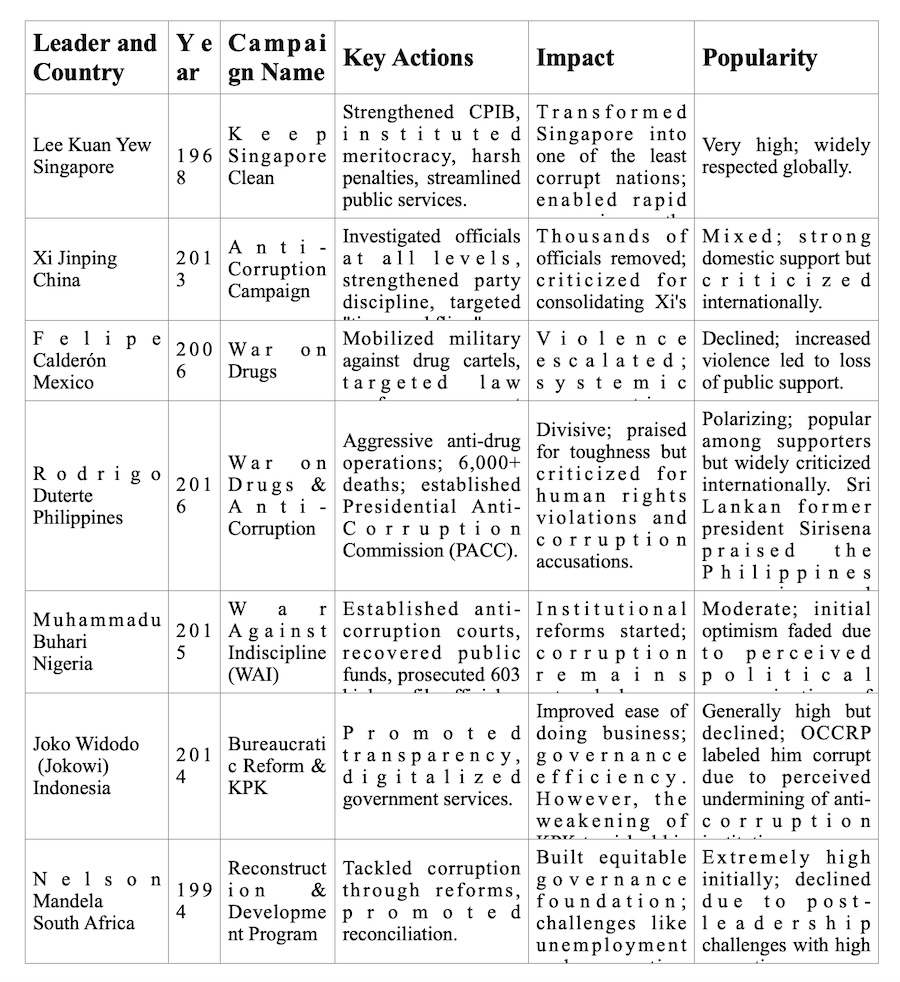
This table highlights that only a very few administrations record a sustained success story with universal acclamation.
Countries like Singapore, South Africa, and the Philippines offer valuable lessons. Singapore’s success highlights the importance of consistent policy and civic engagement. South Africa’s struggles underline the need for strong governance mechanisms, while the Philippines’ polarizing campaigns caution against approaches that alienate segments of society. For Sri Lanka, the path forward lies in a balanced approach. Top-down leadership must be complemented by grassroots participation. Transparency must be paired with accountability, and most importantly, short-term wins must not overshadow the long-term vision.
Despite its potential, the Clean Sri Lanka Program faces significant hurdles. First, there is the challenge of public cynicism. Decades of unfulfilled promises (called politician’s promises) have eroded trust in government initiatives. Winning back the trust of the people will require more than rhetoric; it will demand tangible results. Second, there is the risk of political mismanagement. Sri Lanka’s political landscape has long been characterized by factionalism and short-termism. Insulation from political machinations is sine qua non for the success of Clean Sri Lanka initiative.
Third, there is the question of resources. Transformative campaigns require significant investment—not just financial but also in terms of human capital. Sri Lanka’s economic constraints could hinder its ability to sustain such efforts.
Having served as a Technical Advisor for the IMF’s Governance Diagnostic Assessment Report, I clearly state that Sri Lanka’s corruption cycle has been a key contributor to its current crisis. The crisis itself is a byproduct of governance mismanagement, institutional weaknesses, and large-scale corruption. The recommendations drawn from the IMF report emphasize the need for structural adjustments to strengthen institutional frameworks and governance mechanisms. The Clean Sri Lanka Program represents an important and timely step forward in addressing these systemic issues.
To overcome these challenges, Sri Lanka must adopt an integrated approach. The Economic, Environmental, Social, and Governance (EESG) framework offers a roadmap for sustainable development. By aligning its initiatives with these principles, Sri Lanka can ensure that its efforts are not just impactful but also sustainable.
Moreover, international collaboration will be crucial. Whether it is learning from Singapore’s policies, leveraging South Africa’s grassroots mobilization strategies, or avoiding the pitfalls of Mexico’s militarized approach, Sri Lanka must draw from global best practices. I was once invited to Mexico to understand President Felipe Calderón’s battle with drug cartels—an effort that, while initially heralded, ended up overwhelming his presidency due to escalating violence and social unrest. This experience reinforced the importance of carefully balancing ambition with pragmatism in governance reforms.
In South Africa, while visiting Khayelitsha, one of the most violent townships in the country plagued by gun violence and drug abuse, I witnessed the stark realities of failed governance. Despite various cleanup initiatives by successive governments, Khayelitsha remains a symbol of systemic failure. These failures stem from internal constraints—economic and socio-political upheavals that have created a complex web of challenges, rendering government mechanisms ineffective. The lessons from Khayelitsha’s struggles underline the importance of addressing root causes, including poverty, inequality, and institutional weaknesses, to ensure the success of reform initiatives.
As I reflect on Sri Lanka’s journey, I am reminded of a quote by the Dutch painter Vincent Van Gogh, “Great things are not done by impulse, but by a series of small things brought together.” The Clean Sri Lanka Program is an opportunity for Sri Lanka to embody this principle. The road ahead will not be easy. Change is rarely linear, and setbacks are inevitable. But with visionary leadership, active citizen participation, and a commitment to transparency, Sri Lanka can chart a new course.
In the act of cleaning, there lies a deeper renewal—a hope that Sri Lanka, burdened by decades of mismanagement, may finally rediscover its potential and rise anew.
Lasantha Pethiyagoda / January 14, 2025
Excellent observations and analysis by a relatively young professional. Yes, cleaning an inherently corrupt society is rife with hurdles as it directly challenges the nest-eggs that have been built up using unethical, criminal and wholly selfish methods. The cultural revolution presently underway must be maintained with a firm hand and using all the activists who worked tirelessly to bring about this systemic change.
/
Good Sense / January 16, 2025
Clean Sri Lanka or for that matter clean any country is essential for the upkeep of the country as well as its development. The author of this article has endured great pains to research on the performance of similar campaigns in other countries. Except for Singapore, all initiatives for cleanliness in governance in other countries had some drawback. The author makes it clear that it is not the noise of the campaign that matters but quite a lot others need to go into the drive for cleanliness. Singapore recently jailed a Minister in pursuing its quest for cleanliness. We were only too happy to accept the resignation of the Speaker giving him unlimited time to produce his purported certificates. In the country of squeaky clean he would be required to quit the parliament, and a possible prosecution. So, we have an idea where things will fall short in AKD’s drive for cleanliness.
The author was oozed out of this country. Sri Lanka’s loss is the gain of the International Community. The IMF too has recognized his capacity. Meritocracy and Cleanliness go hand in hand. We are woefully short of the competent and capable. AKD! All the best!
/