

By Rusiripala Tennakoon –

Rusiripala Tennakoon
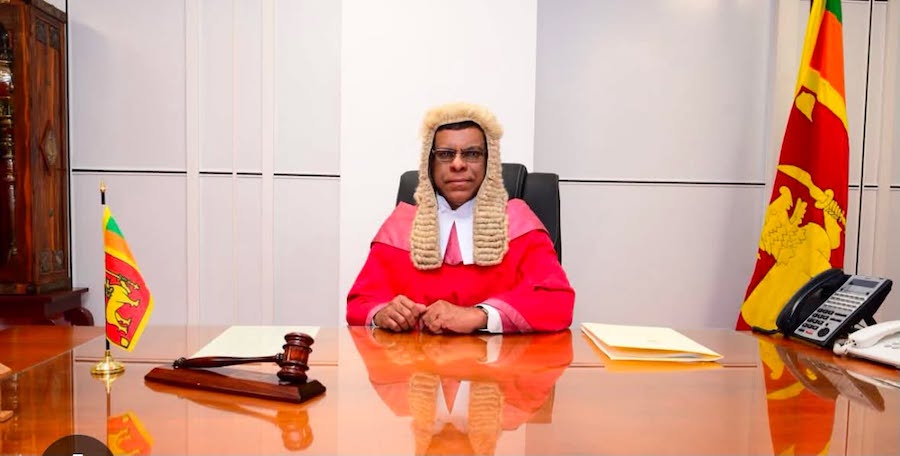
The address delivered recently by Chief Justice Preethi Padman Surasena to Sri Lanka’s newly appointed Magistrates deserves to be remembered not merely as a ceremonial speech but as an important constitutional reflection on the nature of public power and the responsibilities that accompany its exercise.
His observation that a country can be destroyed more rapidly by a weak judicial system than by famine or natural disasters is both compelling and thought-provoking. While natural calamities devastate lives, property and economic activity, history has repeatedly shown that determined nations can recover through resilience, sound leadership and, where necessary, international assistance. A weakened judicial system, however, inflicts a far deeper and more enduring wound. It strikes at the rule of law, erodes public confidence in justice, weakens economic and social stability, and gradually undermines the constitutional foundations upon which democratic society depends. Once that process begins, rebuilding confidence becomes far more difficult than rebuilding physical infrastructure.
Yet the Chief Justice’s most profound message lay not in that warning alone. It lay in his explanation of the source of judicial authority itself.
Addressing the newly appointed Magistrates, he reminded them that the power they exercise is not one they bring from their homes. It is not bestowed upon them personally by the Judicial Service Commission or by any individual. Judicial power, he emphasised, originates solely from the sovereignty of the people and is exercised exclusively for the benefit of the people. Equally significant was his reminder that judicial independence exists not for the personal benefit of judges but to protect the rights, freedoms and confidence of the people whose sovereignty the Judiciary is entrusted to serve.
Those observations go to the very heart of constitutional democracy.
Our Constitution declares in unmistakable terms that sovereignty is in the People. Executive power, legislative power, judicial power and the franchise are not separate sources of authority competing with one another. They are different manifestations of a single sovereign authority that belongs permanently to the people. Those entrusted with the exercise of these powers are therefore not owners of authority but custodians of it.
This distinction is fundamental.
Public office does not convert public power into personal power. Every constitutional office is an office of trust. Whether one serves as a judge, a minister, a Member of Parliament or a public official, the authority exercised is borrowed from the people and must always be exercised for the purpose for which it was entrusted. The office-holder changes; the sovereignty of the people does not.
The Chief Justice’s reference to the franchise completes this constitutional picture. The right of the people to elect their representatives is not merely another constitutional provision. It is the mechanism through which the people periodically reaffirm that sovereignty remains with them. Governments change, Parliaments are dissolved and public officers retire, yet the sovereign authority of the people continues uninterrupted. Every institution derives its legitimacy from that enduring source.
It is precisely for this reason that public confidence occupies such an indispensable place in democratic governance. In an earlier article, I observed that no institution can function effectively once public confidence begins to diminish. The Chief Justice’s address reinforces that proposition with remarkable clarity. Constitutional authority and public confidence are inseparable. An institution may continue to possess legal authority, but if it loses the confidence of the people, its moral authority and institutional legitimacy begin to erode.
This principle applies equally to every organ of government.
The Executive derives its mandate from the confidence reposed in it by the electorate. Parliament exercises legislative authority as the representative institution of the people. The Judiciary exercises judicial power in trust for the people. None of these institutions exists for its own preservation, prestige or convenience. Each exists to discharge constitutional responsibilities faithfully, impartially and in the public interest.
This understanding is particularly important at a time when public expectations regarding integrity, accountability and good governance have never been higher. Citizens today expect institutions not merely to act within the law but to demonstrate fairness, transparency, consistency and restraint. Authority exercised without these qualities may remain legally valid, yet it gradually loses the confidence that alone gives democratic institutions their enduring strength.
Judicial independence itself must be understood in that context. It is one of the cornerstones of constitutional democracy because it protects citizens against arbitrary power. But independence is inseparable from responsibility. It is sustained by integrity, impartiality, competence and fidelity to the Constitution. As the Chief Justice rightly reminded the new Magistrates, judicial office does not entitle its holder to exercise authority according to personal preference. Judicial independence is preserved not by the absence of accountability to constitutional principles but by unwavering adherence to them.
The same philosophy should guide every institution exercising public authority. Governments should never mistake electoral success for an unrestricted mandate. Legislatures should never forget that laws derive their legitimacy from the people they are intended to serve. Courts should always remember that judicial authority is held in trust for those whose rights they are sworn to protect. Public institutions remain strong not because they possess extensive powers but because the people continue to believe that those powers are exercised fairly, responsibly and in accordance with constitutional values.
History offers a consistent lesson. Nations rarely decline because their constitutions lack noble principles. They decline when those entrusted with constitutional authority forget the source from which that authority originates. The gradual erosion of public confidence is often the earliest warning that institutions have begun to lose sight of the trust reposed in them.
The Chief Justice’s address therefore deserves to be understood not simply as guidance to newly appointed Magistrates but as a timely reminder to every person entrusted with public power. It reminds us that sovereignty remains permanently with the people; that every public office is temporary; that every constitutional power is borrowed; and that every institution is accountable, above all, to the people in whose name it acts.
Sri Lanka’s future will ultimately be determined not only by economic policies, political reforms or legal institutions, important though they are. It will depend equally upon the willingness of every organ of government to honour the public trust with humility, integrity, restraint and unwavering fidelity to the Constitution.
Public confidence is therefore not merely a desirable objective of good governance. It is the lifeblood of constitutional democracy. Once that confidence is nurtured, institutions flourish. Once it is squandered, even the strongest constitutional structures begin to weaken.
The Chief Justice’s message is therefore one that deserves to resonate far beyond the courtroom. It is a timeless reminder that in a democracy no public authority is owned. Every power is borrowed. Every office is a trust. And every exercise of that trust must strengthen the confidence of the sovereign people from whom all constitutional authority ultimately flows.
*The writer is the former president Ceylon Bank Employees Union, Chairman Bank of Ceylon and National Gem & Jwellery Authority
nimal fernando / July 4, 2026
With all the Rajapakse crooks getting caught now ……. any chance of you ending up in gaol Rusi?
/
chiv / July 7, 2026
Nimal
Rusiri and Laksiri are like
Siamese Twins with a conjoined Brain.
/
Naman / July 5, 2026
“ a country can be destroyed more rapidly by a weak judicial system than by famine or natural disasters”
What you mean by WEAK judicial system? Do you mean that the judges can be bought over or influenced by the politicians from the ruling party?
A former Chief Justice let Mahinda Rajapaksa free from the case of misappropriation of the Tsunami relief fund? Had he found MR guilty the current history would be rewritten
/
Sena / July 5, 2026
The main and only economic contribution of a legal system in a country is to provide a law and order environment that is conducive to the development of the country where people are encouraged to be honest and productive contributors to the economy.
In that sense the Sri Lanka legal system has completely failed and is heavily compromised. In fact it has been an important contributor to what the present government call 70 year curse. One can present so many examples for the corrupt legal system in Sri Lanka such as sending Mr. Ramanayake to 4 year rigorous imprisonment for exposing their corruption and the only mega fraudster convicted was by a US court after he was found innocent by Sri Lanka courts.
By relying on this compromised judiciary to eradicate and address past crimes the government is making a grave mistake. It is already evident by the snail pace the courts are handling these cases. It seems they are waiting to see the back of the present government The magnitude and depth of corruption have been so great in Sri Lanka, the government should establish all powerful commissions outside the court system to speedily handle these nationally debilitating crimes and punish the culprit or at least recover the stolen public property (just like Lee Kuan Yew did in Singapore). This will also serve as an inducement for public and institutions not to engage in corruption
/