

By Mahil Dole –

Mahil Dole
The temporary halt ordered by the Inspector General of Police on the Kavadi segment of the historic Devinuwara Perahera, followed within a day by its reversal, and the eventual peaceful conclusion of the annual pageant, together form a revealing episode in Sri Lanka’s ongoing struggle between organised crime and the authority of the state.
On the basis of intelligence reports indicating a dispute between organisers and dancers that threatened to escalate into violence, the IGP directed the temporary cancellation of the Kavadi procession scheduled for 28 July. The decision was presented as a precautionary measure to prevent bloodshed. Within twenty-four hours, however, a high-level meeting chaired by the Hon. Minister of Law and Order, Mr. Ananda Wijepala, together with his Secretary and the IGP himself, reviewed the situation and reversed that decision. The pageant proceeded. It concluded without major controversy or breach of peace. The Special Task Force (STF), which was given special responsibility for security arrangements, once again demonstrated its professionalism and operational prowess, as it has done on many previous high-stakes occasions, and reaffirmed its continuing value as a strong and reliable component of Sri Lanka’s law-enforcement system.
Screenshot
This sequence deserves careful examination, not as a mere administrative correction, but as a test of whether the Sri Lankan state is prepared to allow criminal syndicates and underworld networks to dictate the terms on which traditional cultural and religious practices may take place.
A government that yields to the threat of violence from organised crime, even when that threat is framed as an intelligence warning, risks setting a dangerous precedent. Traditional pageants and religious processions are not optional spectacles; they are living expressions of community identity, interfaith coexistence, and national heritage. When external or criminal pressure can force their suspension, the message received by both domestic audiences and the international community is that the state’s writ is negotiable. Law-enforcement agencies appear weaker than the networks they are meant to control. The credibility of the entire security architecture is diminished.
The swift reversal led by the Minister of Law and Order was therefore necessary and correct. It signalled that the government would not simply step aside in the face of syndicate pressure. It reaffirmed that cultural and religious norms cannot be set aside because underworld elements threaten disorder. It also demonstrated that the efficiency and resolve of the law-enforcement system need not be underestimated. The successful conclusion of the pageant without serious incident further validated that assessment.
At the same time, the episode raises legitimate questions about the quality of the initial decision-making process. Intelligence assessments must be rigorous, contextual, and accompanied by realistic options. A recommendation to suspend a major traditional event is a high-impact measure. It requires not only credible information about an immediate threat, but also a clear evaluation of the wider repercussions, social, political, cultural, and reputational. If the assessment that led to the original halt lacked sufficient depth, alternative containment strategies, or an accurate reading of the balance of risks, then the decision itself became vulnerable to the charge of being overly cautious or insufficiently thought through. Decision-making at this level must be realistic and meaningful; otherwise it risks appearing hesitant or embarrassing when subsequently reversed.
This is not a criticism directed solely at any single office-holder. It points to a broader systemic requirement: intelligence mechanisms must be capable of distinguishing between genuine, imminent threats that justify exceptional measures and situations that can be managed through reinforced security, visible presence, and targeted disruption of the individuals seeking to create disorder. The capacity to make that distinction quickly and accurately is a measure of institutional maturity.
The wider context makes the need for such maturity urgent. Since 1 January 2026, Sri Lanka has recorded 26 firearms-related incidents linked largely to rivalry between criminal syndicates. These have left 15 people dead and more than a dozen wounded. The first incident of the year, in the Nawagamuwa police area, arose from a dispute between groups based in Borella. Subsequent shootings, including the killing of a restaurant owner in Bellanwila, have followed a similar pattern of inter-gang score-settling conducted with automatic weapons and a striking degree of confidence. Most recently, two Chinese criminal groups engaged in open confrontation in the heart of Colombo, inside a prominent foreign-investment zone. Although suspects were arrested, the episode raised fundamental questions about how foreign nationals obtained firearms, moved through high-security areas, and chose to settle scores on Sri Lankan soil.
These developments are not isolated law-and-order problems. They represent an asymmetric challenge that places ordinary citizens at risk, strains police resources already stretched by traffic management and routine duties, and directly threatens one of the country’s most important economic pillars, tourism. Visitor arrivals, average expenditure, hotel occupancy, and foreign-exchange earnings are all sensitive to perceptions of safety. When armed confrontations occur in the commercial centre of the capital, international coverage spreads rapidly. Tour operators cancel or divert groups; independent travellers hesitate; high-value segments such as MICE and luxury tourism become particularly cautious. Even modest declines in arrivals produce disproportionately large revenue losses because of the high multiplier effect of tourism spending. Negative safety narratives tend to linger in source markets long after individual incidents have been resolved.
Against this background, the Devinuwara episode illustrates both the danger of appearing to yield to criminal pressure and the possibility of reclaiming initiative through firm, coordinated decision-making. The government correctly refused to allow syndicates to set the boundaries of cultural practice. The same resolve must now be applied systematically to the underlying networks that generate such threats.
This requires a clear-eyed appraisal of existing intelligence mechanisms. Sri Lanka possesses institutions, the State Intelligence Service, specialised police intelligence units, and financial-intelligence capabilities, that have demonstrated effectiveness in earlier high-stakes contexts. Yet current performance remains predominantly reactive. Information is often generated after violence has occurred rather than used to prevent the conditions that allow syndicates to consolidate power, acquire weapons, and project influence over public and cultural space. Inter-agency coordination is frequently fragmented. Human-source networks in critical urban and coastal areas require strengthening. Financial and technical intelligence streams are under-utilised against the revenue models of organised crime. Resource constraints and, at times, political interference further limit the speed, depth, and independence with which these systems can operate.
The remedy is not simply more resources or additional personnel. It is a deliberate shift toward proactive, intelligence-led disruption of networks before they can dictate terms. It is improved joint assessment processes that weigh both the immediate threat and the wider consequences of proposed measures. It is clearer lines of accountability so that high-impact recommendations are subjected to rigorous scrutiny before they become public decisions. And it is sustained political will to ensure that no criminal group, local or transnational, comes to believe that the threat of violence is an effective negotiating tool against the state.
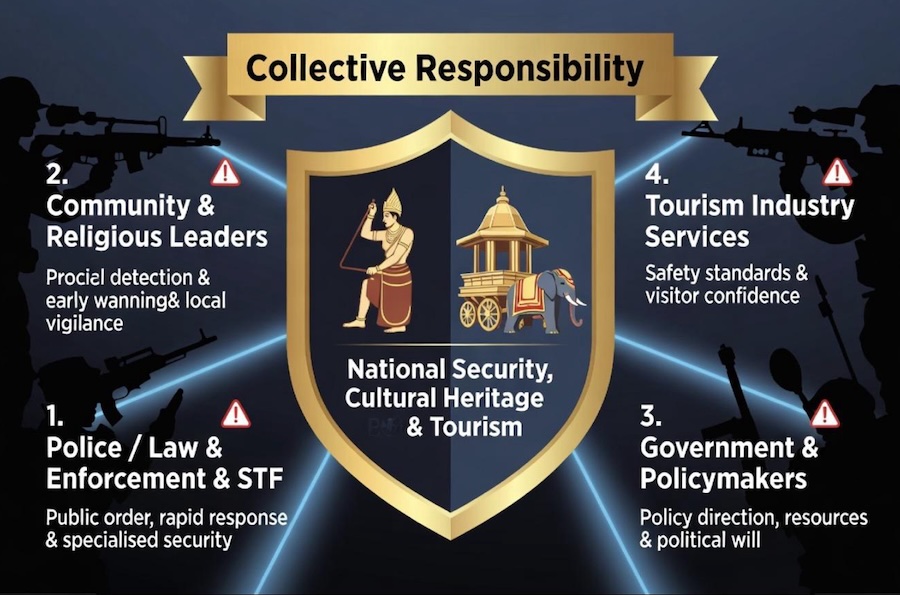
Responsibility for this shift does not rest with the police alone. Officers on the ground already operate under heavy pressure. The burden must be shared across the full set of stakeholders: intelligence services charged with early warning and network disruption; government and policymakers responsible for policy direction, resources, and political cover; the tourism industry, which has a direct interest in safety standards and visitor confidence; and community and religious leaders, who remain essential to social cohesion and local vigilance. Units such as the STF, which continue to demonstrate high operational standards when given specialised assignments, form an important part of this wider architecture. Only when these elements function as a coherent system can the state consistently protect both public order and the cultural heritage that gives the nation its distinctive character.
The Devinuwara Perahera has concluded peacefully. That outcome is welcome. It should not, however, induce complacency. The episode has shown that criminal networks are prepared to test the state’s willingness to defend traditional practices. It has also shown that a determined government response, supported by professional specialised units, can prevent those networks from succeeding.
The task now is to convert that demonstration of resolve into a durable institutional capacity, one that detects threats early, assesses them accurately, and responds in ways that strengthen rather than undermine public confidence in the authority of the state.
Sri Lanka cannot afford a future in which cultural pageants, urban safety, or tourism revenue remain vulnerable to the calculations of organised crime. The events of late July have provided a clear warning and, simultaneously, an opportunity. The warning must be heeded. The opportunity must be seized.
( This analysis is offered in the interest of national security, institutional reform, and public safety)
Mahil Dole – Senior Superintendent of Police (Retd.) Former Head of (Counter Terrorism), State Intelligence Service; Former Director, Police Special Branch