


By W.A. Wijewardena –

Dr. W.A Wijewardena
Alarming AI divide in healthcare
In my previous column, AI’s next big promise: Tackle inequity issues before using it , I argued that beneath the brilliant veneer of artificial intelligence lies a structural failure I termed the “AI Divide”. This divide manifests across corporate, global, and social frameworks, threatening to worsen existing historical injustices rather than solve them. While that warning dealt with macroeconomic infrastructure and the uneven distribution of digital public goods, there is one sector where the AI Divide ceases to be an abstract economic problem and becomes an immediate matter of life and death: healthcare.
Human doctor still master
The integration of Machine Learning (ML) into clinical settings is fundamentally reshaping medicine through unprecedented computational efficiency. AI possesses an extraordinary capacity to synthesise massive volumes of unstructured biological data, rapidly summarising a sprawling “big picture” into actionable data points for rapid clinical decision-making—a feat of pure data processing that human cognitive limits render impossible.
However, an essential ethical qualification must be maintained: the digital system does not replace clinical judgement. The human doctor remains the ultimate decision-maker, interpreting the technical variables generated by the algorithm to chart the patient’s treatment. In this modern clinical architecture, the physician is still the absolute master, and AI serves strictly as an advanced facilitator.
Two AI leaps: Ambient and Agentic AI
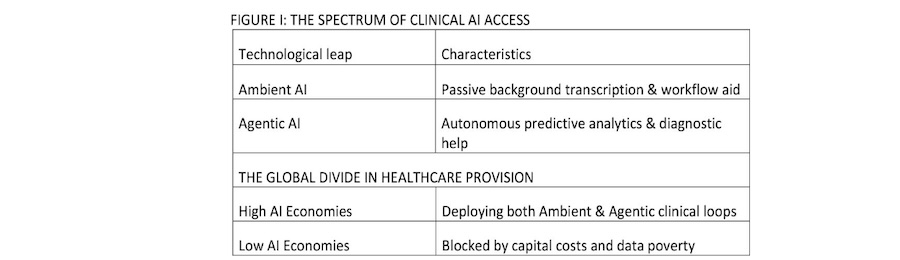
To understand how this facilitation operates today, we must examine the frontline frontier of healthcare analysis, which has split into two core paradigms: Ambient AI and Agentic AI. Ambient AI acts as an invisible, passive observer in the clinical room, automatically transcribing doctor-patient conversations, structuring electronic health records, and lifting the heavy administrative burden off exhausted medical staff. Agentic AI, conversely, operates with autonomous intent; it acts as an active clinical partner that evaluates real-time telemetry, flags early signs of sepsis, predicts patient deterioration, and suggests complex pharmaceutical adjustments. This is flagged in Figure I.
Sri Lanka’s low AI status
This technological leap highlights a stark AI Divide between advanced Western or East Asian economies and nations classified as “Low AI,” such as Sri Lanka. Domestic hospital networks have yet to meaningfully invest in high-AI clinical infrastructure. The State sector operates under severe budgetary constraints, with the Health Ministry budget standing at about 2% of GDP, begging for more resources every year. This leaves underfunded Government hospitals with little funding to procure expensive software licences or high-performance server clusters.
Meanwhile, the private healthcare sector lacks the market incentive to pursue these heavy capital investments. Private providers continue to generate excellent profit margins from their existing infrastructure by capitalising on the inelastic, soaring domestic demand for healthcare services. The resultant aloofness to new investment shifts a heavy economic burden directly onto citizens; historically, private out-of-pocket spending has driven over 43% of total healthcare expenditures in the country despite a public system that is technically free at the point of delivery.
WHO should support low AI countries
For a developing nation like Sri Lanka to cross this chasm, it must execute a dual-track strategy: simultaneously investing in underlying digital infrastructure and systematically training healthcare providers to utilise these algorithmic techniques safely. This capacity-building requires substantial time, meaning the technological divide will inevitably persist and widen in the medium term.
In this challenging environment, the World Health Organisation (WHO) has a vital role to play. The WHO must move beyond issuing abstract ethical guidelines and, instead, actively coordinate the upgrading of clinical AI capacity within developing countries. Unified global action is urgently required to transform medical AI from an exclusive luxury of wealthy nations into a globally accessible public utility.
Anatomy of healthcare bias: Data poverty and myth of generalisability
To understand how a mathematical model becomes prejudiced, one must dismantle the data infrastructure upon which modern AI is constructed. Machine learning models require millions of data points to learn to recognise diseases. However, biomedical data is severely afflicted by what global health experts term “health data poverty”.
For generations, clinical trials, genetic mapping, and diagnostic imagery have disproportionately favoured specific demographic categories. Historically, clinical research participants have been overwhelmingly white, male, and resident in wealthy urban centres, leaving racial minorities, women, and rural populations severely underrepresented. When software engineers train a diagnostic AI on these imbalanced datasets, the algorithm develops a flawed baseline for what constitutes human health.
This imbalance strips away what technologists call the “generalisability” of the algorithm. Unlike physical medical hardware—such as a scalpel or an X-ray machine—which functions identically regardless of the patient’s background, software algorithms are context-dependent and highly brittle. They exhibit high accuracy within controlled research environments populated by the majority demographic but suffer performance degradation when deployed in ethnically or socioeconomically diverse settings.
Poverty of AI research data in low AI countries
Consider the geography of AI research data. A landmark study published in the Journal of the American Medical Association examined dozens of publications comparing human diagnostic accuracy against digital systems. The researchers discovered that the bulk of the clinical data used to train American medical AI models originated from hospitals in just three States: California, New York, and Massachusetts .
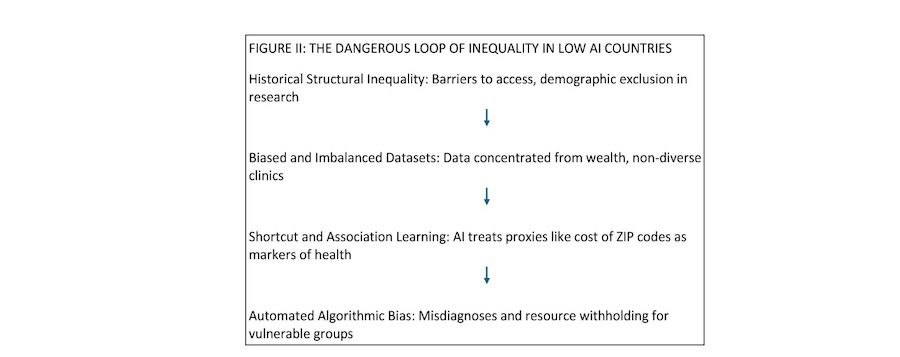
An algorithm optimised for patients visiting elite clinics in Boston or San Francisco cannot easily generalise its findings to a rural farmer in Sri Lanka’s North Central Province or a factory worker in an industrial town in America’s Midwest. The physical realities of disease manifestation, co-morbidities, and environmental factors are completely lost. When a model relies entirely on association-based learning, it resorts to “shortcut learning,” mistaking regional data collection protocols or flawed clinical habits for absolute medical truth. The dangerous bias loop is elaborated in Figure II.
Real-world collateral: When code costs lives
The danger of biased medical AI is not a hypothetical anxiety for the future. The clinical arena is already littered with examples of algorithms that have failed marginalised patient groups with devastating consequences.
1. Dermatological failure
One of the clearest manifestations of visual dataset bias occurs in automatic skin cancer detection. Computer-vision algorithms trained to identify melanomas have achieved astonishing success rates, often outperforming the wisdom of qualified dermatologists. However, independent evaluations revealed that these systems performed with alarming inaccuracy when presented with images of darker skin tones. Why? Because the public and private image repositories used to train the software were overwhelmingly dominated by examples of fair skin. By treating light skin as the normative default, the AI struggled to differentiate between benign dyschromia and malignant lesions on darker skin, directly increasing the risk of delayed care or catastrophic misdiagnosis for millions of non-white patients.
2. Economic proxy trajectory
Algorithmic bias does not only crop up through visual data; it can embed itself within electronic health records and administrative workflows. A famous case study involved a widely deployed commercial algorithm used by major hospital systems to manage the care of millions of chronic patients. The software was explicitly designed to assign a “risk score” to individuals, identifying which patients were sickest and required enrolment in intensive, high-touch medical management programs . Refer to Figure III for details.
The algorithm systematically assigned lower risk scores to Black patients, recommending healthier white patients for premium care programs ahead of much sicker Black individuals. The flaw lay in the developers’ choice of a data proxy. Rather than measuring physiological markers of disease severity directly, the AI was programmed to use historical healthcare expenditure as a proxy for illness, under the assumption that a patient who costs more must be sicker.
The system ignored systemic economic inequalities. Due to historic barriers to healthcare access, lower average incomes, and systemic under-insurance, Black patients spent significantly less on healthcare than white patients with identical clinical conditions. The AI mathematically misinterpreted lower spending as a sign of health, automating a loop where affluent patients were showered with additional medical attention while vulnerable patients were pushed to the back of the queue.
3. Systemic localised disparities in Sri Lankan contexts
In Sri Lanka, the danger of data omission manifests distinctly through regional epidemiological crises. Non-Communicable Diseases (NCDs) now comprise a staggering 85% of the national disease burden, characterised by an aggressive rise in cardiovascular mortality, diabetes, and genitourinary illnesses. Furthermore, rural agricultural regions suffer heavily from chronic kidney disease of Unknown Etiology (CKDu). In endemic areas like Anuradhapura and Polonnaruwa, urinary tract and kidney diseases represent the leading cause of in-hospital mortality. Yet over 46% of Sri Lanka’s total current health expenditure remains concentrated strictly within the Western Province.
If international tech firms design predictive diagnostic tools using data exclusively harvested from highly resourced Colombo tertiary care centres or Western private hospital setups, the resulting software will remain fundamentally blind to the environmental, toxicological, and biochemical realities facing rural farming communities. A predictive AI that equates health tracking with standard urban lifestyle data will fail to detect early-stage CKDu or localised diabetes patterns in rural agrarian populations where diagnostic under-testing remains high. The resulting AI models will inadvertently automate a cycle where medical attention and advanced care remain heavily weighted towards affluent urban networks, leaving the rural poor to face late-stage, symptomatic organ failures without timely warnings.
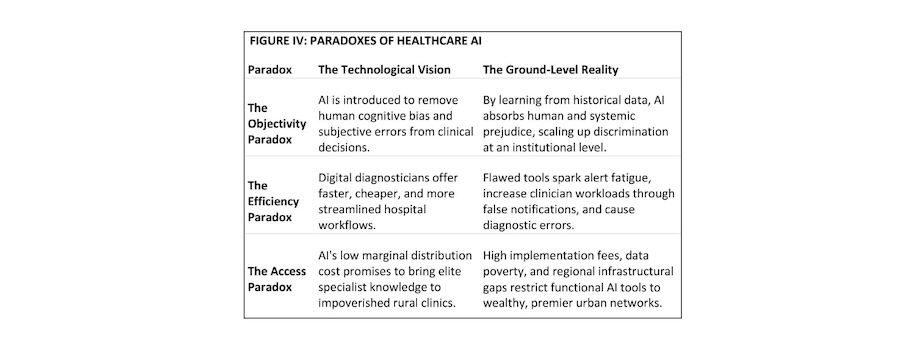
Three paradoxes of healthcare AI
The crisis of bias in medical technology reveals three core paradoxes that policymakers and health administrators must urgently confront:
Healing the system: Technical and structural therapeutics
We cannot simply abandon artificial intelligence in medicine. The sheer volume of contemporary biological data requires computational assistance, and when designed ethically, AI can expand clinical access across the globe. However, to ensure that this technological revolution minimises health disparities rather than aggravating them, we must implement a comprehensive framework of systemic corrections.
Screenshot
Mandating data audits and algorithmic redetections
Food and drug regulatory bodies across the globe—such as national healthcare authorities and global networks—must change how they evaluate software as a medical device (SaMD). It is no longer sufficient for an AI developer to prove that their system achieves a 95% accuracy score on a generic, aggregated test set. Regulations must mandate strict, modality-agnostic algorithmic auditing.
Platforms like the recently developed Generalised Attribute Utility and Detectability-Induced Bias Testing (G-AUDIT) framework point a way forward. These technical auditing tools automatically parse medical datasets across distinct modalities—including imaging, electronic health record text, and tabular ICU data—to detect if a model is relying on shortcut learning or hidden patient demographic attributes to make its predictions. If an AI system displays a statistically significant performance drop when evaluating minority subgroups, it must be denied regulatory clearance for clinical deployment.
Rewriting mathematics of loss functions
When training an algorithm, data scientists can introduce mathematical constraints that penalise the system if its error rates diverge across different demographic subsets. Rather than maximising overall accuracy, the objective function of medical AI must prioritise equity and minimax fairness, ensuring that the model’s error rate is minimised for the least fortunate demographic cohort.
Furthermore, as demonstrated by computational studies, developers can utilise specific data-correction algorithms to compensate for historical under-testing. When the researcher-imposed data bias is mathematically neutralised, standard machine-learning models can accurately identify conditions like sepsis across all patient cohorts, performing on par with an idealised, perfectly balanced real-world clinical dataset.
Democratising deployment infrastructure
Mirroring the arguments from my previous article on the AI Divide, medical AI must not become a proprietary weapon of wealthy pharmaceutical corporations or elite private hospitals. If AI knowledge is managed as a “Global Public Good,” global development entities like the WHO, the World Bank, and regional development institutions can establish decentralised, open-source repositories of diverse clinical data.
By funding internet access, server installations, and specialised training programs in emerging economies, these multilateral financial bodies can ensure that local health institutions can adapt AI software to their unique regional epidemiological conditions, dismantling the digital colonial architecture that characterises the current tech landscape.
Living call for clinical vigilance
Just as medical students take the Hippocratic Oath, promising to “do no harm,” modern computer scientists and health administrators must adopt an equally rigorous ethical framework before deploying algorithms to the hospital bedside.
We stand at a defining historical juncture. If we inject unvetted, biased artificial intelligence into our clinical ecosystems, we will lock in healthcare inequities for generations to come, creating a permanent algorithmic underclass whose sickness is systematically underestimated by the digital stethoscopes of the modern world. We must choose to address these structural issues now, ensuring that the great promise of digital medicine becomes a healing asset for all of humanity, leaving no one isolated in the dark.
[1] https://www.ft.lk/columns/AI-s-next-big-promise-Tackle-inequity-issues-before-using-it/4-795802
[2] https://data.worldbank.org/indicator/SH.XPD.OOPC.CH.ZS?locations=LK
[3] Cited in: https://www.hunimed.eu/news/health-care-ai-systems-are-biased/
[4] https://pubmed.ncbi.nlm.nih.gov/31649194/
[5] See for details: https://iafrica.com/johns-hopkins-fda-team-builds-tool-to-catch-hidden-bias-in-medical-ai-training-data/
*The writer, a former Deputy Governor of the Central Bank of Sri Lanka, can be reached at waw1949@gmail.com