

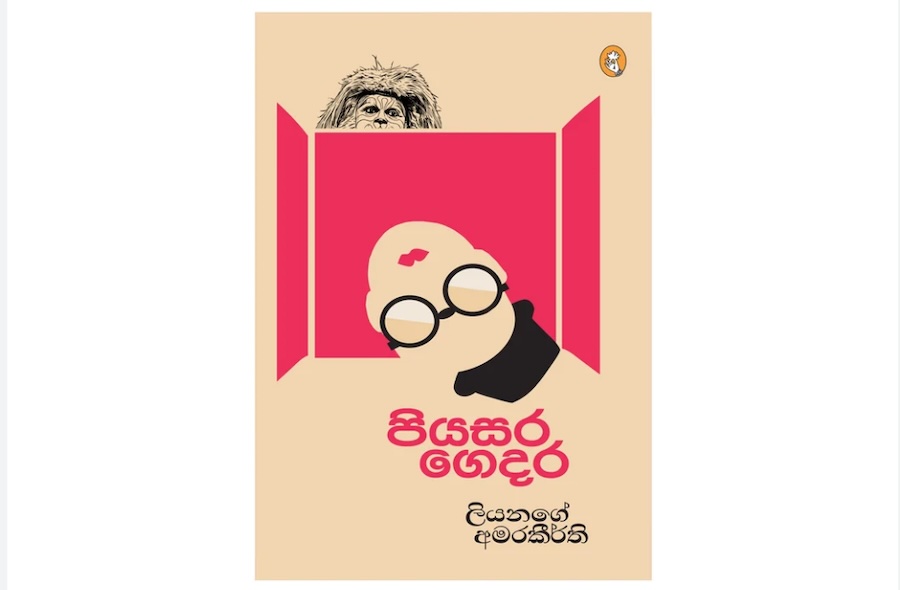
By Ashanthi Ekanayake –

Ashanthi Ekanayake
There has been a trend in social media in inquiring of its users what their favorite literary works are and I took some time to explore which poem I might single out as the best of its kind written in English which is of personal significance. I immediately thought of the poem “Daddy” by Sylvia Plath. I made the choice quickly because I had been thinking of it since I began to read Amarakeerthi’s latest novel. The notion of the father and the larger metaphor of the patriarch or the arch patriarch has been something all societies have grappled with since the beginning. Plath declares in the second verse Daddy, “I have had to kill you.” This act of parricide has been a strong metaphor in many literary works and also in the etiological myths of many peoples.
I was initiated to the history of our race and nation as a young child and I remember that I had no qualms in accepting that I came from a lineage which had a certain “lion” in the beginning and that the lion had two children and that they “married” to start our race. Firstly, I heard this story as a young child and “marriage” did not mean much to me, secondly, I was from a generation which was not allowed to question and challenge my “elders and betters.” I was also a somewhat passive and placid child. When it was (unfortunately) my turn to do the honors in initiating my own offspring they were not so gullible. They were appalled not impressed. They said in one voice “what ignominy to trace ones beginning to parricide, bestiality and incest.” Fortunately for me I know some “Classics.’ So, my rejoinder was that even the Greeks and Romans have similar accounts and reminded them of Oedipus. Oedipus and Sinhabahu both have to kill their fathers to come into their own, regardless of the fact that Oedipus meets with tragedy. The notion of the patriarch and succession through parricide has been a historical reality and a literary strategy explored by many and has an etiological function.
In this sense the narrative of Piyăsara Gedara by Amarakeerthi Liyanage makes the reader question this accepted notion of the patriarch and also the role of the father/father figure by their presence and absence in the novel itself. Not stopping there Amarakeerthi uses the shadowy and unnamed yet unmistakable character of “sir,” in the novel as a parasitic dramaturge who has a rather overbearing personality. This shadowy figure is mirrored by the introduction of fathers who are not quite fathers in the later chapters. Amarakeerthi has been committed to writing novels experimenting with different styles while touching on themes which are current and relevant. His unhurried creative exercise has always managed to keep the reader engaged in questioning social norms and accepted values and exploring the very politics of the creative enterprise and also recent events. The metaphor borrowed from a renowned stylized stage play is an extended metaphor with the heart room of the Dias home gaining an importance as a significant space. (I refrain from exploring the obvious nationalist aspect because the readers will come to these assumptions on their own.)
Just as there are many fathers, Dias appears to be just like the youngsters in the narrative, lost in the ruminations of what his father might have achieved had he not been in the shadow of the dramaturge who himself remains a shadowy figure in the narrative rather like the murder instrument which is not one. His realization that his father was not unique and not deserving of many of the accolades that Dias had wanted as a son for his father gives the novel have a certain bildungsroman/coming of age quality even though Dias appears to be relatively old. A rather late coming of age for Dias because he has to see that his father was not all that he believed him to be. This aspect of the novel also resonates with the notions of anxiety of influence/anxiety of authorship because Dias whom the playwright wants to rename is in fact doing much of the groundwork in research for the work the person referred only as “sir.” The other fathers are of a variety of types that we encounter in our everyday relationships. The absence of one father encourages one character to become vigilante like. The introduction of the manikin/mannequin or “womannequin” provides an alter-ego to one of the characters who is also described as doll like.
As always Amarkeerthi’s latest creation is packed with metaphors which keep the reader alert in piecing together the story. He opens the novel using a technique resonant with the ultra-performativity of the current day and age. His narrative has a cinematic quality which is in keeping with the modern experience of a drone capturing the action as it takes place. This makes the novelist appear very powerful, even godlike and the experience makes the reader a viewer in a sense. He ties this narrative strategy in the final few pages and carries it on to the acknowledgement which is rather like watching movie credits roll at the end where he names the cast and crew. (My name sadly not included as I am currently in a quite literary pariahdom.)
In addition to the dramatic/cinematic quality, the novelist also uses onomatopoeia as a narrative strategy which I will not spoil for those who are yet to read the novel. Among the many themes explored are the
There is an irony in the notion of the patriarch because the very patriarch we challenge literarily or figuratively is the one who gives us our name and our being and makes us into who we are, and ultimately renders himself a figure we have to destroy in order to come into our own. All the characters in the novel, main and the relatively insignificant are all used in exploring this metaphor of the father.
Plath says at the end of the poem “Daddy, daddy, you bastard, I’m through.” The irony of the presence or absence of the father and the notion of bastardy and the stigma involved and the social necessity of the presence of a father, is an aspect of our lives we will continue to explore in our creative enterprise.