

By P M Amza –

P M Amza
When Nepal’s Prime Minister Balendra Shah addressed the 81st Session of the United Nations General Assembly on 24 September 2026, he did not come merely to recount a national tragedy. He came, as he put it, from a country in the Himalayas carrying a “warning for humanity.” It is a warning Sri Lanka and the rest of South Asia should take seriously.
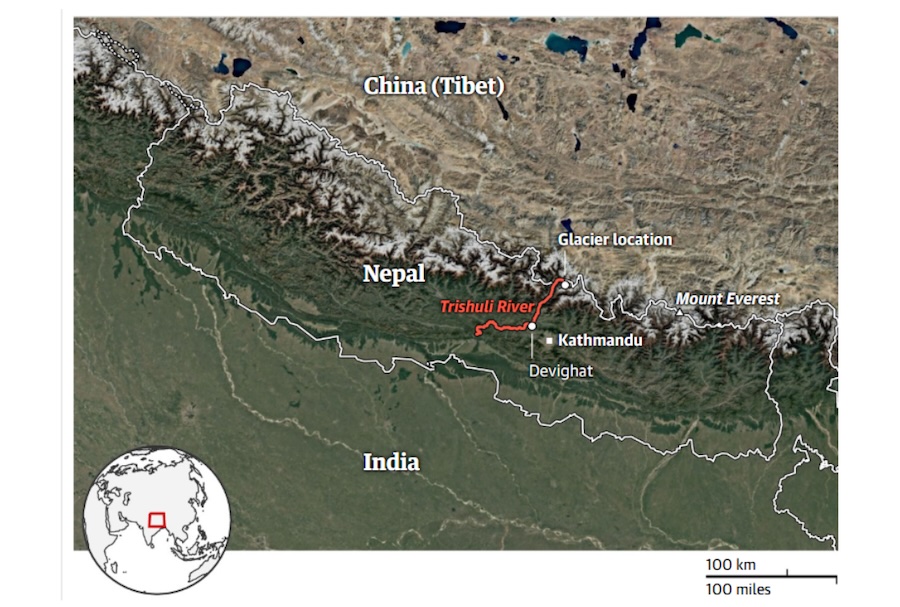
His address followed catastrophic flash floods that devastated Nepal’s mountain communities. Shah spoke of families who had lost loved ones and of bridges, roads, schools, homes and livelihoods swept away. Nepal estimated its physical recovery requirements at about 10 per cent of GDP.
But the significance of his speech went beyond Nepal. Shah drew attention to an injustice at the heart of the global climate debate. Nepal contributes less than 0.1 per cent of global greenhouse-gas emissions, yet its glaciers are retreating, mountain slopes becoming increasingly unstable and rivers less predictable.
This is the essence of climate injustice: those who contributed least to the problem are frequently among those paying its highest price.
Not Nepal’s problem alone
Perhaps the most striking moment for South Asians came when Shah widened his argument beyond Nepal.
“Ask Bhutan. Ask India. Ask the Maldives. Ask Pakistan. Ask Sri Lanka,” he told the General Assembly, arguing that countries in our region are being affected by a climate crisis they did comparatively little to create.
The reference to Sri Lanka should not pass unnoticed.
Nepal and Sri Lanka may appear geographically very different. Nepal is a landlocked Himalayan state; Sri Lanka is an island in the Indian Ocean. Nepal worries about melting glaciers and unstable mountains. Sri Lanka confronts floods, landslides, droughts, cyclones, changing rainfall and coastal vulnerability.
Yet these are not entirely separate climate stories.
From the Himalayas to the Indian Ocean, South Asia constitutes an interconnected environmental space. Changes affecting mountains, monsoons, rivers and oceans ultimately affect agriculture, food security, livelihoods, infrastructure and economic development throughout our region.
Climate change, as Shah memorably observed, does not recognise national borders. Glaciers and floods do not require passports.
Neither, one might add from Sri Lanka’s experience, do cyclones.
Ditwah brought the argument home
Sri Lanka does not need to look towards the Himalayas to understand the economic consequences of extreme weather. Cyclone Ditwah brought that reality painfully home.
When Ditwah struck in November 2025, nearly two million people across all 25 districts were affected. Homes, agricultural land, roads, bridges, railways, water systems, schools and businesses suffered extensive damage.
The World Bank’s rapid assessment estimated US$4.1 billion in direct physical damage — equivalent to approximately 4 per cent of Sri Lanka’s GDP. Infrastructure accounted for approximately US$1.735 billion, agriculture around US$814 million, and residential buildings and their contents about US$985 million.
These figures require careful interpretation. They do not mean Sri Lanka’s GDP contracted by 4 per cent because of Ditwah. Rather, the value of direct physical damage was equivalent to about 4 per cent of GDP. Nor does that figure fully capture lost income, interrupted production or the broader cost of recovery.
That distinction strengthens rather than weakens the argument.
The economic impact of a disaster cannot be measured solely through national GDP. An economy may continue growing while farmers lose harvests, families lose homes, businesses lose income and governments are compelled to redirect scarce resources towards reconstruction.
For Sri Lanka, still consolidating its recovery from its gravest economic crisis since independence, such diversion of resources is particularly significant. Every bridge rebuilt, every damaged road repaired and every irrigation system restored represents resources that cannot simultaneously be devoted to education, health, poverty reduction or other development priorities.
This is how a climate-related disaster becomes a development and economic-security issue.
Rebuilding what was already built
Here Sri Lanka’s experience intersects directly with Shah’s argument.
He asked why poorer countries should repeatedly have to borrow to repair damage arising from a climate crisis they did little to create. Nepal, he argued, should be allowed to build its future rather than continually rebuild its past.
Sri Lanka can understand that frustration.
Almost a year after Ditwah, reconstruction continues. On 30 September 2026, the World Bank approved US$110 million to help repair and reconstruct 600 kilometres of roads severely damaged by the cyclone.
Nearly 2,000 kilometres of provincial roads, more than 3,500 kilometres of rural roads and almost 700 bridges were damaged. Transport-sector recovery requirements alone were estimated at US$1.31 billion.
Importantly, the roads are not simply being restored to their previous condition. Reconstruction is intended to incorporate better drainage, landslide protection and engineering capable of withstanding increasingly severe weather.
There is an important lesson here: reconstruction cannot simply mean replacing yesterday’s vulnerable infrastructure. It must mean building tomorrow’s resilient infrastructure.
Climate change is economic security
The experiences of Nepal and Sri Lanka point towards a broader conclusion.
Climate change can no longer be regarded primarily as an environmental concern. For vulnerable developing countries, it is increasingly an issue of economic security and national development.
A catastrophic flood or cyclone can destroy capital accumulated over decades, interrupt production, threaten food security, damage tourism and transport, destroy livelihoods and impose enormous unplanned expenditure upon governments.
South Asia’s security debates have traditionally concentrated on borders, military competition, terrorism, maritime security and geopolitical rivalry. Those concerns remain relevant. But the twenty-first century requires a broader understanding of security.
A bridge destroyed by a flood does not become less important to national security because no hostile army destroyed it. A farmer who loses his livelihood to extreme weather experiences economic insecurity every bit as real as other forms of insecurity.
Climate security therefore deserves a place in mainstream foreign and economic policy.
From climate finance to climate justice
One of the strongest elements of Shah’s UN address concerned climate finance.
His argument was straightforward: when climate disasters destroy the infrastructure of vulnerable countries, the international response cannot simply consist of another major loan or inadequate grants.
Nepal called for greater grant-based assistance and argued that existing mechanisms, including arrangements addressing loss and damage, remain inadequate.
Loans undoubtedly have a role in development. But there is an important distinction between borrowing to finance productive investment and borrowing repeatedly to reconstruct a road, school, bridge or village destroyed by increasingly severe climatic events.
For indebted developing countries, this can create a damaging cycle: disaster destroys infrastructure; governments borrow to reconstruct it; another disaster follows; and debt accumulates merely to restore what previously existed.
Climate justice must therefore involve more than expressions of sympathy after disasters. It must address who pays, how finance is provided and how quickly assistance reaches vulnerable countries.
A South Asian climate agenda
Shah also offered a constructive proposal: a Himalayan Climate Resilience Mechanism, led by Nepal, India and China.
His proposal envisages sharing satellite data and expertise, monitoring dangerous glacial lakes, strengthening early-warning systems and coordinating cross-border assistance.
South Asia could build upon that idea.
Alongside a Himalayan mechanism, there is a case for a broader South Asian climate-resilience framework connecting the mountains, rivers, plains, coastlines and the Indian Ocean.
Regional cooperation could encompass meteorological information, disaster early-warning systems, food-security planning, emergency response, climate-resilient agriculture, research and coordinated positions in international climate negotiations.
This is an area where the original philosophy of SAARC remains relevant despite the organisation’s political limitations.
Climate change cannot wait for South Asian politics to improve. A cyclone will not wait for diplomatic relations to normalise, and a flood does not enquire about political differences before crossing a frontier.
Indeed, climate cooperation could itself become an area through which regional confidence is gradually rebuilt.
Six words worth remembering
Among the most memorable passages in Shah’s speech were six words:
“Relief. Rehabilitation. Reconstruction.”
And then:
“Responsibility. Reparation. Resilience.”
The distinction is important.
The first three describe what governments and the international community traditionally do after a catastrophe. Emergency assistance arrives, communities are helped and infrastructure is reconstructed.
The second three raise more difficult questions: Who bears responsibility for a warming planet? Who should help meet unavoidable losses? How do we strengthen vulnerable societies before the next disaster strikes?
That is the transition global climate policy must make — from repeatedly reacting to catastrophe towards investing seriously in resilience.
From Kathmandu to Colombo
Sri Lanka should therefore regard Nepal’s appeal not merely as the concern of a friendly South Asian country but as an articulation of a predicament increasingly shared across our region.
Nepal can point to retreating glaciers and unstable Himalayan slopes. Sri Lanka can point to Ditwah. The Maldives can point to rising seas. Pakistan and Bangladesh can point to devastating floods.
Different disasters are delivering the same warning.
This does not absolve developing countries of their own responsibilities. We must protect forests, improve environmental governance, plan cities responsibly, invest in cleaner energy and construct more resilient infrastructure.
But responsibility must also be fair.
Those who have historically contributed most to global warming, and those possessing the greatest capacity to respond, inevitably carry greater responsibility — consistent with the internationally recognised principle of common but differentiated responsibilities.
The glacier melting above a Himalayan village and the cyclone destroying a Sri Lankan road may appear to belong to different worlds.
They do not.
They are warnings from different ends of the same climate system.
Nepal has raised the alarm from the roof of the world. Sri Lanka, standing at the crossroads of the Indian Ocean and carrying the recent scars of Ditwah, has every reason to add its voice.
From the Himalayas to the Indian Ocean, South Asia shares not only geography and history. Increasingly, it shares a climate destiny.
Protecting that destiny requires greater cooperation among ourselves — and a stronger collective demand that the international community transform climate justice from a diplomatic promise into practical action. ENDS
*The author is a former Sri Lankan Ambassador to the European Union, Belgium, Türkiye, Ukraine and Saudi Arabia. He also served as Additional Secretary and Chief of Protocol of the Ministry of Foreign Affairs