

By Asoka S. Seneviratne –

Prof. Asoka.S. Seneviratne
“Democracy has to be born anew every generation, and education is its midwife.” — John Dewey
Sri Lanka’s current controversy surrounding sections of the Buddhist clergy, the imprisonment of Ven. Galagoda Atte Gnanasara Thera, and demands for his release raises questions that extend far beyond an individual monk. At its heart lies a fundamental issue: how should a democratic society reconcile religious respect, monastic discipline, the rule of law and the authority of an elected government?
The controversy is not simply about a robe, a prison sentence or a demonstration. It concerns the relationship between individual conduct and institutional responsibility, between religious influence and democratic accountability, and between political confrontation and national development.
Sri Lanka cannot afford to treat these questions as isolated religious or political disputes. Following a period of severe economic instability, the country needs public institutions that inspire confidence, policies that encourage productive investment, and a society willing to direct its limited resources towards improving the lives of its people.
My argument is straightforward: democracy must be practised as a way of life, monkhood must be understood as an ethical discipline, and economic recovery must be protected from avoidable political and institutional disruption.
These objectives are not contradictory. Properly understood, they reinforce one another.
Democracy Is More Than the Right to Vote
Democracy is commonly understood as a system in which citizens elect their representatives. Elections are indispensable, but they are not the entirety of democracy.
A genuinely democratic society also requires respect for the law, freedom of expression, equality before the law, institutional independence, peaceful disagreement and mutual respect. These principles must govern relationships between citizens, between citizens and the state, and between institutions exercising different forms of authority.
Democracy therefore has a social and cultural dimension. It requires people to recognise that disagreement does not justify intimidation, that influence does not confer unlimited power, and that no individual or institution possesses an automatic entitlement to dictate outcomes to others.
Sri Lanka’s elected government has a responsibility to govern within the Constitution and the law. Religious leaders have every right to advise, criticise and seek changes in government policy. Citizens, including Buddhist monks, also possess rights of peaceful expression and assembly, subject to lawful restrictions.
However, the right to express an opinion is not the same as the authority to compel the government to accept it. Nor does an electoral mandate entitle the government to disregard the rights of those who disagree with it.
Democracy requires both sides to recognise these boundaries.
The question is not whether monks should participate in public debate. They should be free to do so. The question is whether participation should take the form of reasoned persuasion and lawful engagement or become an attempt to exercise coercive authority over democratic institutions.
Monkhood Begins in the Mind, Not in the Robe
A Buddhist monk is known in Pali as a bhikkhu and in Sanskrit as a bhikshu. The word bhikkhu is traditionally associated with one who lives by alms and, within Buddhist teaching, with the pursuit of liberation from suffering and the cycle of birth and death.
Ordination is not merely a change of clothing or social status. It represents a commitment to a disciplined way of life grounded in ethical conduct, restraint, wisdom and the pursuit of spiritual understanding.
This leads to an important distinction.
The robe is a visible symbol of monkhood, but the ethical substance of monkhood must be reflected in the mind and conduct of the person wearing it. One must cultivate the capacity to distinguish what is right from what is wrong, what is relevant from what is irrelevant, and what serves the public good from what serves personal ambition.
In this article, I use the idea of mindhood to describe this internal ethical discipline: the ability to examine one’s own intentions, exercise restraint and act with wisdom rather than anger, ego or the desire for power.
This is not a substitute for the established Buddhist concept of monkhood. It is an argument that genuine monkhood requires an inner disposition consistent with its outward commitments.
The same principle applies to democracy. A person may possess the formal right to vote while failing to respect democratic values in everyday life. Similarly, a person may wear the robe while acting in ways inconsistent with the discipline the robe represents.
The issue is therefore not the appearance of a monk but the relationship between religious status and ethical responsibility.
A robe deserves respect because of the spiritual tradition it represents; it cannot, by itself, establish the moral correctness of every action taken by its wearer.
The Buddha’s Teaching and the Responsibilities of Power
Buddhist history recognises a role for monks in guiding rulers and contributing to public welfare. Monks can offer moral counsel, draw attention to injustice, encourage compassion and remind political leaders of their responsibilities towards society.
Such engagement can be valuable to democratic governance.
A ruler who listens to ethical criticism may make better decisions. A monk who challenges corruption, protects vulnerable people and encourages peaceful solutions can make a significant contribution to national development.
However, the capacity to advise does not automatically confer the authority to command.
The relationship between religious counsel and political power must preserve the responsibilities of both. Elected representatives are accountable for governing the country, while religious leaders are responsible for the integrity of their own conduct and the quality of the guidance they provide.
The Buddhist tradition offers a useful ethical framework through the emphasis on right speech, restraint, compassion and the avoidance of harm. These principles encourage dialogue rather than hostility and reflection rather than impulsive confrontation.
The Sinhala expression associated with Ven. Galkande Dhammananda Thera in the current debate captures the spirit of a civilized solution: “ශීලාචාර විදිහට උත්තර හොයන්න” — seek answers in a civilized manner.
This is not a call for silence. It is a call for a better method of resolving disagreement.
When a religious institution has concerns about prison regulations, the treatment of an ordained person or the relationship between civil law and monastic discipline, those concerns should be examined through evidence, legal reasoning, dialogue and appropriate institutional procedures.
Respect for Buddhism does not require abandoning these processes. Indeed, the credibility of Buddhism is strengthened when its representatives demonstrate the discipline, restraint and wisdom that its teachings encourage.
The Rule of Law Must Protect Everyone Equally
The present controversy illustrates why a clear distinction must be maintained between a criminal sentence and the religious status of the person serving it.
The legal proceedings concerning Gnanasara Thera have included the invalidation of a previous presidential pardon and the enforcement of the remaining prison sentence for contempt of court. The separate dispute over prison attire has generated objections from sections of the Buddhist clergy. These are related public controversies, but they are not identical legal questions.
The state must act within the law, and prison authorities must follow applicable regulations. Equally, questions about the proper treatment of an ordained monk should be considered carefully, with due regard to lawful prison procedures and the relevant religious disciplinary framework.
The answer is neither automatic deference to religious authority nor unnecessary confrontation with it. It is a transparent, lawful and consistent process.
A democratic government should not grant preferential treatment merely because a convicted person holds religious office. Nor should a person’s religious identity become a reason for humiliating or unfairly treating that person.
The principle is equal treatment under the law, accompanied by respect for legitimate religious freedom.
If there is a legal ambiguity concerning prison attire or the respective responsibilities of state authorities and monastic institutions, it should be clarified through proper legal and administrative channels. If changes are required, they should be made transparently and applied consistently, not introduced as a concession to political pressure.
The same principle applies to the government. An elected administration must be prepared to explain its decisions and accept lawful scrutiny.
The rule of law is not an instrument for humiliating religion. It is a common safeguard against the arbitrary exercise of power by anyone, regardless of position, political affiliation or religious standing.
When Religious and Political Confrontation Weakens Governance
Public demonstrations are a legitimate feature of democracy. They allow citizens to express grievances, challenge decisions and demand accountability. Their legitimacy, however, does not make every demand justified or every method appropriate.
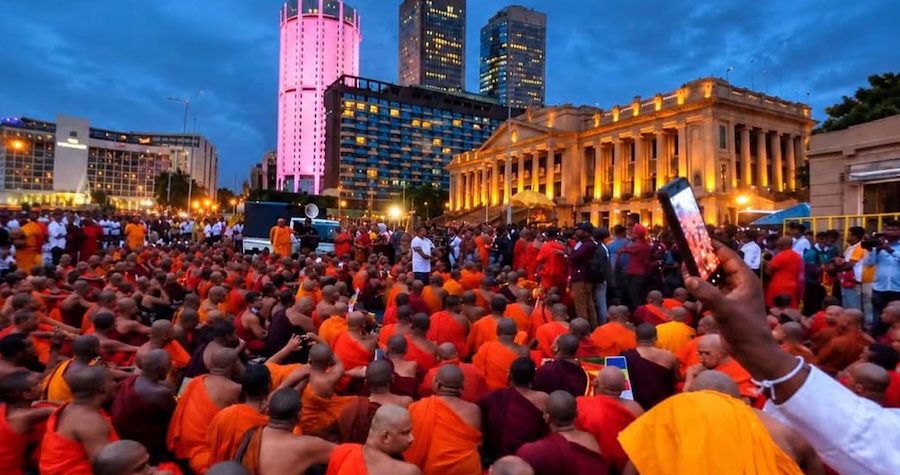
The recent protests in Colombo over Gnanasara Thera’s release demonstrate how a dispute involving religious identity and state authority can absorb the attention of political leaders, public officials and the wider community. Reporting on the demonstrations also records court intervention concerning the protesters’ continued presence near the Presidential Secretariat, followed by discussions with the Ministry of Buddhasasana.
The lesson is not that religious leaders should avoid public affairs. It is that disputes must be resolved through institutions capable of examining the issues impartially.
When political actors mobilise religious sentiment to pressure the government, the judiciary or public officials, they risk converting a question of law and procedure into a contest of political strength.
Such conduct can weaken institutional confidence. It may also encourage future groups to believe that sufficient public pressure can secure exceptions unavailable to other citizens.
This creates a dangerous precedent.
Today, the dispute may concern a monk. Tomorrow, it may concern a politician, businessperson, public official or another influential individual. If institutional decisions become negotiable according to the strength of a constituency rather than the merits of a case, equal citizenship is undermined.
The government must therefore distinguish between listening to religious concerns and surrendering its constitutional responsibilities. Dialogue is a strength; capitulation to coercion is not.
Religious institutions, in turn, should recognise that their long-term credibility depends not on their capacity to mobilise crowds but on the quality of their ethical leadership.
To be Continued with PART II