

By Lilani (Appadurai) Jayatilaka –
Yesterday, we received the sad news that Professor Thiru Kandiah had passed on. In a letter that he had been crafting to my husband Tissa, but which remained unsent in his drafts folder until his daughter Shivanthi shared it with us today, he had referred to Dylan Thomas’ moving poem to his ageing father ‘Do not go gently into that good night’. Though Prof Kandiah acknowledged the innate desire to ‘rage, rage against the dying of the light’, he accepts that such an attitude to ageing and death, could be both a ‘blessing’ and a ‘curse’ and that ‘the more sensible course would most likely be to recognize it as simply inevitable and learn to live with it’. Perhaps that is true, but it is a truth that is hard to accept, especially when we know that the world is that much smaller, that much poorer with the passing of this gentle, intellectual giant.
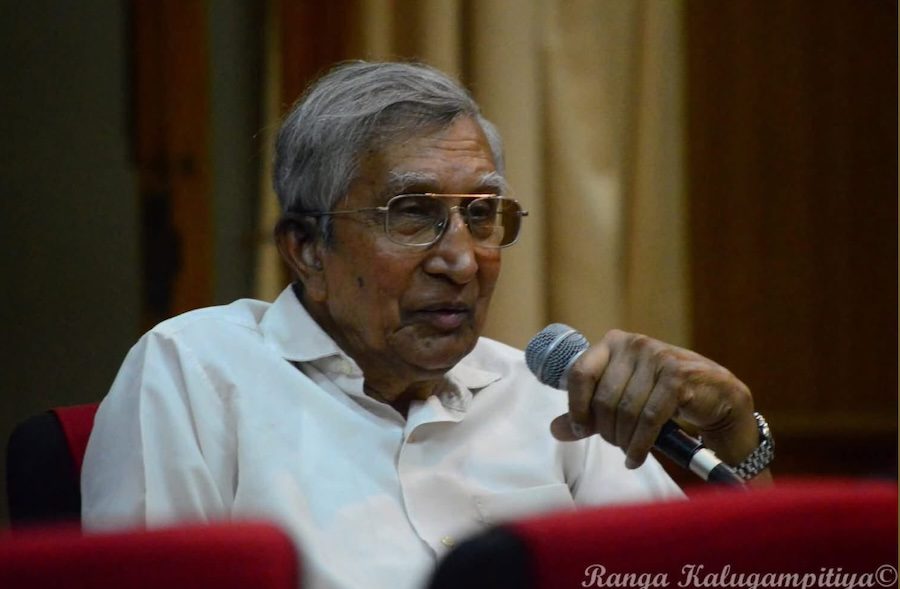
Professor Thiru Kandiah | Photo Credit Ranga Kalugampitiya
I first met Prof Kandiah in my first year as a student of English at Peradeniya. At the time he was a relatively young lecturer and he seemed to fill the lecture room with his presence. He was never still; he never sat down. He strode from one end of the room to the other end as he delivered his first lecture. That first lecture was on the Word Stock of English. Almost fifty years later, I can remember every word of that lecture along with the diagram he drew on the blackboard to illustrate the relationship between core words and borrowed or constructed words in the English language.
As someone whose special area of expertise was linguistics, he had, in my opinion, the driest of topics to handle. But Prof Kandiah was so engaged with the topics he had to teach, that he was able to make them interesting to us as well. And his concern for the welfare of his students did not end in the lecture room at the end of the day. Both he and Prof. Halpe took a lively interest in our welfare and in our performance as their students. We were invited several times to Prof. Kandiah’s home during the four years we were at Peradeniya, when both he and Mrs. Kandiah made us welcome and treated us to some delicious home-cooked meals. As we were away from home and subject to the vagaries of indifferent cooks at our halls of residence, these dinner invitations were greatly appreciated.
Prof Kandiah’s areas of interest extended well beyond the sphere of linguistics. As the lecturer in charge of the MusicSoc and DramSoc at Peradeniya, we were all roped into the activities of these two societies. When Edward Albee’s play, ‘Who’s Afraid of Virginia Woolf?’ was brought to Peradeniya from Colombo with (I believe) the McIntyre duo taking lead roles, we were ferried by Prof Kandiah across campus grounds to sell tickets for the play. I was President of the DramSoc that year and was in charge of seeing that the stage set was ready for the actors. A crucial prop for this play was a sofa which I had failed to procure in time for the performance. Panic stricken, I coerced my bemused aunt who lived in Kandy to part with hers, so that the play could run smoothly. Throughout this fiasco, Prof Kandiah remained calm and comforting, a rock amidst the chaos, never uttering a single word of blame, though I well deserved it.
But linguistics was his passion and he was so invested in teaching it, that he would continue to teach even when he was beset by migraines. We could see that his eyes were screwed up in pain, but he would carry on nevertheless. Apart from linguistics, he also taught us practical criticism on occasion, when he, in the manner of F.R Leavis, would dissect a poem word by word until he had extracted its essence and its every nuance.
My friends and I were inspired and excited by the intellectual stimulation provided by the English Department, and somehow, the very environs of Peradeniya seemed to enhance our understanding and appreciation of English literature. We were dazed and dazzled by all that Peradeniya had to offer: intellectual stimulation of the formal kind in lecture halls and of the less formal kind in debates and discussions late at night with close friends in the privacy of our halls of residence; plays and musical performances to be watched on stage or at the Wala, sitting on the damp steps of the open air theatre surrounded by flares while we watched a performance of ‘Maname’ or ‘Sinhabahu’; trekking half way uphill to the Anglican church for Sunday services or further uphill on Mahasivarathri for an all- night vigil of sorts at the Hindu Kovil; bathing in the nearby Mahaweli river – an action that was strictly forbidden by university authorities and thereby all the sweeter; watching movies at the American Centre in town; or taking the bus into town for a welcome respite from hall food at Lyons’ Café. The list is endless and its joys cannot be quantified.
In sampling all that Peradeniya had to offer, I had spread myself thin and Prof. Kandiah became concerned that I might be losing focus. He called me home to give me a gentle ‘talking to’ which had the desired effect. In the years since, my husband Tissa and I, along with some of my closest friends, have maintained a close relationship with Prof and Mrs. Kandiah. Whenever they visited Sri Lanka, they made it a point to meet us for a meal. Through the years, he has continued to hold our attention with his intellectual prowess, his facility with the language and his knowledge. Nothing had changed. When he wrote to us, we could be sure that there would be one or two words that we had never come across before; when he spoke to us, we would listen spell-bound as he declaimed on various topics of interest. His letters were specially crafted missives -compassionate and warm, yet intellectually stimulating and thought provoking. The last time he visited Sri Lanka was to attend his brother- in -law’s memorial service, and though we chatted briefly after the service, we were not able to share a meal as was our usual wont. But on his previous visit, we watched as Prof Kandiah, older, slightly stooped and noticeably frailer than before, walked away holding Mrs. Kandiah’s hand for support. It is a tableau that haunts us to this day, for we could clearly see the ‘dying of the light’ in his physical deterioration and we could not but ‘rage’ at its inevitability.