

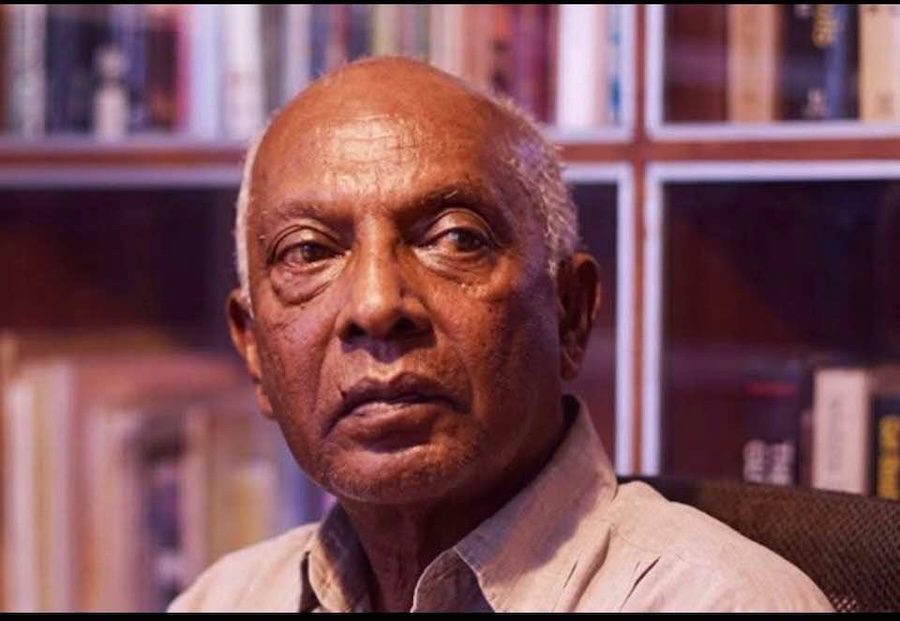

Chandrarathna Bandara
The last of the noblest from among the old leftists has finally bid us farewell. His was a peaceful passing as was deserved. It has happened just at a time when there is a dialogue about his intervention which is a call to the collective conscience. By the time we came to know Lal Wijenayake as schoolboys, Lal Wijenayake had already won himself a name as a lawyer of repute. In 1971 he and lawyers of the ilk of Bala Tampoe sought justice for the rebels at the Criminal Justice Commission. In 1978 he appeared for the university teachers and students who opposed the constitutional changes. He appeared for farmers waiving the retainers and legal fees and paying the court fees himself.
There are two basic reasons why he is received as man of noble disposition. Firstly, it was the honesty and empathy with which he treated all individuals who approached him. Secondly, his unsurpassed expertise in law and those things which were attendant to the subject. He knew the length and breadth of his vocation. As a son of a physician/doctor he received an inculcation in middleclass values which he was able to preserve even while he engaged in politics in his first party which was the LSSP. His engagement and affinity with stalwarts such as N.M. Perera, Colvin R. de Silva and Bernard Soysa had given him the foresight about the type of politics he should become involved in.
Lal Wiajenayake
We were fortunate enough to have had the opportunity to come to know him as schoolboys. We came to realize the value of his mentorship and the fact that we had been able to keep engaging with him for almost fifty years far before his demise. He enriched our lives immensely during this time.
He was a soft hearted man who was sincere. He once confided in me that he kept away from “divorce cases” as they are commonly referred to in Sri Lanka because of this. He told me that he could not bear the weeping of women and children on such occasions. He was the first among the few lawyers who were not merely mercenary in the pursuit of their profession. Everyone among his legal colleagues agreed as one despite their differences that his depth of knowledge of the field was unsurpassed.
It is common knowledge that he was not simply a man of law. He never forsook his first love that of politics in favour of Justitia. He worked tirelessly for social justice right up until his death choosing to disregard even the invisible lines of party politics. He spent his money in order to defeat the Mahinda Rajapaksa regime in 2015. He presided over the Public Representations Committee (PRC) on Constitutional Reform, which was a position which brought him no personal gains. His only aim was to bring about the changes which he felt were absolutely necessary. He took leave from all legal offices during this month. He then forwarded his observations to the government of the time urging change. Yet he was unable to bring them to fruition. The group who were unwilling to compromise their ideal came together forming the United Left Front (ULF). Looking towards the next election he turned to the NPP with much hope sacrificing time, money and effort in order to bring them to power. Though his comrades criticized this move his rejoinder was “Will we as leftists have a better opportunity join in the change?” Even I who write this was persuaded to support the NPP in agreement with Comrade Lal Wijenayake’s stand.
Many eulogies regarding his political activism will be written by man. Those far better suited than I will speak of this aspect of his character. Yet it is imperative that I should write of his impact on my career as a writer. My longstanding friendship with comrade Lal remained unbroken despite my move to Colombo and then on to Canada. It was because of him and other such as Vijaya Wickramaratne, Prof. Vijaya Kumar and Jayampathi Wickramaratne, that I was able to overcome my natural insecurities as someone with a somewhat rural upbringing. How lucky I was to have met these folk as a young schoolboy. Both Lal and I have our alma mater the Dharmaraja in common. Yet his being a senior alumnus was not the reason for our affinity. It was our party that brought us together. He would feed us at the Old Empire or City Mission Hotel when we flocked to his rooms famished after school. He not only discussed politics he shared his knowledge of art and George Keyt, the cinema and other topics of societal interest which contributed to making men of us. He was George Keyt’s friend and patron in Kandy. He has taken us to Colombo when he felt that we might benefit from an Art Exhibition. As an avid reader his walls were all covered with book cases. He had a large and eclectic collection not simply law but also books of and on literature and sport. When I visited him last September the walls were filled with empty shelves. He had donated all his law tomes to the Courts’ Complex Library which had lost much during last year’s Ditwah. Some he had donated to the D.S. Senanayake Public Library. He had published two books of poetry.
An era concludes at the dawn of a new one. Lal was a bridge which connects the old left with the new. He was also the only person who could calm the rivalry between the two factions. He chose to break out of the frame and join forces to bring down a fascist and authoritarian regime/ dictatorship.
From the beginning the old Samasamaja Party drew the erudite due to its prestige. Lal too was among them. He has discussed with us how he learned from these forbears. He told me once that he had come to be introduced to George Keyt through Bernard Soysa.
He chose the NPP as his last front and did not let go of the red flag until his final breath. The NPP leadership reciprocated in kind knowing fully well and appreciating the value he brought to them and what he gave them.
The mysterious and rather dramatic backdrop offered by the Dalada Maligawa, St. Paul’s Church, Raja Gedara and the old prison which made up the Deva Veediya housed the offices which were like eagles’ nests. These rather Dickensian surroundings which reminded one of the gloomy novels of not just Dickens but also Victor Hugo or W.A. Silva were immensely brightened by his pleasant demeanor. He we felt was a misfit in such almost Gothic environs.
Time flies and noble people who gave their lives to the service of justice become part of history. Comrade Lal Wijenayake will join them as someone who has never betrayed his principles.