

By Priyantha Gamage –
Priyantha Gamage
Lal Wijenayake passed away in Kandy on the evening of 31 October 2026, at the age of 86. With him goes one of the last of a generation of Sri Lankan lawyers who believed that a law degree was a licence to serve, not merely to practise.
The tributes came quickly and from every direction. The President paid his last respects in Kandy. The Bar Association, the Centre for Policy Alternatives and the Lawyers Collective issued statements. Old comrades from the Left wrote of him in the press. Each described a different side of the man, but they agreed on one thing: Lal could not be bought, bent or frightened.
I write not as a biographer but as a colleague and a friend. For several years Lal and I worked side by side in the Bar Association of Sri Lanka, he as Chairman and I as Convenor of its Rule of Law Committee. Later, from 2016, I had the honour of chairing that Committee myself. Those were not easy years to hold such a post. What follows is my attempt to record what he was, and what he meant to those of us who stood with him.
A lawyer of the Left, and of conscience
Lal was the son of a doctor. He was educated at Dharmaraja College, Kandy, the University of Ceylon and Ceylon Law College. He joined the Lanka Sama Samaja Party as an undergraduate in the early 1960s and rose to its Politburo. He served for some fifteen years as a provincial councillor and was Leader of the Opposition in the first Central Provincial Council.
His practice spanned more than 52 years. Much of it was given to those who could least afford a lawyer: trade unions, plantation workers and the Ceylon Federation of Labour. A friend recalled that he refused to take divorce cases because he could not bear to see women and children in tears. That small detail tells you a great deal about him. He was also a poet, with two published collections of verse, among them Thanikame Soshawa (The Clamour of Solitude), and a friend and patron of the painter George Keyt in Kandy.
He was never a comfortable party man. He argued inside the LSSP for leaving governments that had betrayed their promises. When the party stayed in the Rajapaksa government after the murder of Lasantha Wickrematunge in 2009, Lal broke with it. He went on to help form the United Left Front. Throughout, he defended the rights of the Tamil and Muslim people at times when doing so invited danger, not applause.
He challenged the 18th Amendment in the Supreme Court in 2010, when so many on the Left voted for it. He was a founding convenor of Lawyers for Democracy, which became the Lawyers Collective. He spoke out against the impeachment of Chief Justice Shirani Bandaranayake. After 2015 he chaired the Public Representations Committee on Constitutional Reform, travelling the country to hear what ordinary citizens wanted in a new constitution.
His last battle was perhaps his bravest. In 2026, as a member of the NPP’s own Leadership and Executive Councils, he opposed the government’s 22nd Amendment extending judges’ retirement ages, and petitioned the Supreme Court against it. He told the BASL President that he might sit on the NPP’s Leadership Council, but he would not compromise his principles. He remained in the party and refused to join opposition protests, yet he would not be silenced. At 85, he was still teaching us what independence means.
Our years on the Rule of Law Committee
Lal and I served together on the Rule of Law Committee of the Bar Association of Sri Lanka, he as Chairman and I as Convenor, during [years]. It was a time when the rule of law in this country had, in his own words, been reduced to the nominal existence of legal institutions. Power was concentrated in one family. Journalists were killed or driven into exile. A Chief Justice was removed. Lawyers who spoke out were watched, and some were threatened.
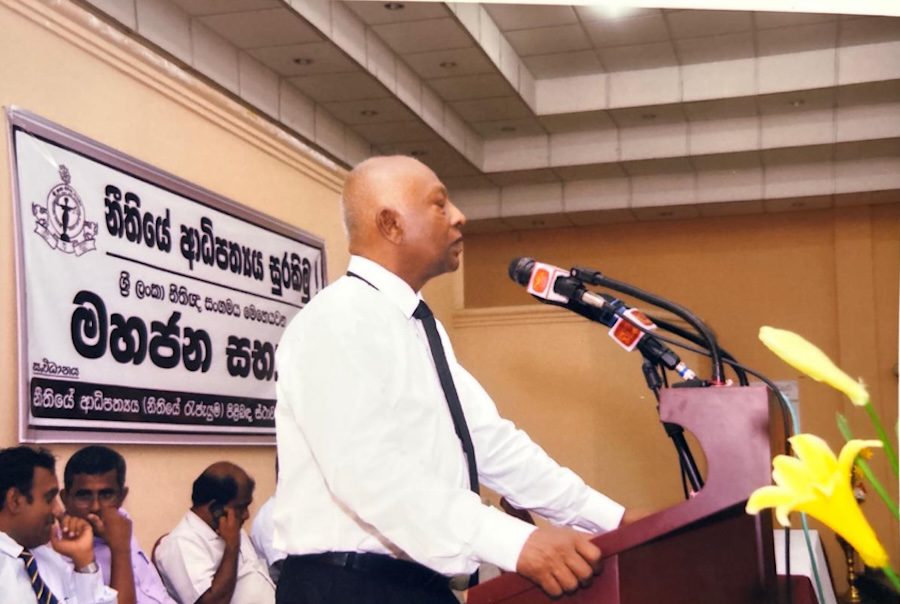
In that climate, the Committee chose not to stay silent. Over those years we issued statement after statement under our two names, on [e.g. the impeachment of the Chief Justice, abductions and disappearances, attacks on lawyers and journalists, the 18th Amendment]. Many were carried in the mainstream press and in Colombo Telegraph, often when few others would put their names to such words. We also took the message to the people, holding public meetings and seminars in Colombo, Kandy and Kegalle to bring lawyers and citizens together against the excesses of the regime.
Lal Wijenayake addressing a public meeting under the banner “Let us protect the Rule of Law!”, convened by the Bar Association of Sri Lanka and organised by its Rule of Law Committee. The author is seated on the platform.
Working with Lal, I learnt that courage is not loudness. He was calm and precise. He drafted with care, because he knew every word would be scrutinised by those in power. He never inflated a fact, and he never softened one either. When others advised caution, he would ask simply whether what we were saying was true and whether it needed to be said. If the answer to both was yes, the statement went out.
Our friendship was built as much on the road as in committee rooms. Lal would set out from Kandy, and I would join him at Kegalle for the journey to Colombo. On the way there and again on the way back, countless times, we would stop at the Mihira hotel in Pasyala and talk: about the law, politics, the state of the country, and a myriad other things. Those conversations taught me as much as any law book, and it is them I shall miss most.
Those were tough years for both of us. I do not think I could have endured them as well without a Chairman like Lal beside me. When I later took the chair of the Committee myself, from 2016, it was his example I tried to follow.
Farewell, comrade
Lal was laid to rest at the Mahaiyawa Crematorium in Kandy on 2 November 2026, in the city where he went to school and where, even in his last months, he was working to build a Left Centre.
Few who saw him on public platforms knew the private man. In Thanikame Soshawa there is a poem of the same name in which he writes of the solitude that had settled around him: a quiet time, well suited to reading and writing, yet one in which his mind kept turning back to the past rather than forward. Childhood, school, youth, the setbacks and victories of a long career, people remembered and forgotten — and above all the old books, letters, paintings and photographs that, he wrote, were precious to no one but himself. Reading it now, I see another side of the man I stood beside on so many platforms.
ඇස් ඇර
අනාගතය දෙස
මා සිතන්න දරන වෙර
පූස්සකි
අනාගතය ගැන සිතිය නොහැකිද?
අනාගතයක්
නොමැත
එය මට දැන් වැටහී ඇත
කුමක් කරමිද
අතීතයේ මම ජීවත් වෙමි
- From one of his poems…
The last time I saw Lal was on 29 July 2026, at the Special General Meeting the Bar Association called at its headquarters in Colombo to oppose the 22nd Amendment. He was 85 and sat on the ruling party’s own Leadership Council; he had every reason to stay away. He came anyway, and he spoke. It felt as though the years had folded back: the same cause, a hall full of lawyers, the same refusal to keep quiet. I did not know it would be our last meeting. I am glad it was there, on the side we had always stood on together.
He was not a man without critics, and he would not have wanted a tribute that pretended otherwise. But his worth never lay in being always right. It lay in keeping disagreement possible: in court, in public, and inside his own movement. He held that democracy, equality and the independence of the judiciary were not up for negotiation, whoever happened to be in power. Too many of us change our principles with the government. Lal did not.
The President came to Kandy to pay his last respects, and that gesture deserves to be acknowledged. But the truest tribute he could pay Lal would be to heed him: to reverse the 22nd Amendment, and to withdraw the Protection of the State from Terrorism Bill, both of which Lal opposed to the very end. That would take political courage. I hope he finds it.
The profession has lost one of its finest. The country has lost a conscience. I have lost a friend and a comrade-in-arms. To his family, I offer my deepest sympathy. To the younger lawyers who never knew him, I offer his example.
Rest well, Lal. The work goes on.