

By Gayanga Dissanayaka –

Gayanga Dissanayaka
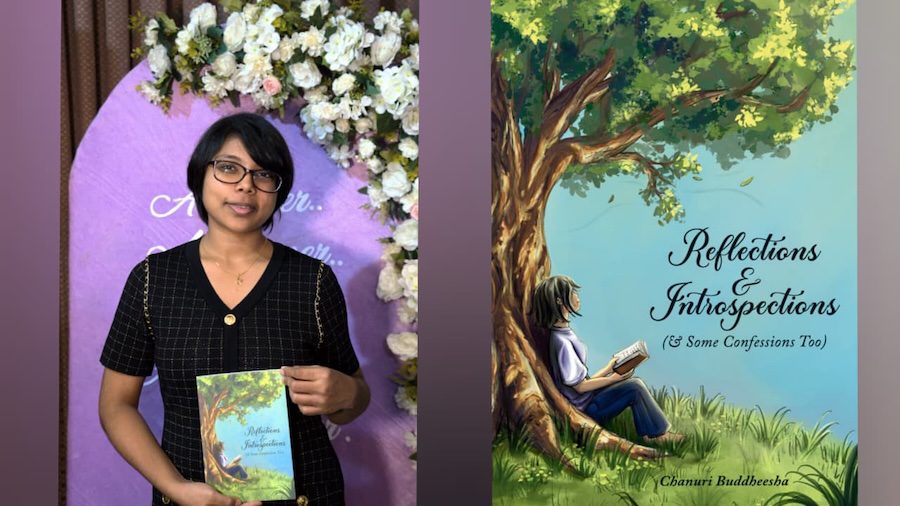
Chanuri Buddheesha was never a writer, but she had always been a storyteller. She remembers using her toy animal figures to make up all kinds of stories even before she was nine years old. “My mother was a housewife so she always observed how I played and had no idea how I came up with these stories,” recalled Chanuri. “One of those stories was how the lion, the king of the jungle, had enough of all the responsibility and decided to step down, and how he went on an entire self-discovery journey.” Likewise, for Chanuri, it wasn’t exactly writing, but storytelling has been a part of her life since her childhood. At the drop of a hat sometimes, she can just make up a story. “My brain was very fast in that sense. If anything, I feel like that is the only power I have. Writing came afterwards. I was just good at English and read a lot of books. I didn’t really learn English from school, but mainly from reading,” she said. Today, Chanuri is a debut author of her poetry collection, Reflections and Introspections published through The Jam Fruit Tree Publications.
“At my first school, we had a huge library even though the school was small. I remember their TinTin and Asterix sections very well,” said Chanuri. “The rule in that school was that until you were in grade five, you were not allowed to borrow books because children were not very responsible. But I read voraciously and actually enjoyed the library period so much that my parents went and spoke to the principal and they let me borrow books.”
Chanuri mentioned how her parents often read to her during mealtimes. Which meant they would always feed her with a book by her side. She mentioned how it was definitely her parents who instilled the reading habit in her. Her father had a secret stash of books and she would wait for him to go to work, wait till her mother was also busy and slowly open it. “It was a creaky cupboard so I would shut the door so that no one would hear. He had Perry Mason books and I developed a taste for it too,” recalled Chanuri fondly.
Apart from the storytelling aspect, Chanuri was also a deep thinker. She explained how she has this irresistible desire to dissect everything. She likes reaching conclusions but at the same time would also like debating those conclusions. So most of the time, she is arguing with herself. “It happened while I was writing Reflections and Introspections as well. It does however get exhausting at times. There have been times when I couldn’t sleep because I am thinking about something,” said the poet.
Reading English Literature was a connection that Chanuri couldn’t explain. “I just love the language, especially the archaic language and the language used in literary classics. Those writing styles even make me laugh because there is a distinct humour to them. Shakespeare can be very funny too. Even The Mill on the Floss had a language style that could make me laugh,” she said.
The first author that stayed in Chanuri’s mind and left a good impression was Jane Austen because of Pride and Prejudice. She recalls reading that book again and again. Before venturing into poetry, she was into novels, fiction and prose. The first thing she ever wrote was a knockoff of Cinderella. “I hated that the step-sisters were so unkind to her and wanted to change it. I remember I wrote pages and pages and I was so proud of it,” she said. “I wrote another story when I was eleven, a story about a wolf, which started with a school writing prompt. But generally writing to me takes so much thinking.”
When Chanuri was younger, she was given a penguin classic unabridged copy of Jane Eyre by her mother when she was admitted to the hospital. Chanuri remembers the book to be complicated, with long sentences and difficult to get through. But it was a challenge that she liked, it felt like a puzzle that she had to solve. “It was my first exposure to that kind of deep, convoluted writing. Something clicked in me and I wanted to read more penguin classics books. The introduction, the notes I read, all of it,” said the poet.
Chanuri would like her poetry collection, Reflections and Introspections to be read within the academic circles because for literature lovers, part of the fun at school and university was dissecting and trying to figure out what they mean. In an era where thinking is also done for us, she believes that it’s really important to keep our brains working. As a published writer now, there was a weight of responsibility that Chanuri felt while writing this book because she was putting her work out into the world. This meant people would be buying it and spending their time and energy on it. Therefore she believed that it had to be something worth their time. “It also shouldn’t lead anyone down the wrong path, and I take that very seriously. I wrote this to give my readers a neutral point of what I’m talking about, to present the facts as it is and let people do with it what they want,” Chanuri said. “As a Buddhist, I always keep an open mind and I believe not to speak about anything without ignorance. In my book, I’m just planting seeds of thought, if my readers feel like that seed is for them, they can choose to water it.”
Chanuri explained how all of us are thinking very fast because we want to move on to the next thing. Since we are extremely stimulated, not many people would spend a lot of time reading long sentences because most of us don’t have the patience for it. She explained how in archaic language, you are forced to pause, slow down and focus. “This kind of language holds something that is more than just a pleasure-read, which is why I used that kind of language in my poetry collection as well.”
To the poet, it feels like archaic language and archaic phrasing holds an entire world of meaning. Being able to read and understand something in archaic language is like having access to a world that not many do. Chanuri believes that language is the vehicle that brings out the depth of the story. “There’s almost a spirituality in it sometimes, something that connects so deeply to the soul. There is another plane of existence that they are reaching into and giving us a connection to. So I have a vast amount of respect for those writers because sometimes I cannot believe how one can capture so much in a book,” she said.
“When I got the news that my book is out, I couldn’t believe it at all. When I came to The Jam Fruit Tree Publications and held the book in my hands, I was utterly surprised. After seeing my manuscript on the screen for so long, seeing it as a physical book felt like an entirely different experience,” she said. “I have never really felt like I belonged anywhere and never tried to fit in. After becoming an author, I felt that sense of belonging for the first time.”
Chanuri hopes her book will spark discussion, and even debate. Her poetry collection is about planting a seed in her readers’ mind and giving them something worthwhile to think about. “Everything that I have thought about has come from books or because of books. Because sometimes all it takes is thinking about one little aspect to change your entire perspective on something,” Chanuri said.