

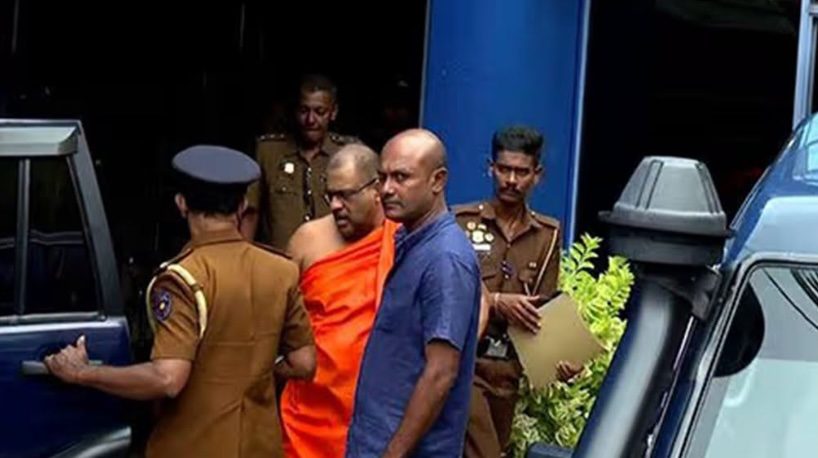
By Sarath de Alwis –

Sarath de Alwis
Anuradhapura, the enduring crucible of our Grand History and Noble Kings has today turned into an amphitheater for a comic opera staged by a disparate and desperate opposition. In a frantic bid for survival, a strange coalition of the Rajapaksas, Ranil Wickremesinghe, Sajith Premadasa, and Dilith Jayaweera have all lined up to present themselves as the new champions of the saffron robe.
Of all the opposition mandarins, Sajith Premadasa stands out as the most eloquent reservoir of hogwash, vehemently insisting that secular law cannot infringe the inviolability of the saffron robe.
He completely forgets that the Enlightened Master explicitly directed his followers to stitch their robes out of ‘Paansa kula’ the discarded, decaying cloths gathered from cemetery cadavers.
They all rush to the Ancient City to launch their bids to return to relevance and credibility! Yet the street-level agitations of the saffron-clad political actor known as Balangoda Kassapa was never a spontaneous movement.
It is nothing but a theatrical curtain-raiser for a much broader, systemic offensive against the NPP government and President AKD. It is a war by other means—the other means being the saffron shield.
The true scale, scope, and purpose of the saffron iceberg broke cover with a staggering institutional directive. In a letter dated October 30, 2026, the Mahanayake of the Kotte Chapter of the Siam Maha Nikaya, Most Ven. Dr. Ittapana Dhammalankara Thera, officially requested the Commissioner General of Prisons to arrange a date and time for a ten-member delegation of the Sangha Sabha to enter Welikada Prison to conduct a formal re-robing ceremony for the convicted monk Galagoda Atte Gnanasara.
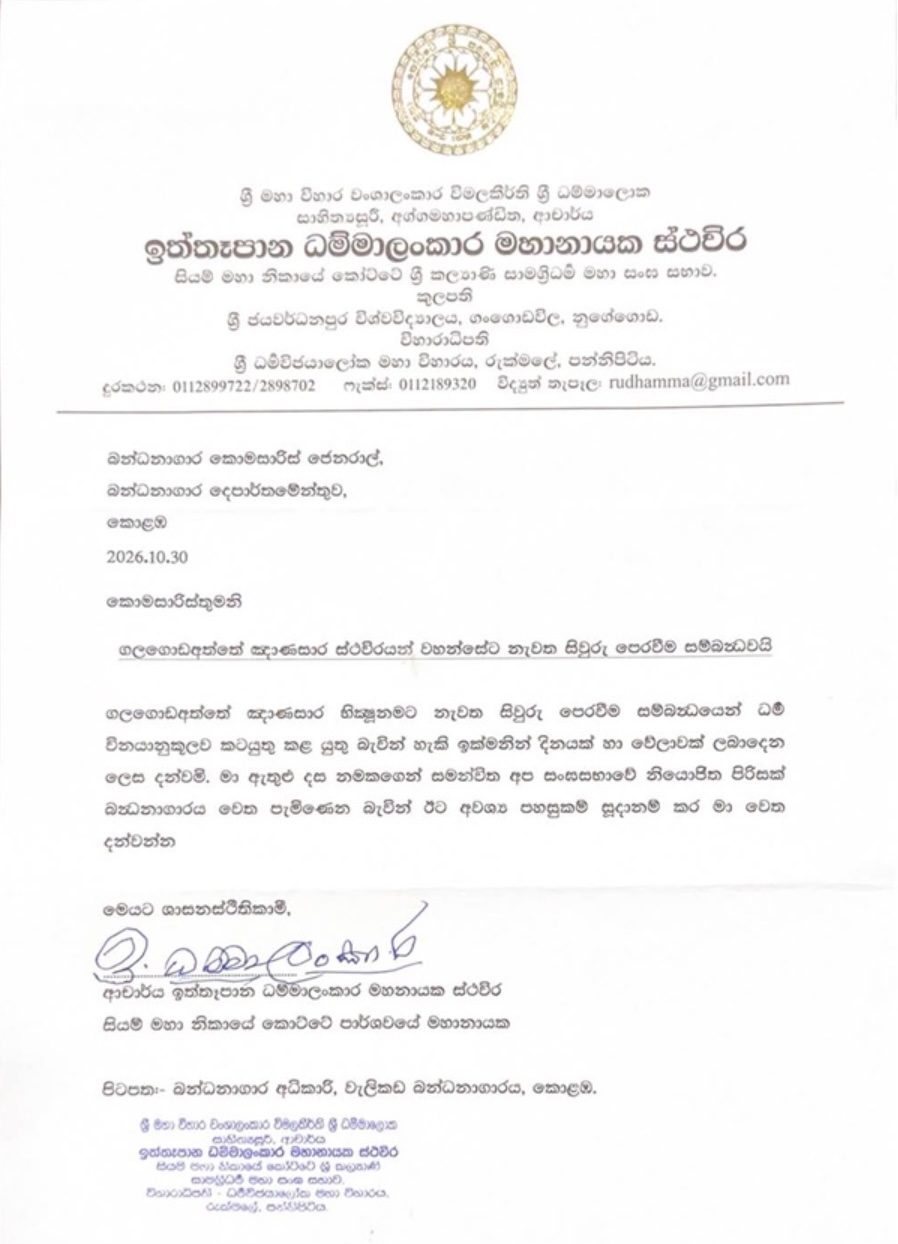
Screenshot
By demanding that a secular prison, with its rigorous order, be pliant enough to bend to ecclesiastical jurisdiction under their interpretation of what the Buddha taught as Dhamma and what the Buddha dictated as ‘Vinaya’, the Kotte Chapter of the Siam Nikaya hierarchy has brought the nation-state to a critical crossroad.
We are compelled to ask a foundational question that fifty years of constitutional appeasement of the Sangha Order have sought to evade—first in the 1972 constitution, and second with the 1978 constitution.
Are we a modern, true Republic in the Rousseauvian sense—where the General Will of sovereign citizens is absolute—or are we a de facto theocracy where judicial accountability stops at the command of the Buddhist supra clergy.
In his ‘The Social Contract’ Rousseau leaves no room for such ecclesiastical dualism. He dictates that sovereignty is nothing less than the exercise of the General Will, declaring that it is ‘inalienable’ and that ‘the sovereign, who is no other than a collective being, can be represented only by himself.
To Rousseau, any private faction or partial society that demands a separate exemption from the common law breaks the social pact, for the collective citizenry alone holds the absolute authority to govern the republic.
The foundational architecture of this self-inflicted crisis was laid during the post-independence era.
To understand how a convicted prisoner can have an entire monastic council march into a state facility to restore his institutional armor, one must trace a self-inflicted crisis built on constitutional appeasement and absolute neo-liberal mischief. Let us not forget that Gnanasara performed his first contemptuous dance against the judiciary inside the Homagama Magistrate’s Court, wrapped in that very same saffron robe. Now, the Kotte Kalyanasri Sangha Sabha intends to stage another epic farce inside the walls of a secular state prison.
The structural decay began under the 1972 Constitution, introduced by the Sirimavo Bandaranaike-led United Front Government.
In a bid to appease a majoritarian Buddhist psyche, the 1972 constitution granted Buddhism the ‘foremost place’ and mandated the state to ‘protect and foster’ it.
This piece of constitutional mechanics legally transformed the monastic hierarchy from spiritual guides into constitutional stakeholders holding an implicit veto over state policy.
This historical trap was aggressively expanded in 1978 by that Latin-epigram-loving political fox, JR Jayewardene. While fondly quoting ‘Infelix qui sancta docet si vivat inique’—’Unfortunate is the one who teaches holy things but lives wickedly’—JRJ executed a maneuver of profound neo-liberal mischief.”
JRJ expanded the constitutional mandate to include the preservation of the nebulous ‘Buddha Sasana’. By institutionalizing the ‘Sasana’ a term elastic enough to encompass not just spiritual sublime doctrine, but vast networks of untaxed monastic wealth, extensive land ownership, and autonomous temporalities such as the Dalada Maligawa, Sri Padasthana, and Atamasthana—the state created a parallel, unregulated, but venerated quasi-state.
The subsequent creation of a dedicated Ministry of Buddha Sasana effectively insulated the clergy from secular auditing and legal oversight, rendering the hierarchy structurally immune to the rule of law.
We would do well to remember that even the Kandyan King Kirti Sri Rajasinha, who facilitated the historic 1753 return of the higher ordination from Siam, fiercely retained absolute sovereign authority over the clergy.
Not only did he reserve the right to appoint the Sangharaja, but when a palace assassination plot was uncovered in 1755, he promptly imprisoned the newly appointed Sangharaja Welivita Sri Saranankara ‘Therunwahanse’ on suspicion of complicity.
If an 18th-century absolute monarch understood that spiritual robes do not grant immunity against the laws of state survival, why has a modern democratic republic forgotten it? President AKD, it is time to learn from our history.
The current standoff exposes the ultimate irony of our contemporary political landscape. A disgruntled political class, having lost their grip on the nation’s rudder, is now reduced to the sorry state of clinging to the aging udder of a worn-out sacred cow. When retired Admiral Sarath Weerasekara—a blinkered ideologue of the old guard and now media mogul DJ’s fellow traveler—is seen holding backroom meetings at five-star hotels with Kasun Kularatne alias Balangoda Kassapa under the guise of paying homage, the farce is laid bare.
Surely, the Ministry of Buddha Sasana should possess the precise details of Balangoda Kassapa’s registration, the recognized Nikaya to which he belongs, and the specific ecclesiastical lineage from which he received his higher ordination!
That it does not is the ultimate proof of an intentionally constructed blind spot in this whole business.
The old regime can no longer rely on the traditional Sangha hierarchy, which has occasionally shown institutional restraint.
Instead, they are forced to subsidize, amplify, and weaponize independent actors masquerading in saffron to manufacture moral panics on demand.
They are aided by private television channels brazenly dedicated to giving them unhindered, unlimited exposure under the convenient cover of freedom of expression.
Under free-market global commerce, the essence of Prince Siddhartha’s renunciation has been distorted into a corporate shield by an entrepreneurial priestly class.
By simply draping a piece of cloth over his shoulders, any political agitator can instantly inherit a shield of constitutional immunity that protects them from secular state auditing, penal codes, and judicial mandates.
Has anyone ever bothered to ask some of these saffron-garbed potentates why they sport an additional, glistening saffron shawl thrown so stylishly over their shoulders?
To some, the saffron robe has ceased to be a symbol of world-renunciation. It has become a fashion statement and a marker of elite status.
This sorry state completely exposes the modern myth of the Arahat Dhajaya—a faith marketer’s coinage designed to stress the absolute sacred status of the robe-wearer. In the cultural imagination of the island, the saffron robe is revered as the very pennant of Arahat Mahinda, son of Ashoka, who according to legend brought the Dhamma to the rock of Mihintale.
Yet, according to eminent historian Romila Thapar, Arahat Mahinda’s visit to Mihintale was not a miraculous, vacuum-born conversion of an ignorant king.
Rather, his objective was institutional organization. Mahinda arrived as an official envoy of a highly sophisticated Mauryan state to formalize religious ties, organize monastic orders, establish a disciplined monastic code (Vinaya), and structurally align the Anuradhapura monarchy with the state-patronized Buddhist models of Emperor Ashoka. The deeper details of that structural discussion could await another day.
The saffron robe was meant to signify the ultimate conquest of ego, greed, and worldly power.
But when the robe is used to protect individuals from criminal investigations, evade court orders, and host political strategy sessions with discredited politicians, it ceases to be the pennant of Mahinda.
It becomes a cynical costume of political convenience, degrading the very heritage it claims to protect.
That said, the opposition’s calculations fail to account for the organic, unyielding dynamics of the Aragalaya. The 2022 uprising was fundamentally a post-nationalist awakening that shattered the old ruling elite’s ability to trigger automatic communal, religious, and tribal reflexes. The consecutive electoral triumphs of the NPP completely disrupted a cozy ecosystem that had survived for seventy-six years.
The modern Sri Lankan citizenry has learned a brutal economic lesson. They now know that a politician’s duplicitous devotion at a temple does not prevent the bankruptcy of a nation.
The organic consciousness of the Aragalaya acts as a discerning firewall against these manufactured crises, rendering the old guard’s tools obsolete.
The entire Buddhist monastic establishment is now forced to make a defining choice between 21st-century modernity or tribal primitivism.
Will the Maha Sangha evolve into an exemplary spiritual body bound by moral accountability, or will it persist as an unregulated parallel government clinging to feudal land ownership, untaxed wealth, and medieval legal immunities?
If President AKD and the NPP government are genuinely committed to a systemic overhaul, they must confront this historical trap head-on. The state must completely repeal the British-inspired Buddhist Temporalities Ordinance, cutting monastic property management off from the state’s benevolent Nelsonian eye.”
To rescue the spiritual heritage from political manipulation, the state must look back to move forward. It must re-establish the core tenets of Ashokan Buddhism that Arahat Mahinda brought to the island.
Ashokan governance was defined not by giving a monastic monopoly unchecked constitutional vetoes, but by active state purification of the Sangha, enforcing strict moral accountability.
These make-believe edifices built on elite preservation and structural immunity are historically unsustainable.
The Welikada prison re-robing theater and the Anuradhapura Satyagraha are not revivals. They are the final, desperate gasps of a feudal-minded oligarchy both lay and ordained resorting to the oldest trick in the book.
Dr. Gnana Sankaralingam / November 12, 2026
Not only the robe, but Buddhism itself had been above the law. Placing Buddha statues at strategic places such as Vavuniya town center, Trincomalee town center, Junction of the road to Madhu Church, unauthorised construction of Vihares in state lands in the south and private lands in the north and disobeying court order regarding controversial Buddhist practices infringing on legitimate rights of others, have taken place in the past and is continuing unabated. Government has not taken any action against these, but have taken firm stand on Buddhist monks who are a threat to their rule. Naturally Bankrupt Sinhala politicians are capitalising on this to create chaos.
/