

By Jehan Perera –
Jehan Perera
The death sentence on Sivarasa Anojan, a Sri Lankan citizen convicted of blasphemy in Saudi Arabia has taken a central place in national consciousness for the past several weeks. It has been in the headline news since it was first reported last month. There have been many initiatives taken locally to get a more lenient sentencing by the Saudi authorities. There is also an undercurrent that is critical of both the culture and religion from which this sentencing emanates. This also sustains the widespread publicity being given nationally to the issue. By way of contrast, the controversy caused by the forcible removal of the Thileepan statue in Jaffna has not significantly impacted upon the national consciousness. There was only passing mention of the incident in the national media which has been overtaken by other events.
However, in the north and east of the country, and in the diaspora, the removal of the Thileepan statue has become a major issue. It has led to protest marches led by university students and widespread condemnation by civil society and political groups. The issues underlying the Thileepan statue have deep undercurrents in the Tamil consciousness particularly in the north and east which time is unlikely to dispel. The real test of harmony in a multi-ethnic, multi-religious society like Sri Lanka is not whether communities coexist peacefully when nothing controversial is at stake. Rather, the test is how they respond when an event touches their identities and grievances. The death sentence imposed on Anojan in Saudi Arabia and the removal of the Thileepan statue in Jaffna carry the risk of becoming grievances to entire communities.
In the case of Anojan, a young Tamil migrant worker, he was first sentenced to five years imprisonment and a fine of three million Saudi riyals over a Facebook comment. Both he and the Saudi prosecution appealed, with the appeal court raising the sentence to death. This has led to public sympathy for him in Sri Lanka. Appeals for clemency have come from the President, government and opposition leaders, clergy of all faiths and Muslim political leaders. At the same time there is a need to reject attempts to turn the case into a source of anti-Muslim sentiment or collective blame. Peacebuilding therefore has to be within Sri Lanka as well as diplomatic. Religious leaders and civil society in the country should be ready to quell rumour, even as Muslim, Buddhist, Hindu and Christian leaders stand together publicly.
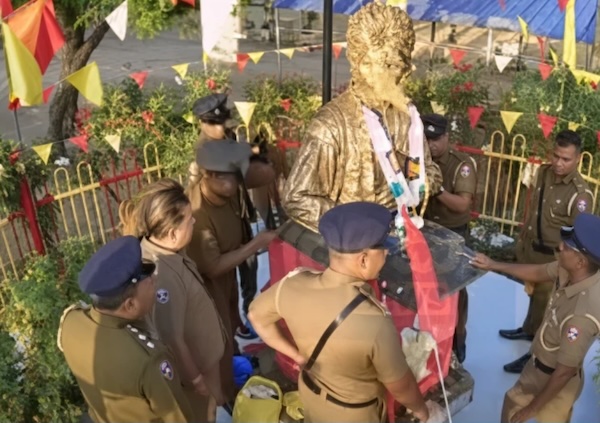
Thileepan Statue
The Thileepan controversy has had a different trajectory.. Many Tamils admire Thileepan, the LTTE name of Rasaiah Parthipan, who died on 26 September 1987 after a twelve-day fast. His demands were addressed to India but included matters pertaining to the Sri Lankan government including the release of detainees held under the Prevention of Terrorism Act. The statue put up during this year’s commemoration was removed by police in the early hours of 27 September, a day after the commemoration ended. The government’s legal concern, as articulated by its spokesperson, was the LTTE remains a proscribed organization and before removing the statue, police had presented facts to the court. But law and memory answer different questions and the depth of Tamil anguish cannot be disregarded.
For many Tamils, remembrance of Thileepan is connected to their sense of loss and historical memory. The memorial has been destroyed and rebuilt more than once, and each destruction has added to the meaning it carries. Many who mourn Thileepan are grieving a young man who died without violence and by his own fast. They also grieve an era of loss of the struggle for Tamil rights and self-determination for which Thileepan has become a symbol. The Office for Reparations Act, No. 34 of 2018, provides for collective reparations and gives the Office for Reparations a role in policies on memorialisation. This does not automatically permit any particular statue, nor does it override laws on public places or proscribed organisations. But it shows that memorialisation is recognised within Sri Lanka’s framework for reparations and reconciliation. There is also a wider question of equality. The JVP that now leads the NPP Government was itself once proscribed when it took up arms against the state in which tens of thousands died, later entered democratic politics, and now for many years has publicly commemorated its own fallen. The opportunity to remember those who died should not belong to one community alone.
A commitment to peacebuilding requires that the same trust that has been given to former militants of one community needs to be given to members of other communities if equal citizenship and equal rights are to have meaning. Further, the Office for Reparations Act provides for reparations through livelihood. It is today a fact that those former LTTE members who went through the government’s rehabilitation process find it difficult to get jobs in the private sector. Private sector employers are reluctant to come under surveillance for employing former LTTE members. There needs to be equal access to employment and removal of unjustified barriers to reintegration, with targeted public programmes where necessary. Until this situation is realized on the ground, the government needs to consider employing those who went through the government’s rehabilitation process and still unable to find suitable employment.
Continuing Peace
The challenge that post-war Sri Lanka faces, a full 17 years after the end of war, is to strengthen the foundations of trust between communities rather than deepen existing suspicions. Anojan is an individual Sri Lankan citizen facing a severe sentence in another country. His case should not become a reason to blame Sri Lankan Muslims. Thileepan is remembered differently by different communities, but the dispute over his memorial should not become a reason to revive the communal divisions of the past. The cases are also mirror images in an important respect. In the Anojan case, the state is an advocate pleading before another government. In the Thileepan case, the state is the actor whose decision is being judged. The first calls for quiet diplomacy and restraint in public language. The second calls for fairness and explanation, and the burden on the state is heavier.
The common roots of the two cases lie in mistrust that does not belong to one community alone. It has been produced by experiences of discrimination, violence, insecurity and loss that have been interpreted differently by different communities. Grievances turn communal when an individual is seen as a representative of a community, when institutions seem to treat communities unequally, and when people feel their pain goes unacknowledged. Each of these can be addressed. The system change that the Sri Lankan people voted for in 2024 would need to include a government that rejects collective blame, acknowledges grief and explains its decisions openly. It also requires state institutions to act transparently and consistently, so that no citizen feels that the law protects some communities more than others.
This peacebuilding imperative requires enlightened leadership as much as legal authority. It requires leaders who will speak to their own communities against prejudice, even when this is politically inconvenient. It requires religious leaders who will demonstrate solidarity across religious boundaries. And it requires civil society to recognise that peacebuilding is not simply preventing violence after tensions have risen, but is addressing the mistrust and grievances that allow tensions to rise in the first place. Sri Lanka has learned, at great cost, that communal divisions can become much larger than the events that initially give rise to them. The Anojan and Thileepan cases give Sri Lanka an opportunity to demonstrate that it has learned from its past. The test of Sri Lanka’s continuing peace is whether we can address difficult grievances without turning them into communal ones.
CChampa / October 6, 2026
Buddhist statues are not allowed in the North and the East but terrorist statues are allowed. What kind of law is that?
All terrorist statues and monuments in the North and the East should be razed to the ground and the gruesome crimes committed by terrorists should never be forgotten.
Marginalizing Buddhism, showing contempt to Buddha statues, restrictions and hostility against Buddhism and Buddhist monks particularly in the North and East, and distortion of Buddhist scriptures are acts of blasphemy and hate crimes, and therefore, perpetrators should be brought before the law.
/
Ajith / October 6, 2026
“The Anojan and Thileepan cases give Sri Lanka an opportunity to demonstrate that it has learned from its past.
These are two different cases.The Anojan case involved another state and his life. Thileepan case is about remembrance.
/