

By Kasuni Ranasinghe –

Kasuni Ranasinghe
I have stood at the place where the last bomb went off.
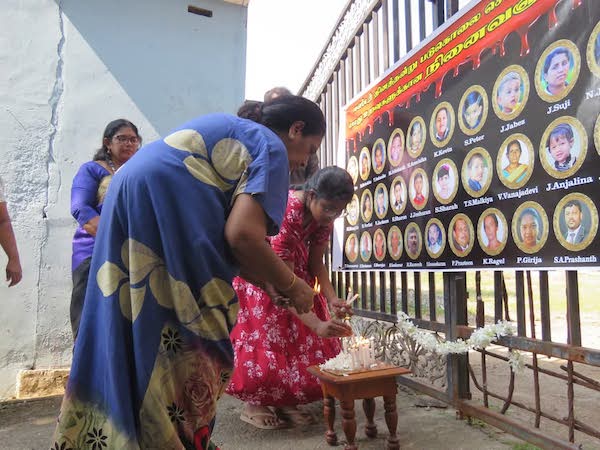
In the weeks after Easter Sunday 2019, I travelled to Kattankudi as (then) the research analyst at Institute of National Security Studies (INSS) Ministry of Defence, Sri Lanka, with my research team. We visited the Zion Church in Batticaloa, where worshippers had died that April morning. We walked the streets where Mohammed Zaharan Hashim had built his following. We entered the madrasa and the checkpoint where he had operated with growing impunity for years. We spoke with officials, community leaders, and civilians whose lives had been cleaved in two by a single day.
What I expected to find was anger, or political defiance, or the kind of brittle solidarity that sometimes forms around grief. What I found instead, in almost every conversation, was something quieter and more corrosive. Fear. It was not fear of violence that I encountered on those streets. It was the fear of being guilty by association, forever, a deeper fear — the fear of permanent suspicion. The fear that innocence could no longer protect you.
That fear is still there. Seven years later, it has not been resolved. It remains one of Sri Lanka’s most consequential national security vulnerabilities. Because communities that fear the state do not share intelligence with it, and communities that do not share intelligence create the exact conditions that made Easter Sunday possible.
In 2026, Sri Lanka’s official metrics look reassuring. Zero terrorism-linked fatalities in 2024 and 2025. A score of zero in the Global Terrorism Index. Tourist arrivals are recovering. An economy growing again at five percent after the catastrophe of 2022. By every conventional measure, the island is stable.
But stability is not security. Stability is the absence of visible violence. Security is the presence of the conditions — trust, justice, institutional competence, community partnership — that make violence progressively less likely. By that measure, Sri Lanka’s work is substantially unfinished.
The structural conditions that produced Easter Sunday have not been dismantled. The Integrated Threat Assessment Centre that analysts recommended in the immediate aftermath exists, seven years on, as a draft in a National Security Strategy document that has not been operationalised. Madrasa regulation remains piecemeal. The narcotics crisis — in the first nine months of 2025 alone, police seized over three tonnes of heroin and crystal methamphetamine and arrested more than 122,000 people — has created a generation of economically marginalised young men aged 19 to 26 who represent a new and underanalysed radicalisation risk. The political-criminal nexus that sustains the drug trade has survived Operation Yukthiya’s headline seizure figures largely intact.
And the reconciliation failures are compounding. The NPP government swept to power in late 2024 on a historic cross-ethnic mandate — winning, for the first time, majority Tamil support in Jaffna and Vanni. It promised to abolish the Prevention of Terrorism Act, return military-occupied land, and build a new political culture of inclusion. By mid-2026, PTA use has increased. Land returns have not materialised at scale. The UN Human Rights Office documented ongoing arbitrary detention and torture in its 2025 annual report, noting that the structural conditions that led to past violations persist.
This is not merely political disappointment. It is a security failure in the making. The lesson I carried out of Kattankudi was not about ideology or intelligence. It was about trust. The Muslim Federation of Kattankudi had been warning authorities about Zaharan for years. The information existed. The community was offering it. The state was not receiving it — not because the capability was absent, but because the relationship was broken.
That relationship remains broken across the communities that have experienced state violence and state indifference as lived realities. In the north and east, Tamil communities operate under a surveillance apparatus the UN describes as largely intact, with minimal oversight. In Muslim-majority areas in the east, the aftermath of Easter Sunday has meant years of collective suspicion dressed as counterterrorism. In both communities, the practical consequence is the same: intelligence that could protect the country stays inside the community, because there is no trusted channel through which to share it.
This inversion is the central failure of Sri Lanka’s current security posture. What the country needs is not more surveillance. It is the ITAC — finally operationalised, with community representation and statutory independence. It is a madrasa regulation designed with Muslim communities, not imposed on them. It is land returns and transitional justice not as concessions to external pressure but as national security investments in the trust that makes early warning possible. It is a narcotics strategy that dismantles networks, not just fills prisons. It is a political culture that governs for all citizens, because states that govern for all citizens are harder to destabilise.
Standing in Kattankudi in 2019, I was struck by the ordinariness of the place. A street. A building. The physical trace of something catastrophic in what was otherwise an unremarkable piece of a small coastal town. The people I spoke with that day were not inhabiting an analytical framework. They were managing school fees for children whose fathers were in custody. They were trying to explain to young people that a faith shared with a mass murderer did not make them his accomplices. They were living with a fear that no policy document had yet been designed to address.
Seven years on, that fear endures. The silence after the bomb is not peace. It is a warning that has not yet been heard.
*Kasuni Ranasinghe | Research Student, Macquarie University | Former Research Analyst, Institute of National Security Studies Sri Lanka
Ajith / June 13, 2026
“Seven years on, that fear endures. The silence after the bomb is not peace. It is a warning that has not yet been heard.”
The research about the fear endures did not start with Easter bombing but it started with the dawn of so called independence from the rule of the country moved from British control to Sri Lankan control with a family.
/