


By Asoka S. Seneviratne –

Prof. Asoka.S. Seneviratne
“This is not just a tax drive; this is a renewal of the social contract” ~ President Anura Kumara Dissanayake
Anura Kumara Dissanayake (AKD), in his role as Minister of Finance, recently launched a tax week. In my view, it is not merely a revenue initiative. Rather, it acts as a national call for fairness, responsibility, and rebuilding trust between citizens and the government. By cultivating a culture of voluntary compliance, eliminating corruption in tax administration, and expanding the tax base with equity at its core, the government is laying the foundation for a new social contract. Every rupee collected should represent justice, rather than acting as a burden, in a society that demands accountability and provides opportunity. This article aims to elaborate on the above, ensuring that AKD’s initiatives yield the desired outcome.
The Theme of the Tax Week
President Anura Kumara Dissanayake’ s recent “Tax Week” initiative in Sri Lanka focuses on the theme of “Equity, Efficiency, and Enforcement” (EEE) in tax policy. This campaign highlights the government’s commitment to reforming the tax system to be more progressive, transparent, and digitally integrated, aiming to boost revenue collection while ensuring fairness. Equity entails progressive tax relief for low- and middle-income earners. In this context, the government has raised the tax-free threshold for monthly incomes from LKR 100,100,000 to LKR 150,000, 000, providing significant relief to lower-income earners. Additionally, graduated tax exemptions have been introduced for higher income brackets, ensuring that those with greater earnings contribute a fairer share. In terms of efficiency, the digitalization of tax collection is at the forefront. Therefore, plans are in place to digitize the Value-Added Tax (VAT) collection process, thus improving efficiency and transparency in the tax system. Furthermore, implementing Point-of-Sale (POS) systems across VAT-registered businesses is a key initiative to facilitate digital transactions and reduce reliance on cash. Finally, enforcement involves strengthening tax compliance. In this regard, a more interventionist approach has been suggested to recover uncollected revenue, emphasizing the need for the IRD to collect the full tax revenue. Note that collaborative efforts among the IRD, Customs, and the Excise Department are being encouraged to tackle tax evasion effectively. Given all the above, the broader economic objectives of these tax reforms are part of a wider strategy to increase Sri Lanka’s tax-to-GDP ratio from approximately 9% to 15. 1% by 2025. This aligns with the government’s goals of achieving fiscal sustainability, reducing reliance on external debt, and promoting social equity. In summary, the “Tax Week” initiative reflects the Sri Lankan government’s dedication to creating a fairer and more efficient tax system, which is crucial for the nation’s economic recovery and long-term stability.
Why Sri Lanka’s Tax-To-GDP Matters
Understanding and comparing Sri Lanka’s tax revenue and GDP in the context of other Asian countries is essential. This understanding will provide clarity on the concerns raised by the Minister of Finance regarding the tax drive, as mentioned above. In 2007, the tax-to-GDP ratio peaked at 12.2%, while in 2015, it was recorded at 15.2%. Sri Lanka’s revenue-to-GDP ratio declined significantly after 2019, primarily due to tax cuts (e.g., the reduction of VAT from 15% to 8%) and the economic fallout from COVID-19 and the 2022 crisis, which reduced tax revenue to 8.3%.
Due to COVID-19 and VAT reduction, there was a significant decline to 7.4% in 2022, the lowest in the period. Along with the IMF bailout program and efforts to improve revenue collection, it reached or recovered a rate of 9.8% in 2023. The above figures highlight the volatility in Sri Lanka’s tax revenue relative to its GDP, underscoring the challenges in maintaining consistent fiscal health. Compared with the above, the performance of some Asian countries can be presented as follows: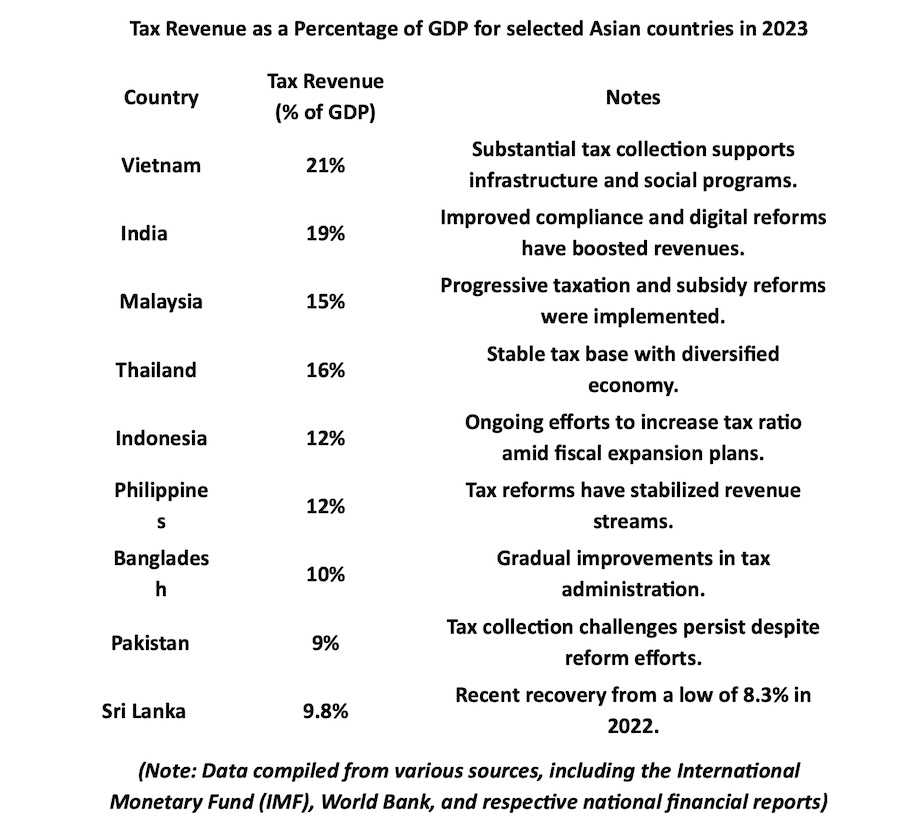
The statistics above highlight that Sri Lanka’s tax revenue-to-GDP ratio is among the lowest in Asia, underscoring the need for continued fiscal reforms and improved tax administration to boost revenue collection. In other words, Sri Lanka’s government revenue-to-GDP ratio is consistently low in Asia, historically hovering around 8–12%, while most peer countries range between 14% and 20%. This fiscal weakness is a fundamental cause of Sri Lanka’s debt crisis and has become a central focus of current economic reforms.
Challenges: The Narrow Tax Base
Narrow Tax Base: Many sectors and individuals are excluded from the formal tax system, resulting in a small segment of the economy or population paying taxes. Numerous individuals, businesses, and sectors remain outside the formal tax framework—either unregistered, underreporting income, or not taxed at all. Additionally, in Sri Lanka, a narrow tax base stems from a significant informal economy (e.g., small vendors, three-wheeler drivers, freelancers, professionals, or businesses that don’t declare their full income). Tax exemptions or holidays granted to specific companies or sectors also diminish tax revenue. This situation illustrates that weak data systems cannot effectively track real income or assets.
The next concern is, why does a narrow tax base cause a problem? A narrow tax base means that a relatively small number of individuals shoulder the tax burden, which is both unfair and unsustainable. In this situation, the government struggles to raise enough revenue for public services, leading to high borrowing or an over-reliance on indirect taxes (such as VAT), which disproportionately impact the poor. This is indeed a significant issue in Sri Lanka. Addressing the narrow tax base issue in Sri Lanka requires comprehensive, fair, and innovative reforms. The objective is to integrate more people and businesses into the formal tax system while maintaining public trust and fostering economic growth.
Seven Solutions for Broadening the Tax Base
The narrow tax base is at the heart of the issue with the low tax rate; addressing problems related to this narrow tax base is crucial. I can offer seven solutions as follows. First, formalize the informal economy. To encourage small businesses, street vendors, freelancers, and self-employed workers to register with the Inland Revenue Department (IRD), provide simplified tax systems (such as a turnover-based small taxpayer scheme) to lessen the compliance burden, and offer incentives like easier access to loans, licenses, pensions, and more for registered taxpayers. Second, enhance taxpayer identification, particularly the Tax Identification Number (TIN), and improve data integration. Additionally, leverage National Identity Numbers (NIC), mobile data, banking records, and land/property ownership to identify potential taxpayers while integrating systems among the Inland Revenue Department (IRD), Customs Department, Motor Vehicle Department, and local authorities. Third, use technology to monitor income by promoting e-invoicing, digital receipts, and online tax filing, employing artificial intelligence (AI) and big data analytics to uncover patterns of tax evasion. Furthermore, mandate digital payment systems for high-turnover businesses (e.g., supermarkets, pharmacies). Fourth, eliminate unnecessary tax exemptions. In this regard, review and cut outdated or unfair tax holidays, especially for large companies that do not create jobs or exports, and ensure that religious institutions, NGOs, and cooperatives are not misused as tax shelters. Fifth, strengthen tax administration by training IRD revenue staff in modern auditing and customer service, introducing performance-based incentives for tax officers to broaden the tax base, and combating corrupt practices and bribery within the system. Sixth, enhance public trust through transparency. This includes showing the public how tax money is spent (e.g., through dashboards and reports) and promoting the idea that “tax is not a punishment, but a contribution to economic growth and development.” Currently, public awareness of this aspect is low, as many, including senior politicians, neglect to clearly explain what economic growth and development are. Instead, they often use the two terms interchangeably. These two concepts are closely connected: without economic growth, there can be no economic development. This also means inviting ordinary citizens to participate in decisions about how the government should collect and spend public money, especially during the national or local budget process. Seventh, progressive and fair tax policies are critically important. In this respect, introduce or increase wealth taxes, capital gains taxes, and property taxes. Ensure the system is progressive, so that higher-income earners contribute a larger share. As of June 2025, Sri Lanka’s taxation framework includes a Capital Gains Tax (CGT) of 10%, while wealth taxes and comprehensive national property taxes are in various stages of proposal and implementation.
Determinants of success for Tax Week
The President’s tax awareness initiative is a timely and commendable effort that addresses a critical gap in public understanding, strengthening the foundation for a fair and sustainable revenue system. It reflects both leadership and foresight, offering citizens the knowledge needed to actively participate in building a just, transparent, and self-reliant economy. Given all the above, this initiative represents a bold and necessary step in transforming Sri Lanka’s tax culture. It is not merely a campaign—it is a nation-building exercise rooted in accountability, civic responsibility, and long-term economic resilience. In short, an informed taxpayer is a powerful partner in national progress. The President’s initiative brings clarity, trust, and momentum to our fiscal future.
Key Determinants for a Successful Tax Week Initiative listed below:
i. Public Awareness & Education
* People must understand why taxes matter — not just as an obligation, but as a contribution to public goods like health, education, and infrastructure.
* A strong media campaign, community outreach, and education materials are essential.
ii. Public Trust in Government
* Citizens are more willing to pay taxes if they trust that funds will be used responsibly.
* Demonstrating transparency, reducing corruption, and publishing clear reports on how tax money is spent are crucial.
iii. Simplified Tax Processes
* Tax filing must be easy, accessible, and digital-friendly, especially for small businesses and the self-employed.
* One-stop platforms, mobile apps, or community tax help centers can make a big difference.
iv. Visible Enforcement Against Evasion
* Tax Week should include visible action against high-profile tax evaders to show that everyone is accountable.
* This sends a strong message that the system is fair and consistent.
v. incentives for Voluntary Compliance
* Introduce short-term penalty waivers, early payment discounts, or even public recognition for exemplary taxpayers.
* Taxpayer of the Year” awards or tax lottery systems can motivate people.
vi. Inclusion of the Informal Sector
* Offer simple tax schemes or flat rates for informal workers (e.g., vendors, three-wheelers, freelancers).
* Link tax registration with benefits like access to credit or government tenders.
vii. Political Will and Leadership
* Success depends heavily on active involvement by leadership, especially AKD’s commitment to fairness and accountability.
* Cross-ministerial support (finance, justice, local government) is also critical.
vii. Data-Driven Targeting
* Use national databases (land registry, vehicle ownership, mobile banking) to identify untapped taxpayer groups.
* Target messaging and enforcement efforts accordingly.
ix. Legislative Support
* Ensure necessary laws and regulations are in place (e.g., for taxing rental income or enforcing audits).
* Parliament must support the initiative with adequate legal and budgetary resources.
x. International Credibility
* A successful Tax Week conveys a clear message to the IMF, World Bank, and development partners that Sri Lanka is committed to domestic revenue mobilization.
* This can help secure better financial support terms.
The success of Tax Week hinges on combining education, transparency, technology, and strong leadership to foster a culture of shared responsibility and fair contribution.
Summary
President Anura Kumara Dissanayake’s “Tax Week” initiative, launched in his capacity as Minister of Finance, signifies a significant shift in Sri Lanka’s approach to taxation. Centered on the theme of Equity, Efficiency, and Enforcement (EEE), the initiative aims to rebuild public trust, promote fairness, and strengthen fiscal responsibility. Equity is advanced through increased tax-free income thresholds and progressive taxation. Efficiency is improved through digital reforms, such as VAT digitalization and POS integration. Enforcement efforts aim to enhance compliance and crack down on evasion through collaboration among key departments.
The backdrop to this initiative is Sri Lanka’s historically low tax-to-GDP ratio, which fell to 7.4% in 2022 before recovering to 9.8% in 2023—still significantly below that of regional peers, such as India (19%) and Vietnam (21%). A narrow tax base, widespread exemptions, and weak administrative capacity are identified as core challenges. The article proposes seven practical reforms to broaden the tax net, including formalizing the informal sector, reducing exemptions, utilizing digital tools, and enhancing public trust and transparency.
To ensure success, the initiative must promote public education, simplify tax processes, demonstrate visible enforcement, and secure legislative and political backing. If executed effectively, Tax Week could catalyze a cultural transformation in Sri Lanka’s tax system.
Conclusion
“Tax Week” is more than a policy drive—it is a nation-building mission rooted in fairness, civic responsibility, and economic resilience. For Sri Lanka to break free from its reliance on debt and achieve sustainable development, increasing domestic revenue is essential. Through effective leadership, transparency, and inclusive reforms, the AKD/NPP government is establishing the groundwork for a fair and modern fiscal state. Ultimately, a well-informed and engaged taxpayer is not just a source of revenue, but a partner in national progress. If implemented well, the Tax Week initiative could raise awareness, improve voluntary compliance, and support the broader IMF-backed revenue goals for 2025.
*The writer, among many, served as the Special Advisor to the President of Namibia from 2006 to 2012 and was a Senior Consultant with the UNDP for 20 years. He was a Senior Economist with the Central Bank of Sri Lanka (1972-1993), asoka.seneviratne@gmail.com
davidthegood / June 6, 2025
Prof. Asoka Seneviratne, Tax evasion has always been a major set back in our nation as far back as I can remember. It has now become like a habit. An unbelievable mistake occurred long before JRJ when even the pension got into the tax bracket, but due to screaming protests, it was corrected soon.
/
Ananda_1956 / June 6, 2025
Proficer, apprecate your study on tax. no one pay tax willingly. there is investigatin division and not active at all.I.R d issue assessments and tax payers appeal agains .this process goes up to supreme court.. matters postpone like land cases. some companies 85 million ,250 million
drag on. lawyers also want to postpone and earn money. Default tax units not fully active. as
rave k said, collection part must give private companies.
some tax payers not submitted returns last 3 years. why ird cant remind them.every town
lot of vat liable business and registered for vat.
/
SJ / June 8, 2025
“no one pay tax willingly. “
Not really.
A socially informed population is happy to pay if the tax system is fair and taxes are ploughed back into the community.
/
nimal fernando / June 6, 2025
People will pay taxes even grudgingly …….. if they know they are put to good use. …….. If they are not robbed, wasted, used to give pols and their hangers-on ludicrous perks, ……. do I have to tell you again what happened right before your eyes?
–
This is the case …….. in most countries of the world. ……. Pols can and do rort everything in sight ……. and most times get away with it ……. with the loving approval of the people.
–
That’s why people clamour to come into politics.
–
Gonna create a party …… Elon’s funding it …… hop on for the ride ……..
–
–
Christ was nice to tax-collectors. DTG is a latterday tax-collector.
–
“tax collectors were often considered outcasts and viewed negatively in Jesus’s time, he did not condemn them outright. Jesus embraced and interacted with tax collectors, even choosing one, Levi (Matthew), as one of his disciples. This demonstrates his message of love, forgiveness, and inclusivity, extending to those considered sinners and outcasts.”
/
Native Vedda / June 7, 2025
nimal fernando
–
“People will pay taxes even grudgingly …….. if they know they are put to good use. “
–
Poor people pay taxes on consumption whereas lower/upper middle classes have no option but to pay taxes who are mostly on PAYE schemes where the employers are forced to deduct taxes from their employees at source.
–
Rich people have their own highly paid Accountants/Tax consultants who help the tax payer plan for Tax avoidance/evasion, off shore company, ….. money laundering, ….
The Sri Lankan state is enthusiastically involved in setting up “Port City Colombo” with great financial and technical support from SJ’s benevolent China.
The Sri Lankan Mudalalies, big businesses from within and outside, Criminals, ….. will be facilitated to park their untaxed income, undeclared profits and corresponding foreign currencies at banks and businesses at Park City.
–
Well …..
/
nimal fernando / June 7, 2025
Native,
–
Why do taxes collected from hard-working poor suffering people’s blood sweat and tears …….. have to maintain 2 armour plated luxury Mercedes S 500s for Ranil? …….. For doing want?
–
Wouldn’t a tuk-tuk suffice?
–
Why all the conspicuous consumption ……. just to show the gullible like you ……. that he is a man of importance?
–
Was LKY judged by his car …… or his work/achievements?
–
Ol’ Thorstein Veblen would’ve used your fave Ranil as a classic example! :)))
/
Native Vedda / June 7, 2025
nimal fernando
–
Thanks for introducing Thorstein Veblen.
I never heard of him from my Elders.
I will read up on him.
–
I have heard of Conspicuous consumption not the one who coined it.
Thanks again.
I can quote Thorstein Veblen whenever I get the urge to drop names, like Noam Chomsky, Amartya Sen, John Kenneth Galbraith, Joseph Schumpeter, Jean-Jacques Rousseau (Social Contract – must read), …..
–
Why hasn’t Dayan Jayathilake introduced Veblen into his typing?
–
/
LankaScot / June 8, 2025
Hello Native,
Even in the UK Veblen is mostly unknown; perhaps he is taught in the London School of Economics. But I can understand why Nimal is attracted to his Views. Veblen was a critic of Modern American Capitalism but not a Marxist. I think I will try to find out some more of his Views.
Best regards
/
Native Vedda / June 7, 2025
nimal fernando
–
No doubt Even LTTE’s fund managers could use the facilities at Port City to do legitimate business with Sri Lankan state, help fund life style of Sinhala/Buddhist petit bourgeoise, (just dropping names), corrupt officials, politicians, …. might buy the latest Range Rover SV (starting price from £162,000 +Taxes) for the most noisy member of Saffronista.
–
The state will be forced to tow investor’s line.
SJ will be happy praising Mao’s vision for this country:
“For he’s a jolly good fellow, for he’s a jolly good fellow,
For he’s a jolly good fellow, which nobody can deny,
Which nobody can deny, which nobody can deny!”
/
Raj-UK / June 8, 2025
Northern European countries like Norway, Sweden, Denmark have high taxation but the citizens enjoy a higher standard of living. The country which impressed me most is Finland, which, in the 80s, was considered as the country with the highest suiside rate but now it is the country with the happiest people in Europe. According to my Finnish friend, the transformation was due to ‘social responsibility’ taught from a very young age. Taxation is high with 100% surcharge on sugar & alcohol but everybody pay their fair share of taxation.
There are no poor people, only a middle class with small rich ‘upper’ class but the gap is small. Everybody is considered equal, the former President can be seen cycling in the town with no bodyguards. He gets the same pension as others after contributing to the fund when earning. However, I am not sure if this is what we want in SL.
/
leelagemalli / June 8, 2025
R-UK,
I don’t think anything will be beneficial for the country’s general welfare until they implement a tax system that taxes high earners more than low earners, as is the case in Germany. Since corruption is ingrained in every organisation in the nation, much of it without their knowledge, Oupr people generally oppose paying taxes.
–
Corrupt practices are not limited to stealing money; all forms of corruption should be eradicated by raising public awareness. In our own country, corrupt businessmen behave similarly to Buddhist temples and their owners, who abuse the position that a “sanga costume” holds in society in an attempt to gain some measure of impunity.
/
SJ / June 8, 2025
R-UK
There is much history to the social welfare system in Nordic countries.
It did not pop out of nowhere.
Social Democrats played a dominant role in the creation of the the social welfare system in the 1930s.
/
ramona therese fernando / June 7, 2025
Finally,…..at last! Great job by AKD at doing what no other president bothered to do. Keep a beady eye on tax collection and keep beady eye on Sri Lanka Airline’s profits is the motto. And go after the money launderers, the offshore and overseas accounts, and Lankan businesses that operate out of Sri Lanka that never return their dues. Wish Sri Lanka the best under AKD!
/
leelagemalli / June 8, 2025
RTF,
Dear Ramona,
What kind of food did you eat today? By the way, did you dream about CLOWN-TRUMP and lose all memory of the facts?
Do you have any updates regarding Thambutthegama Deyyo’s leadership during the past eight months?
Looking back, he has failed to “walk his talk” in the modern era, despite the fact that fools-dominated paradise gave him a chance to use his own scathing rhetoric.
Even though he has a number of other criminal cases against him, it was reported yesterday that a high criminal who did not even spend a week in prison had received a presidential pardon. How is it possible that -323- containers filled with dangerous items be released and kept out of the public eye?
/
Ajith / June 7, 2025
“Tax Week” is more than a policy drive—it is a nation-building mission rooted in fairness, civic responsibility, and economic resilience. For Sri Lanka to break free from its reliance on debt and achieve sustainable development, increasing domestic revenue is essential.”
Talk, Talk, Talk about only about debt, development , increase revenue but nothing about peace building.
/
SJ / June 7, 2025
Frustration that began to seep slyly only weeks go now seems to come out in buckets full.
/
hanchopancha / June 7, 2025
Prof. Ass. Before the Government, elected from a corruption free platform, it must account for the taxes already collected from from the hard working population. Reason the country is bankrupt is because the past rulers set their minds on enriching themselves. There was pillage, plunder, stark robbery, solely concentrated on personal glory. People kicked them out from positions of power in total disgust. Instead of making them pay for the destruction they caused, they are maintained out of public taxes in absurd comfort and luxury while majority of the population live in poverty who find it hard to secure even a basic meal. It is a encumbrance of the Government to correct this great disparity.
/
leelagemalli / June 8, 2025
Mr. HP,
Even though he hadn’t thoroughly studied anything beforehand, AKD came to set taxes free for everyday necessities while levelling incredibly harsh criticism at the previous leaders.
Even though he has a massive mandate in parliament today and has been in power for eight months, he hasn’t done much to address even small problems, much less revolutionary changes to the system. Some speculate that under L-Board governance, we are in a worse mess now than we were earlier.
–
Although they made much of their transparency and accountability, transparency is now on par with North Korea. On the other hand, not much is known about the bilateral agreements that Sri Lanka and India signed. Additionally, they have not disclosed any information regarding the container goods of 323 containers, they secretly released. Report revealed that some of those container goods were -redlabelled- ..
PUNRUDAYA of THAMBUTHTHEGAMA BP will cause sinking this nation further !.
/