


By Piyadasa Edirisuriya –

Dr Piyadasa Edirisuriya
Release of the 2025 Corruption Perception Index (CPI) Report by the Transparency International has brought significant level of attention in many parts of the world including Sri Lanka. Specially for Sri Lanka. Sri Lanka’s CPI score in 2025 is 35, up slightly from 32 in 2024. This small increase indicates a marginal improvement in perceived public sector integrity. Sri Lanka’s global ranking improved from 121 in 2024 to 107 in 2025 among 182 countries. This is one of Sri Lanka’s largest recent jumps in the index. A score of 0 equates to high perceived corruption and 100 to very low perceived corruption. However, despite the improvement, Sri Lanka still scores well below the global average (42/100) and remains in the lower half of rankings, signalling persistent corruption challenges. There is a difference between actual corruption level and perceived corruption level. The core difference lies in measurement: actual corruption levels represent the true, often hidden, frequency of corrupt acts, while perceived corruption levels (like in the Transparency International CPI) reflect public or expert opinion about the extent of corruption. Perceptions often drive public discourse, but may not perfectly match actual, unrecorded incidents. Over the past decade, Sri Lanka’s CPI scores have fluctuated but have predominantly been low, reflecting long-term governance and corruption issues. Historical data shows scores in the low 30s and rarely exceeding mid-30s. The general pattern has been declining or stagnating progress, with notable dips around 2022–2024 before the slight uptick in 2025.
In the case of Sri Lanka, low CPI scores correlate with lower investor confidence, inefficient public services, weaker civic trust and challenges in judicial independence. Addressing corruption comprehensively will likely require sustained institutional reform, stronger enforcement, and broader political commitment to transparency. Before examining the issue further, we need to do an exploration of major sectors in Sri Lanka that are perceived as especially affected by corruption, drawing on recent surveys and institutional analyses to complement the CPI data and public perceptions. The CPI captures perceptions of public-sector corruption — but looking at specific sectors shows where those perceptions are focused and why.
Law Enforcement & Police
Among other sectors, this sector stands out as the leading sector. Public perception surveys repeatedly rank the Police as the most vulnerable to bribery and corruption in Sri Lanka. Common issues include petty bribes, facilitation payments, and abuse of discretionary powers for personal or institutional gain. Corruption in policing erodes public trust and undermines effectiveness in law enforcement and crime prevention. As a result, citizens may prefer to avoid reporting crimes or to pay bribes to resolve matters informally. Furthermore, institutional legitimacy is weakened when enforcement agencies are seen as corrupt rather than neutral.
Political Institutions & Public Administration
It is common that in many countries including Sri Lanka, politics and political institutions are ranked among the top perceived sources of corruption. These political corruption manifests as misuse of public office for personal or partisan gain, patronage in government appointments, awarding of contracts without transparent competition and favouritism and nepotism. These serious matters as political corruption often sets the “tone at the top” — enabling weaker oversight and embedding rents into other parts of governance. It directly influences budget allocation, legislation, and procurement.
Customs and Revenue-Related Agencies
Customs Department consistently perceived as one of the most corruption-prone state institutions. Among others, issues include under-invoicing, smuggling facilitation, and biased enforcement of trade regulations. One example is that soon after the present government came into power, the custom has done a quick release of 323 containers from the port to the importers. However, there are inquires going on until now on this controversial release.
Apart from the customs other revenue offices like Inland Revenue, Excise, and Motor Traffic are seen as having a large economic impact due to corruption, especially where fees and licensing intersect with personal gain. The issue here is that revenue leakage weakens the tax base and narrows fiscal space — limiting public investment in services and infrastructure.
Health Sector
Studies have identified multiple forms of corruption in healthcare, such as informal payments by patients to providers, ghost workers (payroll fraud), absenteeism, reimbursement fraud, improper procurement practices, and dual practice conflicts of interest. Health sector corruption harms service delivery and outcomes, especially for vulnerable populations. It also increases costs and reduces access to essential medicines and quality care.
Education Sector
The Ministry of Education and schools are mentioned among institutions perceived to be prone to corrupt practices. Common issues can include nepotism in hiring/appointments, bribery in admissions or examinations, and misuse of educational funds or resources (though large-scale empirical data specific to Sri Lanka is more limited). Corruption in education undermines meritocracy, reduces quality of learning, and can entrench inequality.
Land, Local Government and Internal Administration
In this sector corruption could show up in a number of areas. Land Registry and local government offices are also commonly cited as vulnerable. Issues often include bribery for title transfers, zoning permits, and tax assessments. Crruption in land administration (especially real estate, zoning, and permit processes) affects property markets and can facilitate illicit land deals or dispossession of poorer landholders.
Judiciary and Justice System
The main issue here is the risk of influence on the system. External assessments of Sri Lanka note that the judicial system is a high-risk area for corruption, including through political influence and perceived lack of independence. When judicial processes are influenced by corruption, the entire rule of law is weakened — making accountability for corruption itself harder to enforce.
Public Procurement and State-Owned Entities
While not always captured in public surveys alone, public procurement in Sri Lanka is widely seen as a corruption hotspot (as with many countries where large contracts and spending occur). The issue of lack of transparency and competitive bidding creates rent-seeking opportunities. Corruption often extends to parastatal entities (e.g., state health suppliers, utilities), where weak oversight enables misuse of resources or favouritism.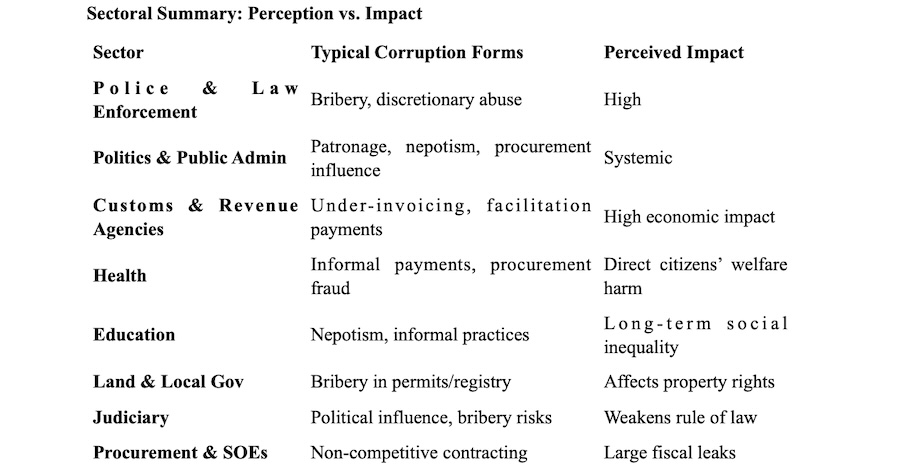
Why Sector-Level Analysis Matters
Understanding which sectors are most vulnerable helps explain why Sri Lanka’s CPI scores remain low. Corruption is not confined to isolated agencies but woven through core governance, revenue, and service delivery functions. Tackling these issues requires targeted reforms — such as:
• Strengthening independent oversight bodies.
• Enhancing transparency in procurement and licensing.
• Reforming police and customs practices and
• Ensuring merit-based recruitment and accountability in education and health systems.
Major anti-corruption reforms and initiatives in Sri Lanka
It is worthwhile to have a comprehensive look at major anti-corruption reforms and initiatives in Sri Lanka, how they’ve been evolving, and how they tie back to changes in the CPI and broader governance outcomes.
1. Updated Legal Framework: Anti-Corruption Act & Related Laws
Anti-Corruption Act, No. 09 of 2023
This law was a major overhaul of Sri Lanka’s anti-corruption legislation, consolidating prior statutes and expanding the powers of the Commission to Investigate Allegations of Bribery or Corruption (CIABOC). It broadens CIABOC’s authority to investigate more types of corruption, including private sector bribery and trading in influence. It also includes asset and liability declaration requirements for public officials, designed to improve transparency and make illicit wealth easier to spot.
Election Expenditure Act, No. 03 of 2023
Introduces limits and reporting requirements for campaign spending in elections — a critical step in reducing undue influence and “money politics” which often fuels corruption. This helps improve transparency in political financing and reduces opportunities for vote-buying or excessive expenditures linked to bribery.
Other Enabling Legislation
Proposed and developed laws such as a Proceeds of Crime Act to strengthen asset recovery and regulations to require disclosure of beneficial ownership by companies further close corruption loopholes and align with international standards.
2. Institutional Strengthening
Commission to Investigate Allegations of Bribery or Corruption (CIABOC)
CIABOC is the central anti-corruption body in Sri Lanka. Recent reforms have enhanced its mandate, resources, and investigatory powers, including authority for surprise audits and pre-investigation asset freezes.
National Anti-Corruption Action Plan (2025–2029)
Launched in April 2025, this plan is a multi-year roadmap to coordinate reforms across government, strengthen governance, and promote accountability. Its objectives include better rule of law, expanded civil society engagement, and more robust transparency mechanisms in public life and procurement.
IT-Enabled Tools for Transparency
CIABOC has rolled out a digital case-file tracking system to modernise investigation workflows, reduce delays, and support transparent case management. Other planned digital tools include an e-Asset Declaration platform, enhancing real-time transparency of official financial disclosures.
3. Right to Information, Transparency and Civil Society Monitoring
Civil Society Reports & UNCAC Monitoring
Transparency International Sri Lanka (TISL) has produced independent assessments of Sri Lanka’s compliance with the United Nations Convention Against Corruption (UNCAC). These reports highlight progress (e.g., new laws, institutional reforms) and remaining gaps — particularly in enforcement, resource constraints, and proactive disclosure by public bodies.
Action Committees & Coalitions
New coalitions including civil society, watchdog organisations, and community groups are advocating for right-to-information laws, stronger parliamentary oversight, and whistleblower protections, which are essential to sustainable governance reforms.
4. Enforcement and Political Accountability
High-Profile Investigations
The encouragement of investigations into former officials and high-level cases (e.g., Central Bank bond scandal and other procurement irregularities) indicates an intention to enforce accountability. Notably, a former president was arrested in 2025 amid scrutiny over alleged misuse of public funds — a symbolic shift toward holding powerful individuals accountable, though outcomes are still unfolding.
Public Service Reform
Political leaders have emphasized removing political interference from enforcement processes and demanding greater compliance within the public service.
5. Integration with Economic and IMF-Linked Governance Reforms
As part of IMF-supported economic programs, Sri Lanka has committed to strengthening public financial management, tax transparency, and procurement systems — reforms that implicitly support anti-corruption goals by reducing discretionary spending and closing governance gaps. External actors (like the IMF) emphasise the importance of governance, transparency, and prudent fiscal practices alongside macroeconomic stability, signalling that anti-corruption reforms are part of broader structural reforms.
Sri Lanka’s notable 14-place rise in the CPI (2025) — from 121 to 107 — suggests that recent reforms may be improving perceptions of corruption risk, especially in public sector transparency and enforcement. These reforms address key drivers of corruption perceptions: legal authority, transparency, institutional independence, digitalisation, and enforcement aspects that many CPI contributors (business leaders, experts) consider when scoring countries.
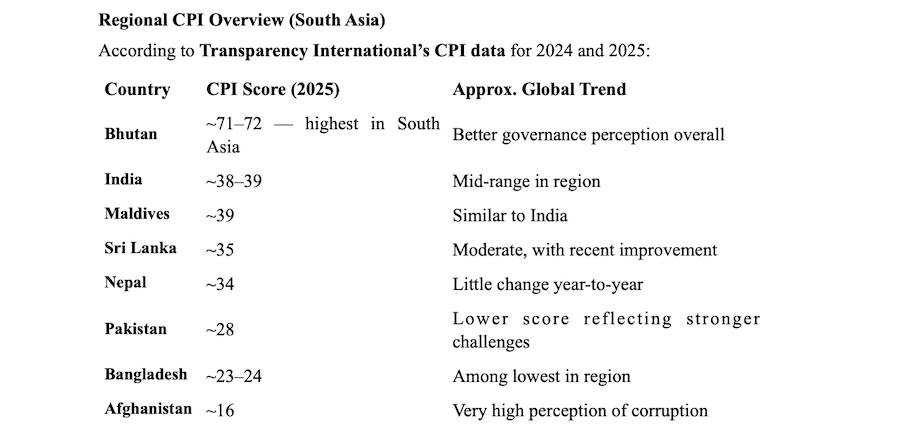
We may compare Sri Lanka with other Sout-Asian nations to see the progress.
Screenshot
Except for Bhutan, South Asian countries generally score below the global average (~42–43), indicating widespread governance and corruption issues across the region.
Remaining Challenges for Sri Lanka
Despite progress, independent assessments (like those from civil society) point out gaps that could undermine impact. These include
Weak enforcement may be an issue for the country. Strong laws are only effective if consistently applied. Just because of we have laws, that doesn’t mean everything is good. Institutional capacity and political interference continue to limit anticorruption agencies. These issues need to addressed effectively. Proactive disclosure and public access to information remain uneven in practice.
*Dr Piyadasa Edirisuriya, Former Academic, Monash Business School, Australia; email: pedirisuriya@gmail.com