


By Asoka S. Seneviratne –

Prof. Asoka.S. Seneviratne
“The Stone Age did not end because the world ran out of stones, and the Oil Age will not end because we run out of oil.“ ~ Sheikh Ahmed Zaki Yamani
Sri Lanka is a nation caught in a tragic paradox. We are currently facing the most severe energy crisis in our history—marked by frequent supply disruptions, rising prices, a dangerous reliance on costly, polluting heavy fuel oil (HFO), and significant foreign exchange shortages that make importing coal a constant challenge. However, just under 100 kilometers offshore, beneath the tranquil waters of the Mannar Basin, lie proven, world-class natural gas deposits.
The gas is there. In 2011, Cairn India struck gas in two exploratory wells (Dorado and Barracuda), confirming a working petroleum system. Numerous independent assessments have since validated that the Mannar Basin has the potential to transform Sri Lanka from an energy importer to a net exporter. Yet, fourteen years after that first flare was lit, not a single cubic meter of gas has reached our shores. From many points of view, this is a tragedy. While we remain paralyzed by bureaucratic red tape and an inability to attract a single major investor—as confirmed by the 2026 National Audit Office—nations like Guyana, Ghana, and Senegal have soared. They didn’t just find resources; they found the political will to exploit them. This article explains that Sri Lanka should learn lessons from the rest of the world in order to do the right thing at the right time now.
1. The Capital Trap: The High Cost of “Protecting” Zero
The first uncomfortable truth policymakers must accept is that offshore deep-water exploration is an extraordinarily high-risk, capital-intensive industry. A single exploratory well can cost upwards of $180 million. A full field development plan requires $5 to $10 billion in upfront capital (CAPEX). Indeed, given the current situation facing Sri Lanka, this is massive. At the same time, we must be strategic & insightful as well.
In other words, for Sri Lanka, navigating a complex debt restructuring cannot afford this. We are entirely dependent on Foreign Direct Investment (FDI) from “Supermajors” like Shell or ExxonMobil. However, we suffer from a lack of “Investment Gravity.” Investors are not looking for gas; they are looking for a stable 30-year fiscal environment. Historically, we have demanded a massive “Government Take,” thinking we are protecting our sovereignty. But in the brutal reality of energy markets, 80% of a project that never starts is mathematically zero. The following information is convincing: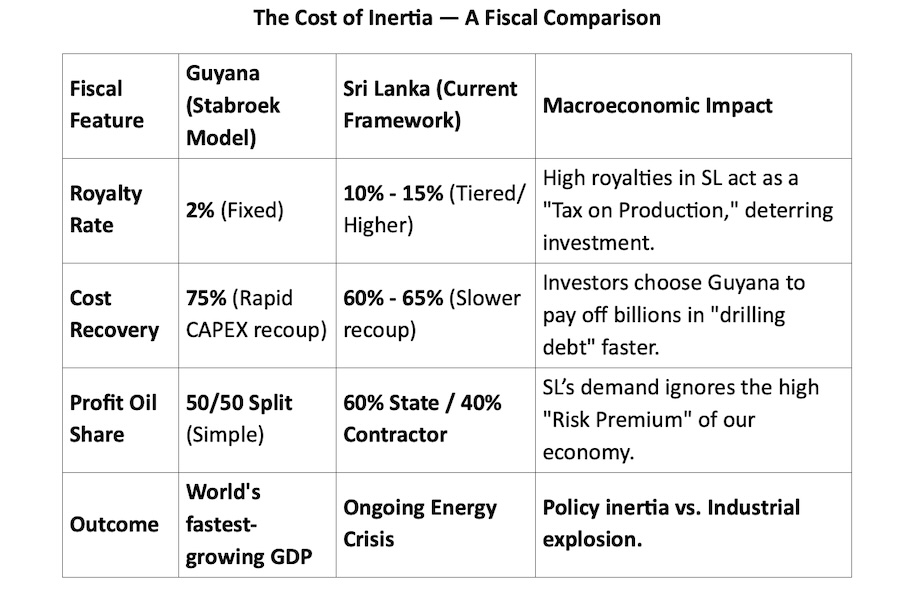
We must stop prioritizing the theoretical value of the gas and start prioritizing the actual flow of investment. A moderate share of a billion-dollar production stream is infinitely more valuable in many ways than a “perfect” contract that no one will sign. This means reality on the ground is more convincing than otherwise.
2. The Export Dichotomy: Protecting Tea and Garments
A common question arises: “If we export gas and billions of dollars flow in, isn’t that purely good?” Not necessarily. This brings us to the Export Dichotomy. It is a counterintuitive phenomenon where a sudden surge in one export (gas) can kill traditional sectors like tea, rubber, and apparel.
When gas dollars flood our economy, the demand for the Rupee skyrockets, causing its value to appreciate sharply. While a “strong Rupee” sounds patriotic, it makes our tea and garments more expensive for foreign buyers. If a Sri Lankan t-shirt suddenly costs $20 instead of $15 because of currency shifts, global buyers move to Vietnam. This “Dichotomy”—a booming energy sector alongside a collapsing manufacturing sector—is the “Resource Curse.” To prevent this, we must not spend the gas dollars directly into the domestic economy; we must “sterilize” them through a Sovereign Wealth Fund.
Examples, Botswana (Pula Fund): Created specifically to manage revenue from diamond exports. By investing these foreign earnings offshore, Botswana prevents the local currency (Pula) from appreciating, protecting other sectors like agriculture and manufacturing. Russia (National Wealth Fund/formerly Stabilization Fund): Originally created to sterilize petrodollar inflows, the fund prevents excessive appreciation of the ruble and serves as a buffer against oil price volatility. Timor-Leste (Petroleum Fund): The fund holds petroleum revenues offshore to manage exchange rate pressures and prevent appreciation, allowing for the sustainable development of its non-oil economy.
3. The Chicken-and-Egg Dilemma: The FLNG “Supermarket” Solution
The FLNG means Floating Liquefied Natural Gas. It refers to a revolutionary offshore facility designed to extract, liquefy, store, and transfer natural gas directly over an offshore field, eliminating the need for long pipelines to land-based processing plants. Our greatest strategic error has been linking development strictly to domestic consumption. The logic of “find gas, build a pipeline to Kerawalapitiya, and convert our plants” is a classic economic “Catch-22.”
Think of it like building a massive, high-end supermarket. No developer will spend billions to build it if the only customer allowed is one single, cash-strapped neighbor (the CEB) who may not be able to pay the bill. Global giants need an “AAA-rated” buyer to justify a $5 billion investment. To break this, we must adopt Floating Liquefied Natural Gas (FLNG) technology—essentially a factory on a ship that processes gas at sea for sale to the global market (Europe or Japan) for immediate USD revenue.
The ‘Export-First’ strategy separates gas development from Sri Lanka’s internal economic problems. By using FLNG technology, the investor secures ‘AAA’ global buyers from the start, making the project financially viable despite local liquidity issues. Think of it as a ‘Portable Supermarket’: if the immediate neighbor (the CEB) can’t pay, the ship simply sells its product to the global market (Europe or Japan). This allows international revenue to cover the $5 billion infrastructure cost. Once the initial investment is recovered, Sri Lanka benefits from the ‘overflow’—accessing its own natural gas at a much lower cost without taking on heavy national debt.
4. What is a Sovereign Wealth Fund? The “Bird-in-Hand” Mechanics
To manage the Export Dichotomy, Sri Lanka must implement a Sovereign Wealth Fund (SWF). Think of a SWF as a “National Savings Account” that belongs to all citizens, including those not yet born. It is a technically robust stabilizer that works through three mechanisms:
Sterilization: Instead of letting gas dollars enter our local banks and drive up the Rupee’s value, we keep 70% of the revenue offshore, invested in global stocks and gold. This keeps our local tea and garment sectors competitive.
The “Bird-in-Hand” Rule: The government is prohibited from spending the “principal” wealth. We only spend the interest earned from the fund. This ensures the gas—a depleting asset—is converted into a perpetual financial endowment.
Stabilization: When global energy prices crash or we face a disaster (like a cyclone or pandemic), the fund provides a liquidity injection to protect social safety nets without needing high-interest emergency loans.
5. Policy Inertia vs. The 2030 Stranded Asset Clock
The central crisis of our energy future lies in the haunting reality that we may soon possess a vast resource of gas but find ourselves in a desert of investment. While the Mannar Basin holds physical wealth, the global “Stranded Asset Clock” is ticking toward a 2030 deadline where fossil fuel reserves risk becoming unrecoverable, not by depletion, but by financial abandonment. Major global lenders have already erected a “Financial Border” through strict Environmental, Social, and Governance (ESG) mandates, transforming what we view as a “timeless treasure” into a prohibited legacy asset that no reputable bank will touch. Every day spent in legislative debate over the Petroleum Development Authority (PDA) structure is a day the “Risk Premium” for Sri Lanka climbs, pricing us out of the market and leaving us to negotiate with predatory “vulture” investors who thrive on our desperation. We are racing toward a “Debt-Asset Trap” where our policy inertia acts as a dam, diverting billions in capital to more decisive nations and leaving us with a resource that is worth everything to our national pride but nothing to a world pivoting toward Green Hydrogen. If we do not treat this administrative delay with the same existential urgency as a sovereign debt default, we will eventually find ourselves standing over a goldmine in a world that has stopped using gold—holding an obsolete asset that serves only as a monument to our own indecision.
6. Institutional Capacity: Building the “Nervous System.”
Investors seek a specialized, empowered “One-Stop Shop.” Unfortunately, such an entity does not exist in Sri Lanka. Ghana succeeded by establishing an independent Petroleum Commission, designed to be led by individuals who could bridge the gap between international industry standards and local governance. Dr. Kwabena Donkor, the first CEO, was the central figure in the Commission’s founding. He brought significant expertise in energy policy and played a key role in establishing the “world-class regulator” vision. He focused on recruiting Ghanaians from the diaspora who had worked with global giants like Shell, BP, and Exxon Mobil—insulated from politics and staffed with global experts—a good example to follow. In Sri Lanka, responsibility is spread across ministries, political task forces, and local authorities, leading to a loss of institutional memory. We need a professional body capable of issuing licenses and enforcing regulations without waiting months for a Cabinet sub-committee once it has been primarily approved by the Cabinet. In short, after Cabinet approval, an implementation strategy or plan is essential. Given these priorities, the “One-Stop Shop” for the Manner basin project must be anchored in the newly established Chief of Staff of the Office of the President, enabling the President to expedite the project as a top priority.
Executive Summary & Strategic Roadmap for Policymakers
The Status Quo: Sri Lanka is currently sitting on a “dead asset.” The 2026 Audit proves our approach has failed. The opportunity cost is mounting in billions of lost GDP.
Recommendations:
20-Year Non-Partisan Energy Covenant: Legislate a “Stability Pact” signed by all parties to guarantee contract terms for 20 years.
Export-Led Master Plan (FLNG): Pivot to global exports to unlock immediate FDI.
Digital ‘Open-Data’ Bid Round: Market our 3D seismic data directly to “Supermajors” via a global digital platform.
Fiscal Realism: Align our royalty terms with Guyana to become “investable” again.
Pre-emptive SWF Legislation: Pass the Sovereign Wealth Fund Act before the first well is drilled.
Conclusion: The Strategic Ultimatum
The natural gas of the Mannar Basin is not merely a resource; it is Sri Lanka’s last great engine for macroeconomic survival, along with about US$37 billion foreign debt. We stand at a definitive crossroads: we can either leverage the FLNG “Export-First” model to fund a century of prosperity, or allow this wealth to become a tragic footnote of missed potential.
This is no longer a matter of policy preference—it is a mathematical necessity. The global energy landscape is shifting rapidly toward decarbonization. If we do not monetize these assets now, we risk leaving billions of dollars of “stranded assets” under the seabed while our nation continues to borrow for its energy needs. By adopting the FLNG “Supermarket” solution, we bypass our internal credit struggles, invite global capital to build our infrastructure, and finally secure energy sovereignty. The clock is ticking. We must let the global market pay for our future today, or we will be forced to pay the price of our indecision for generations to come. The window is open, but it will not stay open forever.
*The writer, among many, served as the Special Adviser to the Office of the President of Namibia from 2006 to 2012 and was a Senior Consultant with the UNDP for 20 years. He was a Senior Economist with the Central Bank of Sri Lanka (1972-1993). He can be reached at asoka.seneviratne@gmail.com
LankaScot / March 26, 2026
Hello Prof. Seneviratne
Much as I would like to suggest a European Company for solving the Mannar Deep water Issues, American Companies with decades of experience in various parts of the World are as good as any.
Halliburton is one of the better known –
https://www.halliburton.com/en/completions/well-intervention-and-diagnostics/subsea-completion-interventions-systems
I have seen most of the Publications regarding Cairn’s findings and do not recall any that give a realistic estimate of the likely size of the Reserves and the potential Revenues to be expected.
Now if the US and Israel succeed in destroying the Middle East Oil and Gas Fields, then Mannar may turn out to be viable.
Sri Lanka can divide up the Offshore EEZ with as many blocks as it likes, but if no-one is willing to do modern Subsea Seismic Surveys or drill some more Exploration Wells (Wildcats) then it is money wasted.
Best regards
/
Ariya / March 26, 2026
This is certainly an exciting and compelling proposition. However, it is important to remain mindful of the associated environmental and social costs — from potential ecosystem degradation and pollution to longer term climate and community impacts. The area in question appears to be environmentally sensitive, and local communities depend heavily on fishing for their livelihoods.
Given these factors, the assessment needs to extend beyond purely economic and financial considerations. I am interested to know whether a broader cost–benefit evaluation has been undertaken, incorporating input from key stakeholders and examining how other countries have mitigated similar adverse effects.
/
Mallaiyuran / March 30, 2026
LankaScot,
Last time, LankaScot brought a report on Mannar Oil and posted it. The report explicitly stated that significantly more funds are required to confirm the viability of further exploration. In CT, it is common for individuals to engage in debates without thoroughly reading the material. For successful investment, quantity, quality, and a conducive political environment are essential. Investors are unlikely to risk their hard-earned money on uncertain ventures, such as betting on a bottle of used oil.
The first “Socialistic game” in Langkang was introduced by Don Stephen and SWRD within the Estate industry. They deceived Britain in a manner similar to the wedding custom of “showing the pretty Nangi and successfully give out poor looking old Akki.” As a result, Britain vacated several strategic assets, including Up Country tea and rubber Estates, Trinco Harbor, China Bay Airport, and the Oil Farm. Chavo did it to America and Maduro paid for it by rotating the griding stone inside the prison. If Langkang had informed Britain of their intention to sever ties and establish the “Sinhala, Buddhist, Socialistic Republic Constitution,” Britain might have charged Don Stephen for the nationalized assets.
Langkang invited a Singapore ship that was leaking nitric acid and was at risk of sinking. Lacking insured repair facilities, Gothapayal brought the ship in for repairs. When the ship sank, Langkang blamed Singapore and demanded $2 billion for environmental damages
/
Mallaiyuran / March 30, 2026
However, the Singapore court only imposed a court fee on Langkang and did not entertain any further claims.
Langkang’s industrial and business laws are widely recognized, making it difficult to obscure their influence or consequences, even metaphorically “inside a plate of rice.” This is reflected in a Sinhalese saying: “Like the way Sinhala Buddhists show the path of Kotte to Paranki.” The phrase refers to the historical event where Sinhala Buddhists attempted to cheat the Portuguese Navy from seeing the Kotte Palace. In Kandy, captured and handed over their own Kandy Tamil King to Britain, subsequently signing the Kandy Accord. Over time, there were repeated attempts to break away from colonial rule, including rebellions against the colonialists.
• They an invited Rajiv and attacked with a gun, and it was claimed that the intention was to harm or kill the Indian Prime Minister.
• In a more recent incident, a bank Letter of Credit (LC) was signed to import Poop from China. When port authority laborers refused to unload the shipment, attempts were made to cancel the LC and return the ship to China. This action resulted in People’s Bank being blacklisted for not paying for LC.
• The Langkang’s only honestly elected NPP government refused to pay the agreed price for green energy purchases, leading Adani to terminate all contracts with Langkang.
/
Mallaiyuran / March 30, 2026
• The so-called “Evil Emperor” signed a contract with New Forest Energy Company to import ship processed LNG. However, Gothapayal canceled the contract.Despite various archaeological evidence cited, there is no extractable oil or gas in Mannar. Greatness here is the Colombo Media, every day revise the narration to make it more interesting tale and rewrite it. The Mannar oil invention by Siri Ma O was only because SLV had kept pressing Banda to recognize the Tamils as the beneficiaries of Tamil area wealth. Banda – Chelva pact, and Indo – Lanka pacts accepting it as reasonable negotiation. Siri Ma O wanted to show the Kottai to Tamils on returning their stolen sovereignty, so she discovered the oil in Mannar, instead of Hangbangtota. Now NPP government was pushed around by Champika, Lemon Puff Veeraya, Valaiththodam, Rear Admirable, and other hardcore SinhaLE Veerayas. So now they denied America the planes landing right but allowed Iran to berth its War ship. They created story that the Iranian ship was damaged that is why they took the ship inside, and claimed, but American planes were in condition to fly so they didn’t need Langkang’s support. These guys cheating America with a fake damage report to get some extra money from Iran. America just now gave NPP 10 ships. So now NPP showing Kottai to America too, in line of Portuguese, Tamils, and India.
/
Mallaiyuran / March 30, 2026
Siri Ma O sought to appease the Tamils by symbolically returning their stolen sovereignty, leading to the supposed discovery of oil in Mannar rather than in Hangbangtota. This was a strategic move designed to showcase the “Kottai” to the Tamils, reinforcing the narrative of restitution.
The current NPP government has faced significant pressure from figures such as Champika, Lemon Puff Veeraya, Valaiththodam, Rear Admirable, and other staunch SinhaLE Veerayas. In a contentious move, the government denied America permission for its planes to land but allowed Iran to berth its warship. A story was fabricated claiming the Iranian ship was damaged, justifying its entry, while asserting that American planes were fully functional and did not require Langkang’s support. The ruth All Iranian ships were coming from Kerala, India. It was cost side navigation if there were any damages to the ship in that short while, they may have called India first, because India is many more times well equipped to repair a ship and put it back on route than the empty Langkang.
This maneuver was an attempt to deceive America with a fraudulent damage report, aiming to extract additional funds from Iran. Meanwhile, America has recently provided the NPP government with ten ships, prompting NPP to employ the “Kottai” strategy with America, similar to historical interactions with the Portuguese, Tamils, and India.
/
Lester / March 26, 2026
The author has a good imagination. A SWF is not feasible while borrowing from the IMF. A better solution, as I have suggested before, is for the government to give citizens access to global capital markets, particularly the US stock market. This would be the equivalent of injecting foreign liquidity into domestic markets. It would have a similar effect as foreign remittances from the Middle East, except this could be implemented much more easily.
The other suggestion is for Sri Lanka to begin a small arms export industry. Iran is able to put up a good fight using just drones and missiles.
/
Mallaiyuran / March 30, 2026
The poor understanding of the economy of Author is he describing if the Oil Industry pickup, all others must go down. If the Oil industry is doing well and attract number of labor, all the industries in the country would need more automation. This will make the production cost cheap and same time the owner getting higher profit.
/
old codger / March 26, 2026
“When gas dollars flood our economy, the demand for the Rupee skyrockets, causing its value to appreciate sharply. While a “strong Rupee” sounds patriotic, it makes our tea and garments more expensive for foreign buyers. “
That’s why Venezuela was never as rich as Dubai.
For a change, Professor ASS has taken to talking real economics rather than JVP economics.
/
SJ / March 30, 2026
“The Stone Age did not end because the world ran out of stones, and the Oil Age will not end because we run out of oil.”
It is stupid not even funny.
/