

By Jehan Perera –
Jehan Perera
The passing of Dr. Devanesan Nesiah a few days ago brought back memories that spanned more than four decades. Devanesan signed the witness register at my marriage in 2002. It was a year of hope. The Ceasefire Agreement between the government and the LTTE had brought a respite from a war that had devastated the country for nearly two decades. The possibility of peace seemed real. It was fitting that Devanesan should be present on that occasion because his entire life was dedicated to building bridges across divides and seeking rational and humane solutions to conflict. He was a friend, mentor, and guide whose life embodied values that Sri Lanka, indeed the world, needs today.
Devanesan Nesiah
In reflecting on Dr. Nesiah’s life, we need to be reminded that the forces that unite us as a people in Sri Lanka are stronger than those that divide us, and that the bonds of human affection can transcend even the deepest divisions of ethnicity, history and politics. I first met him in 1984. I had just had my very first newspaper article published in the Jaffna-based Saturday Review. The editor was Gamini Navaratne, a Sinhalese. This was a reminder that even during the darkest period of ethnic conflict, the bonds between communities remained strong. The article I had written was based on my encounters with the anti-Tamil violence of July 1983.
At that time, Dr Nesiah was the Government Agent of Jaffna. Tens of thousands of Tamil people who had fled violence in the south had been transported to the north by a government that had failed to protect them. He came up to me at an event, introduced himself, and told me that he liked what I had written. He also said that he would soon be leaving for Harvard University’s Kennedy School of Government and that we could meet there. Over the next three years, Devanesan and his wife Anita adopted me into their family. I used to visit them two or three times a week, not only to be given meals by Anita but to discuss matters with Devanesan. These included the academic papers and newspaper articles that were written. Later, Anita earned her PhD in religion and served on the boards of many civic organisations, including the National Peace Council.
Practical Solution
In 1992, we had both returned to work in Sri Lanka when Devanesan invited me to accompany him to Jaffna to celebrate the eightieth birthday of his father, K Nesiah, the distinguished educationist affectionately known as Professor Nesiah. The older Nesiah had been a leading member of the Jaffna Youth Congress. This remarkable movement championed complete independence from British rule, national unity, and the eradication of social inequalities based on caste and communal identity. At a time when many feared that independence would lead to majoritarian domination, the leaders of the Youth Congress chose instead to place their faith in a shared Sri Lankan future. They believed that people from different communities could build a common nation while preserving their distinctive identities. So did Devanesan. This vision remains relevant today. It needs to be actualized.
The tragedy of Sri Lanka’s post-independence history is not that diversity exists. Diversity exists in every society. The tragedy is that we often allow diversity to become a source of fear, though we share many of the same values of family, hospitality, respect for elders and compassion towards others. During our visit to Jaffna in 1992, we met representatives of the LTTE administration, including Raheem. The discussion turned to the controversial issue of merging the Northern and Eastern Provinces. Dr Nesiah argued that if the merger could not be achieved due to political opposition, it might be more rational to seek greater powers for provincial councils instead. Raheem disagreed. Devanesan was interested in finding practical ways to achieve justice and coexistence. That was characteristic of him.
Devanesan Nesiah was a student of conflict and strategy. He became a doctoral student of Professor Thomas Schelling, who would later receive the Nobel Prize for his pioneering work on conflict and cooperation. Schelling’s insight was that even in the midst of conflict, there are usually common interests that adversaries share. Even adversaries locked in a struggle usually depend on each other for the outcome they each want. The challenge is to identify those common interests and build upon them. Conflict is not simply a contest between enemies. It is also a search for ways to coexist. Together as students and peace practitioners, we applied those theories to the Sri Lankan context to understand what was going on and to share that understanding with the Sri Lankan people.
Rational Empathy
Dr Nesiah spoke his mind, truth to power. He was a man of logic, rationality, and principle. His integrity came at a cost. His public service career experienced many ups and downs because he refused to accommodate irrational or corrupt demands. There were periods when he was sidelined into that administrative limbo known as the “pool” and assigned no substantive responsibilities for refusing to give in to political demands. Like the rest of his larger family, most notably the Hoole family of Jaffna, he would not abandon his principles. In 2018, to protest the action of President Maithripala Sirisena in sacking the then government he returned his Deshamanya Award (Pride of the Nation) national civil honour. The president’s undemocratic decision was soon thereafter overturned by the Supreme Court as being unconstitutional. Devanesan’s commitment was not to personal advancement, but to what he believed was right.
My wife Sumadhu recalls a story he told her. One day, while travelling on official duty, he told her how he had seen a thalagoya, a monitor lizard, trussed up and being taken away for slaughter. The sight of the creature’s suffering affected him deeply. He said he saw tears in its eyes and described the moment of awakening. From that day onwards, he gave up eating the flesh of animals. The story brings to mind the biblical story of the conversion of St Paul on the road to Damascus and the Buddhist exhortation, “May all living beings be well and happy.” But the deeper significance lies not in religious comparison. It lies in the awakening of empathy.
That was the essence of Dr Devanesan Nesiah’s worldview–to treat all life as being one.The prejudices that society often imposes through ethnicity, religion, caste, or gender had little hold on him. He saw them as human constructs that often served to privilege some while excluding others. Such were his values that made him an extraordinary human being. Dr. Nesiah lived according to that understanding. He showed that integrity can survive amidst conflict. He reminded us that reason and compassion are not opposites but partners, that what unites us as Sri Lankans inhabiting our common island home has always been greater than what divides us, and we need to build our institutions accordingly. I am proud that he was my friend. I am grateful that he was my mentor.
Nathan / June 16, 2026
… believed that people from different communities could build a common nation while preserving their distinctive identities. So did Devanesan. This vision remains relevant today.
The vision remains relevant, yet elusive.
/
Ajith / June 16, 2026
“Such were his values that made him an extraordinary human being. Dr. Nesiah lived according to that understanding.”
Not only Dr Nesiah but also all the Tamils whether it is a diaspora Tamil or any other Tamil militant groups wants to live under united Sri Lanka with the respect and understanding of the principle of justice and equality. We have already lost people like Dr. Nesiah and many other well educated, highly knowledgeable peace loving talented people. Now the country is filled with drug mafias only. Will it come out of it is a question?
/
SJ / June 17, 2026
“all the Tamils whether it is a diaspora Tamil or any other Tamil militant groups wants to live under united Sri Lanka”
Really?
So what was VP up to?
What was the TULF up to?
And what was the Vaddukkoddaii Resolution about?
/
Kumar / June 18, 2026
So what was VP up to? VP was a criminal. As MS Narayanaswamy described in his book ‘An Elusive Mind’ VP, was a ‘grade 7 dropout cycle thief’. Tamil politics paved the way for VP to hide his criminal activities and to live a luxury life under shade of Tamil nationalism.
What was the TULF up to? Winning the next election was their main idea. How? Raise Tamil nationalism while praising the Tamil militants as heroes!!
And what was the Vaddukkoddaii Resolution about? This was a permanent path to that party to emotionalize the people and to win every election.
/
Nathan / June 18, 2026
There is a good abode for you in at cost to the Govt. only!!
/
Rohan25 / June 19, 2026
Relying on a single book by Narayanaswamy to dismiss decades of documented history is a massive logical failure. You cannot use one author to wipe away the UN-investigated war crimes, structural genocide, and ethnic cleansing committed by the Sri Lankan state on the island’s Tamils, from the time of independence. It is absurd to claim an entire state military—with tanks, jets, and international backing—was solely terrorised by a ‘cycle thief’ for thirty years. Furthermore, your history conveniently ignores the state-sponsored marginalisation, denial of land rights, and destruction of education that forced Tamils into war, when all other avenues to obtain their just rights peacefully failed. If the LTTE killing 3,500 civilians is a war crime, then the state deliberately targeting and killing over 175,000 Tamil civilians is an undeniably greater one. The true cause of this conflict, and the nation’s eventual bankruptcy, is not Tamil rebel history, but the systemic Sinhalese-Buddhist racism whipped up by politicians since independence to gain power
/
Rohan25 / June 19, 2026
Living in underground bunkers and fighting in the jungles is the exact opposite of a luxurious life. It is a brutal, unforgiving existence. If you truly believe that hiding in muddy jungle bunkers and dodging artillery is a ‘luxury,’ I highly recommend you and author Narayanaswami trade your current lives for it. Meanwhile, your own Sinhalese army generals seemed to prefer the actual luxury of air-conditioned mansions, while others bled
/
Rohan25 / June 19, 2026
Only a deep sense of denial could mistake jungle warfare and bunker survival for luxury. Calling Tamil suffering a ‘luxury’ is a bizarre delusion. Tamil civilians faced a brutal, unforgiving reality, while your army generals enjoyed true comfort. Let’s not confuse immense suffering with privilege.
/
Ajith / June 19, 2026
“So what was VP up to?
What was the TULF up to?
And what was the Vaddukkoddaii Resolution about?”
My dear Buddhist Sinhala special status Buddhist SJ,
You have lost your memory about the period before 1977, all this happened after 1958 massacre, after Sinhala only, special status to Buddhism which is SJ master mind success. Were you part of 1958? Were you not part of special status to violent Sinhala Buddhism?
/
Jit / June 16, 2026
I have met Dr Nesiah only once, back in 1994, on an official matter when he was serving as a Ministry Secretary — though I can’t recall which Ministry now. What stayed with me wasn’t the office he held, but the man himself. He was humble, charismatic, and genuinely down‑to‑earth, quite unlike most Secretaries of that era. He handled what I needed in no time and still found space for a warm, unhurried conversation.
That brief encounter left a lasting impression of someone efficient, modest, and deeply humane. That is what matters to me. I don’t believe in god, religion, or an afterlife, but I do hope he had a good life, a great family and now is at rest—free from all the noise and nonsense that we are going through now.
/
Nathan / June 16, 2026
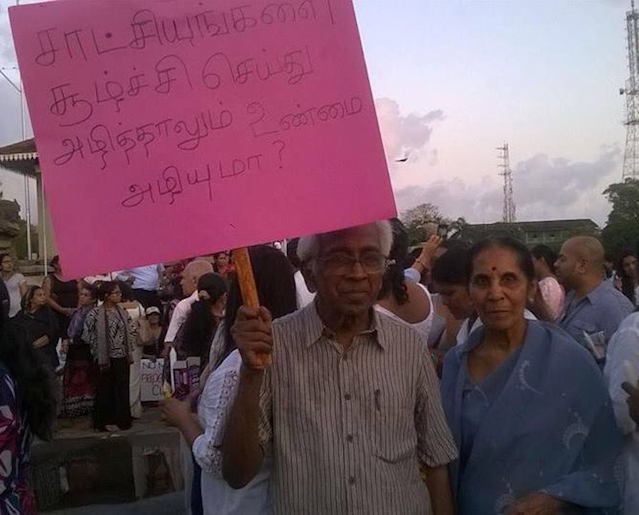
The placard reads:
Will Truth be destroyed, even if evidences are destroyed by manipulation,
/
SebastianSR / June 16, 2026
“Not only Dr Nesiah but also all the Tamils whether it is a diaspora Tamil or any other Tamil militant groups wants to live under united Sri Lanka with the respect and understanding of the principle of justice and equality. “
The above, viz., is simply not true. Look at the pronuoncements of the leaders of the three Tamil Parties GajenPonna, Wigneswaran, and Sivagananm and Dharmalingam for TNA. (i) According to The Guardian, the TNA abandoned demands for an independent Tamil Eelam in 2010 but at every MUlliavaikkal celebration we hear the opposite. These leaders sow distrust to eliminate any possibility of federalism. People like Jehan Perera decline to see this.
GajenP uses the term “Eelam Tamil nation” during his speeches, an indigenous nation in the North and East. This nation claims inherent right to self-determination. Wigneswaran pays lip seviced to unity and uses highly charged nationalist rhetoric. He refers to Tamils as the “indigenous and original owners of this land” while the Sinhala are late comers, an that ancient Sri Lanka is a Tamil Shiva state. Wigneswarna calls the kettle black saying that “Sinhalese maintain an ethnic prejudice” that blocks giving self-governance to Tamils.
/
Rohan25 / June 17, 2026
Your comment oversimplifies Sri Lankan politics by lumping all Tamil politicians together. There is a vast difference between demanding a separate state and seeking federal self-governance. The Tamil National Alliance. The main Tamil party, which officially represents the aspirations of the vast majority of the island’s North East Tamils, officially rejected separatism over a decade ago. They advocate for internal self-determination and provincial autonomy within a united Sri Lanka. Citing figures like Gajen Ponnambalam or C.V. Wigneswaran to represent all Tamils is misleading. They lead distinct parties with their own specific platforms. Both Sinhala and Tamil politics contain a wide range of moderate and nationalist views. Requesting power-sharing and legal equality is not the same as demanding separation. Labelling an entire ethnic group as hidden separatists blocks real dialogue. Your arguments mirror the biased, one-sided narratives found on many extremist Sinhalese nationalist blogs, which distort history to promote a divisive agenda.
/
SJ / June 17, 2026
Little memory lapses help some stories sound credible.
/
Nathan / June 17, 2026
What is your agenda, SebastianSR?
/
Rohan25 / June 18, 2026
This person’s claim to be a Canadian Tamil is highly questionable. Although they display a strong command of the language, their aggressive promotion of a pro-Sinhalese nationalist agenda contradicts this identity. It is unlikely that a genuine Canadian Tamil would consistently echo Sinhalese majoritarian propaganda.
/
Ajith / June 17, 2026
“The above, viz., is simply not true. Look at the pronouncements of the leaders of the three Tamil Parties GajenPonna, Wigneswaran, and Sivagananm and Dharmalingam for TNA.”
“These leaders sow distrust to eliminate any possibility of federalism.”
These so called leaders are politicians who became leaders only after 2009 and not consistence with their demand for federalism. That doesn’t mean the Tamil people are against to federalism.
Federalism is a need not only for Tamil speaking people but also for Sinhalese speaking people as well. This is well proved why Sinhalese leaders misused the power in the name of Buddhism for past 78 years.
/
SJ / June 17, 2026
Separate states federate.
Rarely do regions of a country federate.
There can be autonomy without federation.
/
Rohan25 / June 18, 2026
Before British control, Sri Lanka comprised culturally distinct Tamil and Sinhalese kingdoms. So they were separate states or kingdoms. Initially maintaining this separation, the British unified the island under the 1833 Colebrooke-Cameron reforms purely for administrative convenience. This created a unitary state that dissolved traditional borders and laid the groundwork for future ethnic tensions, ultimately driving Tamil political movements to demand federalism or separate statehood.
/
Naman / June 17, 2026
“ the bonds of human affection can transcend even the deepest divisions of ethnicity, history and politics”
Did those ones who were buried
in “ Chemmani” see any kind of bonds of human affection before being slaughtered by the State Security Forces. It really hurts to the core what the heinous crimes the State did to its own citizens. These can NOT be forgiven or forgotten easily.
Bridges between the minorities and the Sinhala Buddhist supremacists is very hard to be built. Burning the Jaffna Library + massacres in the No Fire Zones in 2009 ++++
are all very unforgettable memories.
It will take an HUGE effort for a Sinhala Buddhist statesman to bring about the ethnic and religious RECONCILIATION. Should not the GoSL be compensated the victims over SEVERAL DECADES!
/
Naman / June 17, 2026
We didn’t have a Government over the last two decades but a Mafia Leader who threatened people who opposed them with torture and deaths.
They should be punished by SL judiciary.
/
Naman / June 17, 2026
GoSL should start documenting anonymous confessions by the government forces that was behind the war crimes. The forces that carried out it on the orders of their superiors should not be punished. Instead those gave orders to them should be punished at the earliest
/
Naman / June 17, 2026
It is soothing to read JP’s articles but they don’t go far to become real in SL civilian lives. What’s happening to Karuna /Douglas Devananda?
/
Nathan / June 17, 2026
Where is KP?
/
Ajith / June 17, 2026
“Where is KP?”
This question would have asked 15 years ago?So far no Sinhalese or Tamil politicians or media or journalists asked this question? KP is more powerful than ltte leader? The answer is simple. All are afraid of the rulers who are above the law?
/
The Truth / June 17, 2026
Very good idea !
One big happy family !
Leela will be my brother, OC our uncle and Mr. 25 our kid brother !
We cannot drop lovable Scotty . But how can we trace the bloodline ?
Maybe 25 can think of a theory. When a great Tamil leader occupied Scotland during the time of Rama ! There is a Tamilian twist to Scotty anyway .
How about Vedda ? A distant cousin with aboriginal connections !
/
Naman / June 19, 2026
Before September 2024, killings torture
Kidnappings rapes drug culture extortions were rampant under Rajapaksas and Ranil W.
For ALL Sri Lankan citizens sake, the current Government even with the “L” boards on their backs are mostly doing the RIGHT things. The Mafia Gangs needs to be jailed and do hard labour for all the sins they had committed.
Clamouring for the repeal of PTA AND for any type of Elections should not be entertained till the judicial cases against the crimes perpetrators and those who assisted them to do so.
Hope these will happen before the next Deepavali!
/
Lester / June 19, 2026
Like his mentor, Jehan P has made numerous attempts to downplay LTTE terrorism.
According to Nesiah, “While it needs to be emphasized that it would be incorrect to condemn an organization as terrorist unless terrorism is integral to its objectives, it could be argued that, based on their track record over the last two or three decades, all the armed services of the State and the allied armed groups, as well as the LTTE and allied armed groups are, to a greater or lesser degree, tainted with terrorism.”
” However, there is, as yet, no internationally accepted definition (of terrorism).”
“Terrorism is a controversial and subjective term with multiple definitions.”
Well, he is right on one point (Ex: Al-Jazeera). Even journalists can be terrorists: “Nearly everyone claims to be against terrorism, but even unarmed individuals and groups who favour or use – terror inspiring methods of governance or coercing government or community – are caught up within the dictionary definition of a terrorist. This will include politicians, journalists, community leaders and others who seek to legitimize terrorism”
Like Jehan, he pretends to be ambiguous and expects the State to do nothing. It was the ambiguity and appeasement of Chamberlain that led to WW2.
/
Lester / June 19, 2026
There are many similarities between Hitler and Prabhakaran.
“Above all, Prabakaran, governed by the discipline and victories of Hitler’s army, is trying to enforce the German army’s practices in to the training of the Thamil Eelam Tigers. He says it is because it was disciplined and firm [that] Hitler’s army has made victories its own.
The order was given that as the first part of the army training all being trained should salute as is done in Hitler’s army. Prabakaran who held in esteem the discipline and firmness of Hitler’s army, wanted the Thamil Eelam Tigers’ army to be its representative. I too did not reject it.”
https://www.colombotelegraph.com/index.php/hitlers-rejuvenation-of-germany-as-inspiration-for-prabhakaran/
What about the mental state? Hitler thought the Brits would eventually come round, they were in some sense a natural ally of the Germans. Prabhakaran also came to believe in unlimited appeasement from India and the Sri Lankan State. Using ceasefires as a pretext to re-arm for the next round of warfare.
Fascism may work in the beginning (political expediency), but at some point the State has to take a much harsher response. As we saw with Israel, which attempted to appease Hamas for many years.
/
NutsFirst SriLanka / June 20, 2026
“As we saw with Israel, which attempted to appease Hamas for many years.”
Totally agree, darling Lester.
We all know that Israel obliterated Iran in 2025, as you predicted. I hear the Iranians have turned into Arabs, also as you predicted.
/