


By Mahil Dole –

Mahil Dole
Sri Lanka never fails to surprise. At a time when the country grapples with organized crime, narcotics networks, financial fraud, and lingering national security concerns, a birthday cake inside a police station has managed to trigger outrage, disciplinary action, and even the attention of the Criminal Investigation Department (CID).
One is compelled to ask: Is this really the crisis confronting Sri Lankan law enforcement today? Or is this yet another example of institutional insecurity shaped by populism and amplified by social media hysteria?
The controversy stems from a police officer facilitating a birthday celebration for a suspect in custody. The optics, admittedly, are awkward. In an era where every action is recorded, uploaded, and weaponized online, such gestures can easily be misconstrued as favoritism or unprofessional conduct.
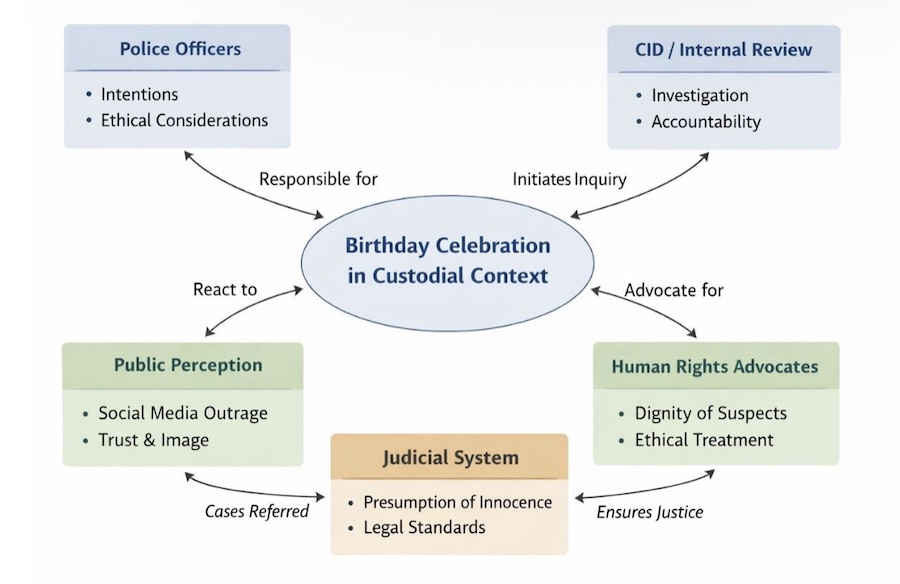
But the reaction swift condemnation, public vilification, and formal investigation reveals something deeper and more troubling: a policing culture increasingly driven by fear of perception rather than clarity of purpose.
Let us be clear. A suspect is not a convict. The principle of innocent until proven guilty is not a decorative phrase in our legal system; it is its foundation. Yet, in practice, we often treat suspects as though guilt has already been established stripping them not only of liberty, but of dignity.
In that context, is acknowledging a birthday an unforgivable act? Or does it simply challenge our deeply entrenched instinct to equate custody with dehumanization?
The real issue here is not the cake. It is the politicization of policing.
Over the years, Sri Lanka’s law enforcement institutions have been subjected to shifting political pressures, inconsistent leadership, and a reactive rather than strategic approach to public accountability. Officers are often left navigating a minefield: act with initiative and risk disciplinary action, or adhere rigidly to procedure and risk operational stagnation.
In such an environment, discretion becomes dangerous. And yet, policing particularly in areas such as intelligence and counterterrorism cannot function without discretion.
During the height of the conflict, when the stakes were far higher than social media criticism, policing required not just force, but finesse. I recall a case involving a high-value operative linked to suicide cadre training. For days, interrogation yielded nothing of substance. The suspect was trained, disciplined, and psychologically resilient.
Then came an unconventional decision.
It was during the New Year period. We discovered it was also his birthday. With due authorization, I obtained a cake, no small task given the holiday closures and brought it into the interrogation setting.
To the casual observer, this might appear as misplaced kindness. In reality, it was a calculated psychological maneuver.
The effect was immediate and profound. The suspect, who had maintained composure under sustained questioning, was disarmed not by force, but by unexpected humanity. Emotional barriers collapsed. Information flowed.
What followed was not symbolic. It was operationally decisive. He revealed details of suicide cadre operations and, crucially, the location of a cache of C-4 explosives hidden in the Hamilton Canal. The recovery of those explosives likely prevented attacks in Colombo and its suburbs. Lives unknown, uncounted were saved.
There were no press conferences. No social media posts. No public applause. In those days, intelligence work was guided by results, not optics.
Today, however, optics appear to have overtaken outcomes. The current controversy illustrates how quickly nuance is sacrificed at the altar of public outrage. Social media, while a powerful tool for accountability, has also become a court of instant judgment one that rarely accommodates context, intent, or professional judgment.
Institutions, in turn, respond not with measured leadership, but with reflexive action designed to contain criticism. This is a dangerous trajectory.
When police officers begin to fear public misinterpretation more than operational failure, initiative will die. And when initiative dies, so does effectiveness.
None of this is to suggest that police conduct should be immune from scrutiny. On the contrary, accountability is essential. If an officer’s actions compromise an investigation, violate procedure, or demonstrate bias, they must be addressed. But accountability must be informed, not performative.
An investigation launched merely to appease public sentiment risks sending the wrong message to the rank and file: that judgment, creativity, and even humanity are liabilities rather than strengths.
Sri Lanka’s policing challenges are too complex to be addressed through rigid formalism alone. Crime is evolving. Extremism is adaptive. Public trust is fragile. In such an environment, the police need more not less capacity for emotional intelligence, strategic thinking, and calibrated discretion.
The irony is striking. At a time when global best practices emphasize community policing, humane treatment, and psychological approaches to interrogation, we appear to be retreating into a model of policing defined by optics and overcorrection.
The lesson here is not that every suspect should be offered cake. It is that context matters. A gesture can be inappropriate in one setting and operationally brilliant in another. The difference lies in intent, oversight, and outcome not in the superficial appearance of the act.
If the recent incident was an ill-judged attempt at informality, it should be corrected with guidance and clarity. But if it was a genuine act of humanity that did not compromise the investigation, then perhaps the greater failure lies in our collective inability to recognize the value of such humanity.
Sri Lanka must decide what kind of policing it wants. One that is rigid, reactive, and driven by public pressure? Or one that is professional, confident, and capable of balancing discipline with understanding?
Because history and experience have shown that sometimes, the most effective tools in policing are not intimidation or force, but insight, empathy, and timing. And occasionally, even a birthday cake.
*Mahil Dole is a former senior law enforcement officer and national security analyst, with over four decades of experience in policing and intelligence, including serving as Head of Counter-Intelligence at the State Intelligence Service of Sri Lanka and a graduate of the Asia Pacific Center for Security Studies in Hawai, USA.