

By P M Amza –
P M Amza
Diplomacy Beyond Official Statements
When world leaders gather for a state funeral, diplomats look beyond the solemnity of mourning. Every handshake, seating arrangement, gesture of respect, and informal exchange is read for its political meaning. Such occasions often create rare openings for discreet diplomacy—opportunities that formal summits, with their rigid protocols and public expectations, may not easily provide.
At the funeral of Iran’s Supreme Leader, however, Tehran appears to have adopted an even subtler language of diplomacy—not through speeches or official communiqués, but through carefully selected verses from the Holy Qur’an.
During more than three decades in Sri Lanka’s Foreign Service, including service in several Muslim-majority countries, I observed that religious symbolism often conveys political messages that formal diplomacy deliberately leaves unsaid. In societies where religion forms an integral part of national identity, sacred texts can become powerful instruments of statecraft. It is therefore unsurprising that Iran, whose political identity is deeply intertwined with Islamic history and tradition, should communicate through a language rooted in its own civilisation.
According to media reports and widely circulated video recordings, Iran reportedly assigned a different Qur’anic verse to each foreign delegation attending the funeral instead of a single recitation for all participants. The reported selections appear to have reflected Tehran’s assessment of its relationship with each country during one of the Middle East’s most challenging periods.
Whether every interpretation advanced in this article reflects Tehran’s precise intention is ultimately known only to those who selected the verses. Yet diplomacy has always depended as much upon perception as intention. Once a symbol is deliberately displayed, it inevitably becomes part of the diplomatic conversation.
This episode illustrates what may be described as scriptural diplomacy—the deliberate use of sacred texts to convey political, moral or diplomatic messages between states. While public, economic, cultural and digital diplomacy are well-established concepts, symbolic diplomacy remains comparatively underexplored. Iran’s reported use of Qur’anic verses appears to represent a distinctive extension of that tradition.
Its effectiveness lies in deliberate ambiguity. A carefully chosen symbol allows different audiences to derive different meanings simultaneously. The intended recipient may recognise appreciation or encouragement, domestic audiences may perceive affirmation of national policy, while external observers detect strategic signalling. It is precisely this ambiguity that gives symbolic diplomacy its enduring influence.
Different Messages for Different Nations
Media reports suggest that Iran assigned carefully selected Qur’anic verses to individual foreign delegations.
India reportedly received a verse from Surah Aal-e-Imran (3:173), recalling those believers who, despite warnings that powerful enemies had assembled against them, placed their trust in God rather than yielding to fear. Given India’s close strategic ties with Israel, viewed by Iran as the hostile power, the verse may reasonably be interpreted as a subtle reminder that Tehran values partners willing to pursue independent policies rather than allow external alliances to define their relationship with Iran.
Pakistan reportedly received the Prophet’s supplication from Surah Al-Isra (17:80): “My Lord! Grant me an honourable entrance and an honourable exit, and grant me from Yourself a supporting authority.” Considering Pakistan’s reported efforts to facilitate communication during the recent crisis, the verse appears consistent with Tehran’s appreciation of constructive mediation and responsible regional engagement.
China, Iran’s principal strategic and economic partner, reportedly received a verse emphasising that victory ultimately comes only through God. The selection may be understood as reaffirming an enduring partnership founded on mutual confidence rather than temporary geopolitical circumstances.
Qatar reportedly received a verse emphasising forgiveness, guidance and the completion of divine favour. Given Doha’s role as a trusted intermediary in regional diplomacy, including facilitating dialogue and humanitarian arrangements involving Iran, the verse may be interpreted as expressing Tehran’s appreciation for Qatar’s constructive engagement while encouraging continued reconciliation and regional stability.
By selecting verses that speak of humility, justice and steadfastness, Iran appeared to reassure Moscow that their partnership rests on shared resistance to external pressure while subtly affirming that, in the Islamic Republic’s worldview, political power must ultimately remain subordinate to divine justice and moral responsibility.
Turkey reportedly received a verse honouring those who strive actively in the cause of justice. Iraq was associated with sacrifice, while Egypt reportedly received a verse promising divine pleasure and eternal reward for the righteous. Each selection appears to have reflected Tehran’s assessment of the respective bilateral relationship.
Saudi Arabia: A Message Rooted in Shared Islamic History
Perhaps the most symbolically significant message was the one reportedly conveyed to Saudi Arabia.
According to media reports, the Saudi delegation received Surah Aal-e-Imran (3:13), recalling the Battle of Badr—the first decisive victory in Islamic history. The verse reminds believers that success depends not merely on numerical strength or military capability, but ultimately on steadfastness and divine support.
The choice of Badr is especially significant because it belongs to the shared heritage of both Sunni and Shia Muslims, symbolising unity rather than division. Viewed against the restoration of diplomatic relations between Saudi Arabia and Iran in 2023 after years of regional rivalry, the reported selection appears particularly meaningful. Rather than invoking contentious episodes of Islamic history, Tehran appears to have chosen a chapter that emphasises common origins and shared civilisational values.
Having had the privilege of serving as Sri Lanka’s Ambassador to the Kingdom of Saudi Arabia during the restoration of Saudi-Iranian diplomatic relations, I witnessed the cautious but determined efforts made by both countries to rebuild confidence. Against that background, the reported choice of the Battle of Badr appears particularly significant. It recalled a chapter of Islamic history that unites rather than divides, reinforcing the value of shared heritage in strengthening diplomatic relations.
Yet among all the reported Qur’anic messages assigned to foreign delegations, the one conveyed to Sri Lanka is perhaps the most intriguing. Unlike the verses reportedly selected for several other countries, Surah Al-Fath (48:26) is rooted not in military triumph but in one of history’s greatest diplomatic achievements—the Treaty of Hudaybiyyah.
Hudaybiyyah: Islam’s Greatest Diplomatic Lesson
To appreciate the significance of Surah Al-Fath (48:26), it is first necessary to understand the historical context in which it was revealed.
In the sixth year after the Hijrah, Prophet Muhammad (peace be upon him), accompanied by about 1,400 followers, set out from Madinah to perform Umrah in Makkah. Dressed in Ihram and carrying no offensive weapons, the pilgrims made clear that their mission was one of peace rather than confrontation. Yet the Quraysh, the ruling tribe of Makkah and the Prophet’s principal opponents at the time, denied them entry, and many of the Prophet’s companions regarded the proposed settlement as unfavourable.
The Prophet chose negotiation over confrontation, concluding the Treaty of Hudaybiyyah. Although the agreement initially appeared to favour the Quraysh, the Qur’an described it as “a clear victory” (Surah Al-Fath 48:1). History vindicated that assessment. The treaty ushered in a period of peace that enabled dialogue to replace conflict, Islam to spread rapidly across Arabia and ultimately paved the way for the peaceful conquest of Makkah. For students of diplomacy, Hudaybiyyah remains one of history’s finest examples of strategic statecraft, demonstrating that patience, restraint and principled compromise often achieve what confrontation cannot.
Why Surah Al-Fath (48:26) for Sri Lanka?
Against this historical background, Iran’s reported decision to associate the Sri Lankan delegation with Surah Al-Fath (48:26) becomes particularly intriguing.
The verse states:
“When those who disbelieved had filled their hearts with arrogance—the arrogance of ignorance—Allah sent down His tranquillity upon His Messenger and upon the believers, and made them adhere to the word of righteousness, for they were more deserving of it and worthy of it…”
Three themes emerge from this verse. The first is Sakīnah—tranquillity, composure and calmness under intense pressure. The second is Kalimat al-Taqwa—steadfast adherence to righteousness, integrity and principled conduct. Together, they emphasise restraint, moral clarity and principled leadership rather than impulsive confrontation.
Reading Iran’s Message to Sri Lanka
Iran has not publicly explained why this verse was reportedly selected for Sri Lanka, and any interpretation must therefore remain analytical rather than definitive. Nevertheless, viewed against recent bilateral developments, particularly the IRIS Dena incident, the reported selection invites careful reflection.
One interpretation is that the verse acknowledged Sri Lanka’s commitment to restraint and balanced diplomacy. Faced with a sensitive maritime incident involving humanitarian, legal and geopolitical considerations, Sri Lanka sought to address the matter within the framework of international law and established diplomatic practice. In that context, the reference to Sakīnah may be understood as recognising composure under considerable external pressure.
An alternative interpretation is that the verse conveyed a gentle reminder that composure should be accompanied by timely and decisive action. If perceptions existed in Tehran that a more expeditious response by the Sri Lankan authorities might have reduced the human cost, the verse may have subtly underscored that Kalimat al-Taqwa—steadfast adherence to righteousness and principled conduct—requires not only restraint but also prompt and responsible action.
A broader interpretation is equally plausible. Sri Lanka has consistently pursued a foreign policy of friendship with all and enmity towards none. The verse may therefore also be understood as an affirmation of Sri Lanka’s commitment to an independent and principled foreign policy. In doing so, it reflects the Qur’anic preference for disciplined judgement over the arrogance and impulsiveness that often accompany geopolitical rivalry.
A Lesson for Small States
Whether or not these interpretations reflect Tehran’s precise intentions, the episode offers an important lesson for Sri Lanka and other small states. Their influence rests less on military or economic power than on credibility, consistency and adherence to international law. The Treaty of Hudaybiyyah reminds us that successful diplomacy demands both patience and decisiveness. By exercising restraint while pursuing a clear strategic objective, Prophet Muhammad (peace be upon him) demonstrated that lasting diplomatic success often belongs not to those who react most forcefully, but to those who combine wisdom with timely action.
The Quiet Language of Diplomacy
The reported allocation of Qur’anic verses reminds us that diplomacy is conducted not only through negotiations and official statements but also through symbols, protocol and carefully crafted gestures. During my diplomatic career, I found that some of the most enduring messages between states were conveyed through such subtle signals rather than formal communiqués. Iran’s reported use of sacred scripture appears to belong to this enduring tradition of symbolic statecraft.
Conclusion
Whether every interpretation advanced in this article reflects Tehran’s precise intention is ultimately known only to those who selected the verses. Yet once a symbol is deliberately communicated, it acquires a diplomatic life of its own.
If the reported allocation of Qur’anic verses is accurate, Iran demonstrated a sophisticated use of scriptural diplomacy, aligning sacred texts with the contemporary realities of its bilateral relationships. For Sri Lanka, the episode offers a timely reminder that successful diplomacy requires not only strategic judgement and adherence to international law but also an appreciation of the cultural, historical and religious languages through which nations communicate.
In an age of instant communication and geopolitical rivalry, Iran appears to have reminded the world that diplomacy’s most profound messages are often those left unspoken. They are conveyed through symbols, shared history and, on occasion, sacred scripture—inviting reflection long after the ceremony itself has ended. ENDS
*The author is a former Sri Lankan Ambassador to the European Union, Belgium, Türkiye, Ukraine and Saudi Arabia, and served as Additional Secretary of the Ministry of Foreign Affairs and Chief of Protocol.
old codger / July 9, 2026
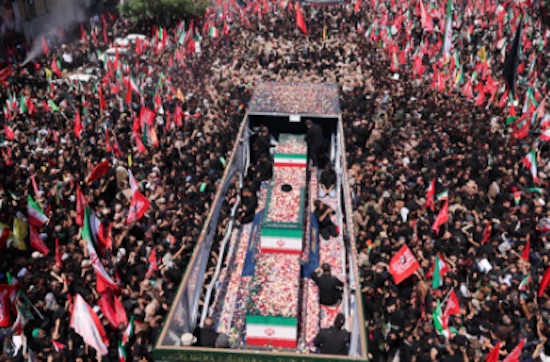
The author seems interested in interpretation of Quranic verses, but what I was struck by is the millions of ordinary Iranians who turned up for the funerals. Compare this with the paltry attendance at Trump’s USA 250 bash.
As a online commentator remarked, if the regime was as heavily tyrannical as Trump says, this would have been the perfect opportunity to stage a revolution. But it didn’t happen, and there was genuine grief at the “tyrant’s” funeral.
/
Leonard / July 10, 2026
old codger
Are you really comparing all those Iranian’s who turned up is because of genuine grief to Ayotola?. What’s the chance of the revaluation against well armed and organized IRGC. May be they are stupid to get killed. And unlike Iran in USA no one force you to attend so called Trump’s USA 250 bash ( by the way it’s not Trump’s bash it’s the country that 250 celebration) . What would happen you think Iranian’s who are forced to attend said and refused?. Are you sure all those women with full burqa or niqab attended the funereal are genuine Grief stricken followers? One more titbit for forty years chanting “Death to America” and dienig on the first day
/
old codger / July 10, 2026
Leonard,
CNN, which is the only western outlet operating in Iran, estimated that millions were in attendance.
You really believe several million can be forced to attend the funeral, in TWO countries?
Surely, you don’t think that even the IRGC can kill a crowd of millions?
In case you don’t know, it is the US, not Iran, that habitually kills millions.
A million in Vietnam
46000 in Afghanistan
150,000 in Iraq
As the women and their dress, don’t you know the difference between a niquab and a burka?
/
Jit / July 12, 2026
“…..CNN, which is the only western outlet operating in Iran, estimated that millions were in attendance…..
–
So you declare the western media is fake when they show people riot against the Khomeini regime but absolutely believe them when they show ‘millions’ in old lokka’s funeral?
–
Very convenient OC!
/
old codger / July 14, 2026
Jit,
“So you declare the western media is fake when they show people riot against the Khomeini regime but absolutely believe them when they show ‘millions’ in old lokka’s funeral?”
No, IF the Western media AND the Iranian/Chinese/Turkish media all agree on an issue, they can be believed. On this issue, they do.
When did I say that the riots were fake? It is the same people who rioted against the economy that are weeping for “lokka”.
/
SJ / July 10, 2026
Correction
A typical Iranian hates the US and Israel more than he hates the severest Mullah.
/
Native Vedda / July 11, 2026
Leonard
–
“What’s the chance of the revaluation against well armed and organized IRGC.”
–
Trump reportedly gave Maduro an ultimatum: relinquish power in Venezuela or surrender the country to the United States. When Maduro refused, Trump sent in special forces and had him abducted.
–
Trump says the U.S. will take over Cuba “almost immediately.” So, he sends in an aircraft carrier to force the island nation into submission by imposing a blockade.
–
Trump has been flirting with the idea of annexing Canada since late 2024. He called Canada the 51st state and its prime minister the “Governor.”
–
Donald Trump wants the U.S. to acquire Greenland.
–
Donald Trump demanded Iran’s “unconditional surrender.”
–
Could you suggest any other alternative means of defending a country’s existence against such threats?
–
Don’t forget that Iran and Cuba have endured U.S. sanctions for many years, long before these latest threats and demands.
/
Jit / July 10, 2026
“….there was genuine grief at the “tyrant’s” funeral….”
Be very skeptical OC!! Its heaps of smoke and mirrors! Iranian regime so far has very successfully pulled the wool over the eyes of most of us!!
/
old codger / July 11, 2026
Jit,
If only IRNA or PressTV said so, I wouldn’t believe it.
But when CNN reporters on the ground also say so, why can’t you believe it?
What about Iraq? Do you believe that the Ayatollahs can threaten Iraqi Arabs too?
/
Jit / July 12, 2026
OC, lets put all these assumptions about ‘biased’ media talks aside and get to the core of the problem. Do you believe the thousands of people who rioted a few months ago were fake? That they were CIA agents? The people who genuinely believed they should decide – not the moral police – to wear the hijab or not? If they have so called ‘elected representatives’ and a ‘parliament’ why people get tortured and killed for doing what they believe??
/
old codger / July 13, 2026
Jit,
“Do you believe the thousands of people who rioted a few months ago were fake? “
No they weren’t fake. But don’t forget that there were millions who didn’t. They weren’t rioting just against the hijab. According to AI : ” The riots in Tehran were mainly caused by economic hardship — especially rising prices, inflation, and the collapse of the Iranian currency. According to recent reporting, the unrest began with shopkeepers and ordinary people protesting higher costs of living, and it then expanded into broader anti-government demonstrations.In short, the immediate trigger was economic distress, but the protests also reflected deeper anger at government mismanagement and repression ” Now, the reason for economic problems is the US economic sanctions, ostensibly to stop Iran building a Bomb. Would you tell me why the US doesn’t sanction Israel for the same reason? Plus, when someone is bombing and killing your neighbours and children, would you support them or your government?
As for biased media, you know what they fed us during the Iraq wars.
Fun fact: Under Saddam, many Iraqi women were westernised, his family included.
Now, Iraq is friendlier to Iran than to the US. The women are veiled.
So, what has the US accomplished, except killing millions of Iraqis to get at the oil?
/
Jit / July 14, 2026
No need to ask CGPT OC, Ive already said those factors two weeks ago:
https://www.colombotelegraph.com/index.php/has-iran-emerged-stronger-after-the-war-assessing-its-regional-power-status/comment-page-1/?unapproved=2546430&moderation-hash=58479bc111c97f88e89bcaa7d66ed5a6#comment-2546430
I just used the hijab case as an analogy only.
OC, my point is – I’m not biased toward the US or Iran just for the sake of some kind of allegiance. I have no bias toward anyone else either! I don’t cling to any side out of loyalty or ideology, and I can’t stand blunders by any. I look at each situation on its own merits and call the spade – the spade — nothing more, nothing less. That’s the beginning and the end of it.
/
SJ / July 10, 2026
oc
Prejudices overcome reason.
Once convinced by the dominant global media that Khameini is a hated man in Iran, what pathetic excuses do people resort to dismiss the reality that he is mourned.
Even the circumstances of his death escape some minds.
*
A typical Iranian hates the US and Iran more than he hates the severest Mullah.
/
Jit / July 12, 2026
Leave you allegiance aside and use common sense SJ! Iran — along with Iraq and Syria, is the cradle of human civilization, evolved over thousands of years. Its people were, and remain, among the most brilliant and creative on this universe even today. They had every right to rise against the US installed puppet Shah’s regime, and they did! They have that same right; the same duty to rise against a gang of theocratic tyrants who have hijacked their nation and drape their brutality in the robes of God.
People who gave the world the wheel, writing, literature, mathematics, astronomy, timekeeping, and the first cities on earth do not need to answer to a cabal of Ayatollahs — clerical despots who have spent four decades throttling the life out of their own civilization, hanging dissent from cranes, and calling it divine will!!
/
Jit / July 10, 2026
Amza, just a curious question to your elated mind after watching millions at Khomeini funeral who most likely were forced to attend. But how do you compare them with the crowds that were truly hurt and genuinely rioted after Ayatollah’s religious morality police killed Mahsa Amini, an innocent woman was tortured and killed for the “crime” of not wearing her hijab?? And what is your compassionate view on those over 6000 protesters killed and 18,000 arrested (whose fate is not known at all) ??
/
SJ / July 10, 2026
“millions at Khomeini funeral who most likely were forced to attend. “
Seems like you have a funny sense of humor?
/
Jit / July 12, 2026
You are absolutely right SJ! I certainly find great humour to see the thousands of people who wept and rioted when an innocent woman was tortured and killed not so long ago are now “weeping” when the perpetrator is killed too. Isn’t this a very funny world my friend?
/
SJ / July 12, 2026
Where did you see all that weeping and rioting? NYT, WSJ?
It is even funnier when people do not see anything wrong when mass killings occur in the name of defending the right of a state to exist.
/
Jit / July 13, 2026
“….Where did you see all that weeping and rioting? NYT, WSJ?….”
–
So I’m supposed to wait until Xinhua publishes — if it ever does — that people are being killed for not wearing a hijab? So even The Guardian reports on the plight of Iranian women are not acceptable to you because they equally flak Chinese ‘democracy’?? What’s the point of defending your ally just for the sake of defending them? You actually believe the Iranian regime’s morality police have the right to decide whether a woman wears a hijab or not? That women should live groveling, obedient, subservient lives to men — particularly a bunch of decrepit old men in clerical robes?
/
SJ / July 13, 2026
I only asked a question.
Did not your usual sources would have carried photographs and videos to quench your thirst?
I have not made any comment in support of anyone other than draw attention to serious insensitivity.
If one cannot answer a question one may simply ignore it. It helps one to appear a little honest.
/
Native Vedda / July 11, 2026
Jit man
–
“….. the crowds that were truly hurt and genuinely rioted after Ayatollah’s religious morality police killed Mahsa Amini, …..”
–
Before pointing our fingers at Iran’s morality police, perhaps we should look at our own. Sri Lanka’s so-called morality police, created under Gota’s administration, was effectively disbanded—or simply abandoned—after Gota was driven out of the country by tens of thousands of ordinary people in July 2022.
–
The 13-member committee was headed by Galagoda Aththe Gnanasara Thero, whose credibility was already well known.
–
Did you see anyone mourning Galagoda?
Did you see anyone mourning Gota?
–
Of course, a few people who benefited from them may have wept. Meanwhile, the children who were allegedly abused by 300 Sri Lankan monks are still waiting for justice, as investigations and legal proceedings continue in many cases.
–
/
Jit / July 12, 2026
We were talking about Iran and Ayatollahs Vaddah! Lost tracks in your own jungle?
/
Leonard / July 11, 2026
Jit
Amza must in his heart believes women showing grief are really scared if there is a regime change they will be forced to give up the Full Niqab and interfere with what they practicing, high levels of modesty (haya), and avoiding unwanted attention from sexsist European white men,
/
old codger / July 11, 2026
Leonard,
Can you you link me to a video of any Iranian woman wearing a “full Niqab”?
A few facts for you:
Many Saudi women wear niqab. Iranian women don’t
Iran has elections and a parliament, however flawed. None in the Saudi Kingdom.
Why are you not talking about Saudi Arabia?
Because you only watch Fox News?
If women choose to wear niqab, is it our business?
/
LankaScot / July 12, 2026
Hello OC,
You have just reminded me of my time in Saudi. We had a Villa in Rahima and many of my Colleagues were ex Marines and Navy Divers. They all kept very fit. If they were Onshore they would all run round the area in the early morning and early evening as the temperature was reasonable. Many times I used to join them. In the early morning the Villa Doors were open and the women would be hanging out washing. It was hilarious seeing these Divers trying desperately to keep looking straight ahead while we passed these open doors. No Niqabs worn.
By the way very few young Qatari women wear the Niqab and none of the Iranian women that i knew. Hijabs were common, however I seldom saw Burqas in Doha; they were more commonly seen in small Villages in the interior. The Bedu (Bedouin) women were usually fully garbed in Burqas.
Best regards
/
old codger / July 13, 2026
LS,
People get their stereotypes from what they are fed on TV, not by living in those places.
I suppose, in the same way, tourists here are surprised that the three wheeler drivers are all out to separate them and their money.
/
SJ / July 13, 2026
oc
I was in Iran in Isfahan in 2002 and in Shiraz in 2009.
Women covered their heads mostly with a scarf, although older women covered the whole head, but none the face.
The universities had more female than males in nearly all faculties. (AI records “While the post-revolutionary government enforced gender segregation in schools and universities, it heavily emphasized education.” But I do not know how gender segregation is possible in universities especially in the professional degree programmes. During both visits there was no visible segregation.
Things could be different in more rural contexts. But people spoke freely on various subjects. They were more sad than angry that the US has branded them a ‘evil’. A group of girls asked my wife “Do we look evil?”.
There are too many countries about which our ideas are moulded by the Western media and most of us rarely challenge those impressions. Some find them fit in well with their prejudices.
/
Jit / July 13, 2026
There is an acclaimed movie maker from Iran – Jafar Panahi. And another – Asghar Farhadi. Both born and bred in Iran, who have been repeatedly imprisoned, tortured and banned by the ‘people friendly’ regime. Panahi particularly talks a lot about the torturous Iranian regime and made some classic movies – some world wide acclaimed and accoladed – mostly about the oppressive side of the regime. They are quite trustworthy stories about the reality of the things happening there, coming from real Iranians – than from a person who spent a couple of days in Iran – most probably fully sponsored by the regime itself.
/
old codger / July 13, 2026
Jit,
Saudi Arabia is much more repressive than Iran. I know because I spent many years there. But I know that most people there are deeply religious and like the rules, including the hijab, and they are happy because the government gives them practically everything free from oil revenue. It could be the same in Iran, but the US has sanctioned the economy because it wants to control the oil.
Remember Afghanistan? The US had to run away. But the Afghans don’t get bombed now.
What right do we have to tell others how they should live if they are happy with it?
Why doesn’t anyone talk nowadays about Afghans or Saudis, but about Iranians? Because Fox News doesn’t?
Iranians were religious even before 1979. Teheran may have been mod, but rural parts were always as they are now. Watch this 1974 video from Teheran and see how many women were veiled even then.
/
SJ / July 13, 2026
What has this to do with my question?
/
old codger / July 13, 2026
Forgot the link:
https://youtu.be/Qad4x_Q7Lbc?si=AaC3M4otliSPHX_d
.BTW, one woman with a short skirt covers her head anyway.
/
Lester / July 11, 2026
The author is using selection bias to show that the Quran is suited for diplomacy.
If the author wants to be objective , he should show us the verses that are not suited for diplomacy. For example, in the same Quran, there are passages in which Jews are turned into apes and pigs.
What about the Siege of Banu Qurayzah?
AI Overview: ” The claim that Muhammad executed 600 Jews refers to the siege of the Banu Qurayza tribe in 627 CE. While widely debated in historical accounts, traditional texts estimate that between 400 and 900 adult male combatants were executed for high treason following the Battle of the Trench.”
The sense of morality in Islam is in start contrast to the Judeo-Christian worldview in the West.So then you have to ask yourself, is compatibility even possible?
This is from the Hamas Charter: ” “Israel will rise and will remain erect until Islam eliminates it
as it had eliminated its predecessors.”
https://irp.fas.org/world/para/docs/880818.htm
Similar to the LTTE terrorists, you are not dealing with rational people.
/
Nutsy / July 12, 2026
Darling,
You really ought to try harder. Not everyone here is as dumb as you are.
“If the author wants to be objective , he should show us the verses that are not suited for diplomacy. For example, in the same Quran, there are passages in which Jews are turned into apes and pigs.”
Why not talk about these bits from the Bible, for instance:
Exodus 21:12–17 — includes death penalties for various offenses.
Deuteronomy 20:16–17 — commands the destruction of certain peoples in the conquest narrative.
Deuteronomy 13:6–10 — prescribes severe punishment, including death, for enticing others to worship other gods.
1 Samuel 15:2–3 — Saul is told to attack Amalek and destroy everything.
Joshua 6:20–21 — Jericho is destroyed, with all living things put to the sword.
Numbers 31:17–18 — commands killing male children and non-virgin women in the aftermath of war.
But how come you’re “Christian” today? The other day you were backing Buddhist child rapists?
/
LankaScot / July 13, 2026
Hello Nutsy,
Not to mention the lying God in Genesis 2:17
“But of the tree of the knowledge of good and evil and blessing and calamity you shall not eat, for in the day that you eat of it you shall surely die”. Adam lived another 930 years.
Or how about the Gambling God of the Book of Job, who made a bet with Satan ‘with God granting Satan explicit permission to test Job’s faithfulness” that no matter what he did to Job, including killing his 10 children and visiting various other Calamities on him, “yet [Job] still responded by worshiping God”.
If there were Olympic Medals for Mental Gymnastics, Christian Apologists would walk away with them.
Best regards
/
Lester / July 11, 2026
*stark contrast
/
chiv / July 14, 2026
Nutsy,
did you see , one nut wonder alleging cheating among Zoology students and teachers
the very next day , cheating the system by giving 20 free GREENS,
not just for him self but for his Ppartner Ttoo. ( up voting )
/