


By Vishwamithra –
“Procrastination is the bad habit of putting off until the day after tomorrow what should have been done the day before yesterday.” ~ Napoleon Hill
Continuous Satyagraha campaigns for over a quarter century and a brutal war over the same period- spanning 27 years- mean the Tamil Question remains an unresolved enigma, evading the commitment of leaders from both the Sinhalese and Tamil communities. This political deadlock is deeply frustrating for the Sinhalese community, while remaining entirely devastating for every single Tamil man, woman, and child living in Sri Lanka. The Tamil Question still remains an unresolved enigma because its roots lie deep within a history of colonial administrative shifts, post-independence nationalism, and failed political compromises. Understanding Sri Lanka’s contemporary deadlock requires tracing how peaceful protests and a devastating civil war grew out of deep-seated historical grievances.
The Roots of Division: Colonial Legacies and Independence
To understand the modern conflict between the Sinhalese majority (predominantly Buddhist) and the Tamil minority (predominantly Hindu and Christian), one must look at how British colonial rule reshaped the island then known as Ceylon. Before European colonization, the island featured distinct kingdoms with fluid boundaries. However, the British unified the administration of the island for economic efficiency.
An undisputed educational advantage was accrued to the reality of Christian missionaries establishing high-quality English-medium schools primarily in the arid north, the traditional homeland of the Sri Lankan Tamils. Consequently, Civil Service was Dominated by the Tamil minority because fluency in English was the gateway to colonial administration, Tamils secured a disproportionate number of sought-after civil service and professional jobs relative to their population size. This structural imbalance fostered deep resentment among the Sinhalese majority, who felt marginalized in their own homeland under British rule.
When Ceylon gained independence in 1948, it inherited a Westminster-style democracy. In a system governed by simple majority rule, power, much to the ire and frustration of the Tamil minority, naturally shifted to the Sinhalese demographic majority. This was further aggravated by the introduction of the Citizenship Act of 1948 by the new Sinhalese-dominated government. This Act stripped nearly one million “Indian Tamils” (brought over from South India by the British to work tea plantations) of their citizenship and voting rights. This move signaled to all Tamils that their security and status on the island were fragile under a majoritarian government. A new phrase and a sociopolitical factor, of ‘minority vulnerability’ entered into the governance machinery and political vocabulary of Ceylon.
The Era of Non-Violent Resistance: Satyagraha (1956–1970s)
As the state sought to correct colonial-era imbalances, it did so through policies that systematically marginalized the Tamil community, prompting a wave of non-violent resistance inspired by Mahatma Gandhi’s philosophy of Satyagraha (truth-force).
The “Sinhala Only” Act of 1956
The defining turning point occurred in 1956 when Prime Minister S.W.R.D. Bandaranaike enacted the Official Language Act, commonly known as the ‘Sinhala Only’ Act. It replaced English with Sinhala as the sole official language of the state. Tamil public servants who could not speak Sinhala were forced to resign, effectively ending equitable Tamil representation in the government, courts, and law enforcement.
The Satyagraha Campaigns
Led by SJV Chelvanayakam and the Federal Party, Tamils launched peaceful Satyagraha campaigns across the North and East. Protesters staged sit-ins, boycotted state institutions, and peacefully shut down local administrations. These non-violent demonstrations were met with state-sponsored police brutality and violent counter-protests by Sinhalese nationalist groups.
The All Ceylon Tamil Congress (ACTC) was founded in 1944 by G G Ponnambalam. Ponnambalam asked for a 50-50 representation in parliament (50% for the majority Sinhalese, and 50% for all other ethnic groups). This was immediately rejected by the British Governor General Lord Soulbury as a ‘mockery of democracy’.
Due to the cooperation of the ACTC with the United National Party (UNP), a group led by S J V Chelvanayagam split from the ACTC in 1949, forming the Ilankai Tamil Arasu Kachchi (ITAK), commonly known as Federal Party. The ACTC was largely discredited when the UNP began to move away from bilingual and bi-communal policies and more towards Sinhalese Buddhist nationalism. As a result, the ITAK overtook the ACTC as the main Tamil party in the country in 1956.
Broken Pacts and Standardization
Moderate Tamil leaders repeatedly attempted to negotiate power-sharing agreements. The Bandaranaike-Chelvanayagam Pact (1957) and the Senanayake-Chelvanayagam Pact (1965) both promised regional autonomy and recognition of the Tamil language. However, successive governments failed to implement either pact due to intense pressure from Sinhalese nationalist politicians and the Buddhist clergy. Both Prime Ministers, S.W.R.D. Bandaranaike and Dudley Senanayake, ultimately lacked the political will to fulfill the promises made to Tamil parties in exchange for their cooperation to form a government. This recurring pattern of concessions followed by abrogations became a primary catalyst for the Tamil leadership’s enduring mistrust of Sinhalese leaders.
In the 1970s, the state introduced a ‘standardization’ policy for university admissions. This system required Tamil students to score significantly higher marks than Sinhalese students to enter universities, particularly in science and engineering fields. For Tamil youths, who viewed education as their primary path to upward socioeconomic mobility, this was the final straw. Two decades of broken political promises and state violence convinced a younger, more radical generation of Tamils that peaceful protest was futile.
The Vaddukoddai Resolution (1976)
In 1976, Tamil political parties came together to issue the Vaddukoddai Resolution. This historic document abandoned the demand for federalism and officially called for the creation of an independent Tamil state called Tamil Elam in the North and East. From this political shift emerged militant groups, most notably the Liberation Tigers of Tamil Elam (LTTE), led by Velupillai Prabhakaran.
The leadership in the Tamil community has shifted from that of a high-ranking nobility and landed aristocracy of Vellalar caste from the ancient Tamil order of elitism to a fisherman born in Valvettithurai, in the Jaffna peninsula.
The spark that ignited full-scale civil war occurred in July 1983. Following an LTTE ambush that killed 13 government soldiers, anti-Tamil pogroms erupted across the country. Over a few devastating days, mobs killed thousands of Tamils, destroyed their homes, and burned their businesses, often with the passive complicity of state security forces.
‘Black July’ drove thousands of radicalized Tamil youths into militant camps and triggered a massive global diaspora of Tamil refugees. For the next 27 years, Sri Lanka was consumed by a near-catastrophic civil war. The LTTE pioneered the use of suicide bombings, assassinated high-profile leaders (including Indian Prime Minister Rajiv Gandhi and Sri Lankan President Ranasinghe Premadasa and Presidential candidate Gamini Dissanayake), and ruthlessly eliminated rival Tamil political factions to establish a de facto mono-party state in the north. The Sri Lankan military responded with heavy bombardment of civilian areas, enforced disappearances, and a strict economic embargo on the northern peninsula. The war ended in May 2009 in a bloody military campaign on the beaches of Mullaitivu. Tens of thousands of Tamil civilians caught in the crossfire were killed, and the LTTE leadership was entirely wiped out.
The military defeat of the LTTE eliminated armed militancy, but it did not resolve the political grievances that caused the war in the first place. Today, the Tamil Question remains an agonizing deadlock.
For the Sinhalese majority, the conflict is often viewed through the lens of national sovereignty and territorial integrity. Decades of brutal LTTE terrorism left deep psychological scars. There is a pervasive fear that granting meaningful regional autonomy to the North and East will eventually lead to the fragmentation of the island. Many Sinhalese feel a profound sense of frustration that despite winning the war and attempting to rebuild infrastructure, the international community and Tamil leaders continue to focus on war crimes and devolution rather than economic unity.
For every Tamil man, woman, and child living in Sri Lanka, the status quo feels utterly damning. The Northern and Eastern provinces remain heavily militarized, with the military occupying vast tracts of private civilian land. Families of the thousands who went missing at the end of the war still receive no answers from the state. The 13th Amendment to the Constitution—meant to devolve power to provincial councils—has been consistently diluted and stripped of real authority over land and police powers.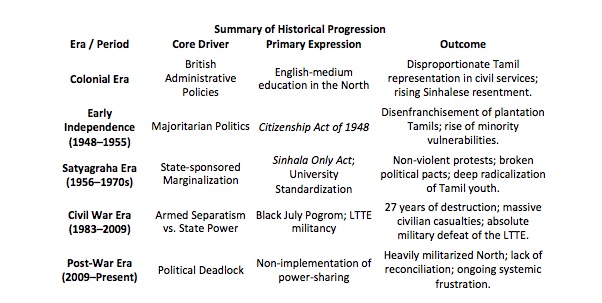
The Tamil Question is an unresolved enigma because Sri Lanka has yet to balance the majoritarian democratic impulse with robust, legally protected pluralism. Until leaders from both communities can move past historical traumas—the Sinhalese moving beyond the fear of national fragmentation, and Tamil leadership successfully negotiating realistic political compromises within a unified state—true reconciliation will evade the island, leaving its people trapped in a cycle of systemic frustration and unresolved grief. President Anura Kumara Dissanayake is one Sinhalese leader in whom the Tamil leadership has not lost its trust, not as yet. AKD simply cannot waste this trust. Procrastination is not a word modern day politics would willingly accommodate. He must move beyond the obvious and look for the ‘perfect’ terrain. Is there such a perfect terrain, one often wonders.
*The writer can be reached at vishwamithra1984@gmail.com
Nathan / July 8, 2026
The Unresolved Tamil Question is a pet peeve of all. Vishwamithra affirms that he is no exception.
But, for him to say that it is evading the commitment of leaders from both the Sinhalese and Tamil communities. Tell me, how you fault Tamil leaders. Or, even better, how Tamil leaders are guilty.
.
Whatever the invaders did was for their own security. They did not do any just to put Tamils on an advantageous footing.
.
… Tamil public servants who could not speak Sinhala were forced to resign,
No. They were packed home!
.
S J V Chelvanayagam splitting from the ACTC was a major blunder.
/
SJ / July 8, 2026
“S J V Chelvanayagam splitting from the ACTC was a major blunder.”
He should have cooperated in the treachery, I suppose?
/
old codger / July 8, 2026
“An undisputed educational advantage was accrued to the reality of Christian missionaries establishing high-quality English-medium schools primarily in the arid north, the traditional homeland of the Sri Lankan Tamils. Consequently, Civil Service was Dominated by the Tamil minority because fluency in English was the gateway to colonial administration”
I believe this is an urban legend propagated by those with vested interests. There were indeed English Medium missionary schools in the North, but but there were even more in the South.
Even AI cannot come up with convincing evidence:
“But the search results still do not expose the exact province-level statistics you asked for.
What this means
At this point, I can say with some confidence that:
the North and East had a stronger missionary-school presence than the South,
English-medium missionary schooling was part of the colonial education system,
but I cannot yet give a verified numerical comparison from the Education Department reports alone.”
In short, there is no verified evidence. But who hasn’t heard of S. Thomas’ , St. Joseph’s, St. Peter’s, St.Benedicts, Trinity, ? St. Aloysius’s produced, among others, N.U.Jayawardena and Cyril Ponnamperuma. That isn’t a complete list, but enough to disprove Vishwamitra’s thesis.
/
SJ / July 8, 2026
oc
It was not the N&E as a whole that had a strong missionary presence
The Jaffna peninsula had a high concentration of missionary schools, several of them American.
The rest of the NP had pretty little
There were tolerably good Catholic schools in Trincomalee and Batticaloa. There were Methodist schools which were not a patch on Jaffna schools. Well to do patents sent their children to Jaffna. (So did several Sinhalese parents.)
Social factors that induced parents to educate children were much stronger in the peninsula than in the East.
Sinhalese middle classes made their money without going for high school education.
The Muslim trader did not care much for education beyond his livelihood necessities, nor did Indian traders. Plantation workers were not encouraged to learn.
/
old codger / July 9, 2026
SJ,
“Sinhalese middle classes made their money without going for high school education.”
Exactly. One cannot blame any group for doing what they are good at, worse still put obstacles in their way to the detriment of the whole country.
There were attempts to replace Muslim/Indian traders with state bureaucrats, but their futility soon became apparent.
/
leelagemalli / July 9, 2026
Hello OC,
The Tamil question is only one symptom of a much wider governance crisis. The people were promised a new political culture founded on transparency, accountability, and genuine system change. Instead, a growing number of controversies has left the public asking whether those promises have been quietly abandoned. The Justice Minister has publicly indicated that he sees no reason to resign over the Negombo prison incident, despite widespread criticism over the functioning of institutions under his purview. Earlier, the Speaker, Asoka Ranwala, resigned from the Speakership following the controversy surrounding his claimed academic qualifications, yet he continues to sit in Parliament despite the fact that many voters believe they were persuaded to support a candidate presented as possessing credentials that later became the subject of serious public dispute. Added to these are continuing questions over controversial public procurement decisions, the reported multi-million-dollar phishing-related financial loss, and other unresolved matters that have generated little visible political accountability. The recurring message appears to be that responsibility belongs to everyone except those occupying the highest offices.
–
The Negombo prison incident represents perhaps the most serious test of this government’s commitment to the principles on which it sought power. Publicly available photographs and videos have raised disturbing questions about how weapons were allegedly introduced into a high-security prison and how such a deadly outbreak of violence could have occurred under the watch of the very institutions entrusted with maintaining security and the rule of law. These questions require an independent, transparent, and credible investigation; not selective explanations or political rhetoric.
/
Pandukabaya / July 9, 2026
Very true, @leelagemalli. Called a spade, a spade.
/
Naman / July 8, 2026
“ He must move beyond the obvious and look for the ‘perfect’ terrain.”
The PERFECT TERRAIN can be created by AKD by passing a NEW CONSTITUTION for the UNITED SL.
The minorities would like to see AKD to transform as a ruler from a Sinhala Buddhist from a rural background to BECOME the FIRST STATESMAN of an harmonious peace loving country.
It is very difficult to transform the country in few months after it has been broken down by the nearly eight decades of misrule.
The People from the ARAGALAYA of March 22 needs to stand alongside the current Government to defeat the attempts by the former corrupt politicians and the thuggish hate mongers in ROBES.
Mother Lanka is still in the Intensive Care unit with multiple illnesses.
Getting her on the path of recovery should be our prime concern
/
Ajith / July 8, 2026
“The minorities would like to see AKD to transform as a ruler from a Sinhala Buddhist from a rural background to BECOME the FIRST STATESMAN of an harmonious peace loving country.”
The term minorities only started with British rule which united all three kingdoms. We should not forgot there was, Dutch and Portuguese rule from 1500 and before that only kingdoms.The first census of British rule include the Tamils of Indian origin. We talk about independence of Sri Lanka/Ceylon and a constitution of British rule and other two constitutions made by Sinhalese governments and make the Tamil speaking people as minorities.
I think this is the first time a Sinhalese journalist in this forum highlight the need for solving the Tamil problem to solve the economic crisis. I hope other Sinhalese journalists and media who genuinely interested in a united country will do the same to encourage the government to a sharing united Sri Lanka.
/
Naman / July 8, 2026
Aragalaya of March 2022, could also be considered as a form SATYAGRAHA where the AFFECTED CONCERNED citizens protested against the government. This finally resulted in us getting the NPP government. Both Locals as well as concerned DIASPORA are HOPING & PRAYING for AKD to succeed
/
Naman / July 8, 2026
The FOUNDATION for the ECONOMIC EMANCIPATION for our Motherland has to be by promoting the SRI LANKAN identity. Without the minorities on board it is hard to achieve economic prosperity.
It is very easy to find the differences between the religious and ethnic groups. Togetherness needs to be promoted for our survival in our country with all the geopolitical and global warming issues
/
Lester / July 8, 2026
“This system required Tamil students to score significantly higher marks than Sinhalese students to enter universities, particularly in science and engineering fields.”
The policy was initially designed to address cheating by some Tamil examiners. In 1972, the policy was modified to DSQ, which actually benefited Tamils from rural areas.
“Industries Minister Mr Cyril Mathew dropped a bombshell alleging favouritism towards Tamil pre-university and university students on the part of Tamil university lecturers. Mr Mathew produced marking schemes and question papers, affidavits and memoranda to back up his charge of Tamil favouritism. He rattled off a long list of academics who had made the identical charge ranging from Prof. A.D.V. de S. Indraratne to the Vice Chancellor Prof. P.P.G.L. Siriwardene, himself. The Minister’s prize production was a diagram.
/
Native Vedda / July 8, 2026
Lester
–
“The policy was initially designed to address cheating by some Tamil examiners.”
Was it?
–
Please explain how this alleged cheating worked and how the policy supposedly stopped it.
–
“Industries Minister Mr. Cyril Mathew dropped a bombshell, alleging favouritism towards Tamil pre-university and university students by Tamil university lecturers.”
–
Cyril Mathew was also the person widely associated with inciting anti-Tamil violence. He has been linked to the burning of the Jaffna Public Library, in which around 95,000 books and manuscripts were destroyed, and has also been accused by many historians and commentators of playing a key role in the Black July during the presidency of J. R. Jayewardene.
–
And you expect CT readers to accept his claims at face value?
–
Are we talking about documented history, or another version of the Mahavamsa narrative describing how education was conducted in the post-independence era?
/
Lester / July 8, 2026
continued…
Students of Zoology at the 1977 Advanced Level examination had been asked to draw the stages of life of a mosquito. Examiners had been specifically instructed that marks be given only if all the stages were drawn. But the Minister produced a Tamil answer script in which the student had scored 5 marks without giving the final stage. A similar answer script of a Sinhala student had been given nought. Mr Mathew’s charge was that Tamil university lecturers over-marked the scripts of students of their community, that they leaked out questions to Tamil students and that they were invited to and attended seminars at Tamil schools where they tackled certain examination questions which curiously enough cropped up in question papers at the next exam….”
Regardless of ad hominem attacks on CM, where is the proof that the Tamil examiners were not cheating?
In any case, if Tamils are so clever, why do they need 70% reservation to compete with Brahmins in TN? Does it mean Tamils are only clever in SL?
/
Nutscounter / July 8, 2026
“why do they need 70% reservation to compete with Brahmins in TN? Does it mean Tamils are only clever in SL?”
AI response to “Give a list of prominent Sri Lankan Canadians?”
“Here are some prominent Sri Lankan Canadians across politics, literature, business, arts, and public life:
Well-known names
Michael Ondaatje — acclaimed novelist and poet, best known for The English Patient.
Anita Anand — Canadian politician and cabinet minister.
Gary Anandasangaree — Canadian politician and Member of Parliament.
M. G. Vassanji — award-winning writer and novelist.
Suresh Joachim — actor, producer, and multiple Guinness World Record holder.
Rohan Fernando — visual artist, painter, and filmmaker.
Pardis Parker — director and comedian.
Kagusthan Ariaratnam — engineer and public figure.
David Chariandy — novelist and academic.
Trevin Bastiampillai — former professional cricketer.
Of course, darling, it is entirely possible that all of the above are Brahmins, and/or closet Sinhalese.
/
chiv / July 9, 2026
NC, I heard some got 10 marks for the same question
” describe the life cycle of Mosquito ( Anopheles / Culex ) ” – 5 marks
Apparently, completing final stage of life cycle with a diagram of a nutless one ,
fresh out of swamp.
Very funny indeed , ” who doesn’t know the final stage of a Mosquito life cycle is an adult Mosquito. ???
unless some thought , it’s frog or cockroach.
Zoology student not knowing Egg, Larva, Pupa . . . . . least could have drawn a Mosquito , to get one mark.
/
LankaScot / July 9, 2026
Hello Chiv,
Due to the Dengue problem we and all our Neighbours were visited by the PHI (Public Health Inspectorate) Department. They inspected all the exterior areas of our Buildings. After they left my wife told me that they had found a Larvae inside a 6″ diameter Pipe that was standing upright outside where we keep Spare Hardware. I went to look at the Pipe; it was open at both ends and bone dry. I am very careful about ensuring that any possible containers for water are not left outside. There is a fairly substantial Mosquito problem in our area, however I am sure that old Drainage Ditches and abandoned Wells are the biggest sources.
Best regards
/
leelagemalli / July 10, 2026
LankaScot,
A responsible society cannot depend entirely on government institutions to solve every problem. Citizens must also be encouraged to protect and clean their own surroundings, especially when public health risks such as dengue are rising at an alarming rate. However, when local authorities and public health institutions fail to manage their responsibilities, the consequences can be devastating. This year’s sharp increase in dengue cases has raised serious questions about the effectiveness of the much-publicized “Clean Sri Lanka” campaign. Despite strong promises and powerful rhetoric, many people feel that visible improvements have not matched expectations.
Reports of neglected waste collection, unpleasant conditions around areas such as Beira Lake and parts of Colombo, and the decline of basic urban maintenance have created frustration among the public. Criticizing previous administrations may have been politically convenient, but the public expects every government—with greater power and authority; to deliver better results, not merely explanations.
/
old codger / July 10, 2026
LM,
My opinion is that the whole anti-dengue campaign is hogwash, the real aim of which is to encourage households to keep their environs neater than in neighbouring countries to attract tourists. Social media nowadays carries a lot of comparisons between the cleanliness of SL compared to other countries.
But the fact is that these other countries have lower rates of dengue despite having more garbage and no nosy PHI’s.
https://youtu.be/QPtlCHFT5z8?si=HmirtAb3XO7UeRCJ
/
leelagemalli / July 10, 2026
cont.
After more than a year in office, many citizens are asking where the promised transformation has taken place. Issues involving prison violence, public security, transparency, economic management, education, healthcare, trade, and national safety have intensified doubts about the government’s ability to convert promises into sustainable action. The government came to power with a strong mandate and pledged greater accountability, yet many believe that transparency and effective governance have not improved significantly. Economic challenges remain a major concern, particularly regarding foreign reserves, debt repayment commitments, and the targets set under the IMF programme.
–
A government should ultimately be judged not by its speeches, slogans, or criticism of predecessors, but by measurable outcomes that improve the daily lives of people. The public’s question today is simple: with the authority they sought and received, why has meaningful progress remained so difficult to see?
/
Native Vedda / July 10, 2026
leelagemalli
–
“After more than a year in office, many citizens are asking where the promised transformation has taken place. “
–
People are accustomed to living on hope and expectations.
–
It has been 78 years of rule by crooks, racists, robber barons, saffronistas, petty Pol Pots, and others of their kind.
–
I’m sorry, but it is not possible to undo that extent of damage and rebuild a country in just two years.
–
/
old codger / July 10, 2026
LS,
This may sound heretical, but wouldn’t it be better to leave large flat containers filled with water outside for the mosquitoes to lay their eggs in?
We could , every other day, empty them into a dry area, effectively killing whatever larvae are present.
But of course that would cause unemployment among the PHIs.
/
Naman / July 8, 2026
Because of the missionaries presence in the North and East of the country prior to the Independence from the colonial powers the Tamils benefited by good education. This led them to serve the colonial power in all parts of Ceylon. At Independence when the power was handed over to the majority race their prime objective was to colonise the traditional Tamil homelands and to bring down their economic status. Instead of improving the education of the majority people and motivating them to work harder towards economic prosperity they were hellbent in destroying the minorities economically as well as depriving them of university education. The SWABHASHA that was brought in nearly 60 years ago not only affected the Tamils but also the Sinhala people. But no one knows why Muslims were allowed to study in ENGLISH !!!
This has resulted in our President and Ministers unable to speak in English in the International Arena.
It’s a long long way for SL to become Singapore where meritocracy Honesty and pragmatism are practiced
/
Native Vedda / July 10, 2026
Naman
–
“Because of the missionaries presence in the North and East of the country prior to the Independence from the colonial powers the Tamils benefited by good education. “
If so why didn’t Sinhalese benefit from missionary schools in the south?
Note here is a rough list:
Catholic
–
• Good Shepherd Convent, Colombo
• Holy Cross College, Kalutara
• Holy Family Convent, Kurunegala
• Joseph Vaz College Wennappuwa
• Maris Stella College Negambo
• St. Anne’s College, Kurunegala
• St. Bridget’s Convent, Colombo
• Saint Joseph’s College, Colombo
• St. Joseph’s College, Wattala
• St. Peter’s College, Colombo
• St Peter’s College, Udugampola
• St. Anthony’s College, Kandy
• St. Joseph’s Boys’ College, Nugegoda
• St. Mary’s College, Chilaw
• St. Sebastian’s College, Moratuwa
• St Joseph’s College, Anuradhapura
• St. Peter’s College, Negombo
• St. Xavier’s College, Nuwara Eliya
• De Mazenod College Kadana
• St. Lucia’s College, Colombo
• St. Michael’s College, Batticaloa
• St. Lawrence’s Convent Colombo
• Holy Rosary School Puttalam
https://aips.lk/catholic-missionary-schools-in-sri-lanka/
Anglican
1. Christ Church Boys’ School, Baddegama
2. Sri Jayawardenapura MV, Rajagiriya
3. St. John’s College, Jaffna
4. St. Thomas’ College, Matara
5. St. Luke’s College, Ratnapura
6. St. Thomas’ College, Mount Lavinia
7. All saints’ College, Galle
8. Trinity College, Kandy
9. Bishop’s College, Colombo
10. St. Paul’s College, Kandy
11. St. Thomas’ Girls’ High School, Matara
12. Christ Church Girls’ College, Galle
13. Hillwood College, Kandy
14. Chundikuli Girls’ College, Jaffna
15. Ladies’ College, Colombo
16. Mowbray College, Kandy
17. St. Paul’s Girls’ College, Milagiriya
Baptist
1. Baptist Ladies’ College, Colombo
2. Carey College, Colombo
Weslyan Methodist
1. Richmond College, Galle
2. The Matara School, Matara
3. Methodist College, Colombo
4. Rippon College, Galle
5. Wesley College, Colombo
6. Methodist Central College, Hakmana
7. Girls’ High School, Kandy
8. Tangalle Boys’ School, Tangalle
9. Southlands College, Galle
10. Kingswood College, Kandy
11. Vishaka Girls’ High School, Badulla
https://catholiceducation.lk/denominations-schools/
/
old codger / July 10, 2026
Native,
I was too lazy to dig up all the missionary schools. You did it.
Most of those schools are now de facto Buddhist schools, churning out patriotic but brainwashed students by the thousands. You know,the sort who think that Sri Lanka is one of the world’s great civilizations.
/
CChampa / July 8, 2026
Vishwamitra
What is the “Tamil question?” I read your article but couldn’t find the “question”. You have forgotten to mention the “question”.
/
Native Vedda / July 8, 2026
CChampa
–
“What is the “Tamil question?”
–
I haven’t got a clue about the Tamil question; however, I do know the answer.
–
Gather all those Kallathonie descendants of Tamil- and Sinhala-speaking people, pack them into boats, and send them back to their traditional homeland in South India.
–
You will be given priority on the first boat so that you can cheer: “Up, up, up!”
–
You will find yourself enthusiastic and cheerful until you reach the southern shores of Tamil Nadu.
/
leelagemalli / July 10, 2026
Hello Champa,
For decades, our country has carried the weight of unresolved ethnic and social tensions that cannot be ignored any longer. The long and painful civil war between the government forces and the LTTE was not merely a conflict of the past; it was a reflection of deeper grievances, fears, and failures that remain part of our national reality. Asking what is the “Tamil question” is should not be seen as an attempt to divide us, but as a recognition that a significant issue exists and requires an honest national conversation.
Similarly, the concerns and challenges faced by Muslim communities must also be acknowledged with fairness and dignity.
A nation cannot move forward economically, socially, or morally while ignoring the struggles of parts of its own population. The true strength of a united country lies not in avoiding difficult conversations, but in having the courage to confront them, understand each other, and build lasting solutions based on equality, justice, and mutual respect.
The “elephant in the room” must finally be acknowledged—not to assign blame, but to heal the wounds of the past and create a future where every citizen feels they truly belong.
/
CChampa / July 8, 2026
Anyone watching FIFA 2026? FIFA is rigged. The winner is pre-determined. It is Argentina. Look at their match schedule. They never played games with big guys. All easy ones. Yesterday, FIFA unfairly eliminated Egypt in order to elevate Argentina. FIFA wants Argentina to win the finals.
Now, FIFA wants to eliminate France. I heard that all the referees in the upcoming France-Morocco match are Argentines. Look at that! Remember the France-Paraguay match? The Uzbekistan referee was utterly biased and anybody could see he was “sold out” before the match. Paraguay was the most unprofessional football team of all time. Shame on them. Now, I suspect their victory over Germany too.
This season FIFA has very unprofessional and biased referees. Most of them are not up to the international standard.
The world wants France to win the FIFA World Cup 2026. They are highly professional and demonstrated star performance in all matches and have saved real football so far.
I am serious about FIFA’s underhand tactics in the upcoming France-Morocco match. FIFA’s chosen referees in the upcoming match will create a similar scenario that we saw in the Paraguay match. Maybe the French President can intervene to uphold the professionalism and impartiality of the match.
/
SJ / July 8, 2026
So the article is about football, is it?
/
old codger / July 9, 2026
SJ,
At least it indicates that Champa is interested in other things besides SB chauvinism. You think Champa is actually a man?
/
SJ / July 10, 2026
oc
Hopefully, human.
/
Lester / July 8, 2026
Champa,
France will win. Messi is superb, but the French team is next level. I am inclined to bet $20K USD on France winning the final, if the stock market wasn’t doing so well. Plus those betting sites only take cryptocurrency.
/
CChampa / July 9, 2026
Lester
FIFA is hell bent on eliminating France from the games. That’s why they appointed an all-Argentine Referee team for today’s match between France and Morocco.
FIFA’s plan is to bring Argentina and Morocco to the finals to give Argentina an easy win.
If Messi is still that good, FIFA need not use underhand tactics, fake fouls, etc., to bring them to the semi finals. How did Argentina end up in the final 8? Messi attacks other players but never gets the Yellow Card while others who do the same always get the Yellow Card.
FIFA 2026 is fixed and everyone now knows.
I wish all the very best to the French team. I hope they will save football from FIFA.
/
Naman / July 8, 2026
CC
What has FIFA got to do with the topic of the article by V?
Go and read the article first and then write your comment
/
Rohan25 / July 8, 2026
Again, historically inaccurate and mouthing state sponsored Sinhalese propaganda to justify Sinhalese marginalisation and discrimination against the island’s Tamils. Education, geography, and colonialism in Sri Lanka created distinct regional dynamics during the British era. In the arid Northern Province, the American Ceylon Mission (ACM) pioneered Western English education after 1813; because the local Tamil population faced poor agricultural conditions, they eagerly embraced English and European sciences as a pathway to upward mobility. British missionaries like the Church Missionary Society and Wesleyan Methodists established English schools in Jaffna but were predominantly active in Colombo, Kandy, Galle, and the Eastern Province. Most Sinhalese remained tied to traditional, self-sustaining agrarian systems. Content in their Buddhist society, they had little economic desperation driving them to mission schools. An exception was made by the Sinhalese aristocracy, coastal trading castes (e.g., Karavas and Salagama), and Christian minorities. They embraced English education for lucrative jobs in the colonial civil service and legal system.
/
SJ / July 8, 2026
An utterly garbled account.
/
Lester / July 8, 2026
Does anyone actually believe, a group of people who supported the worst forms of terrorism , for two decades+, would not cheat on an exam? I have a bridge to sell you!
/
Native Vedda / July 10, 2026
Lester
–
“Does anyone actually believe, a group of people who supported the worst forms of terrorism ……..?
–
Let me think.
Those racists who twice failed to seize state power through terrorism, lost every election they contested, and failed to convince the people to embrace their brand of Sinhala-Buddhist communism—are we now expected to believe they had the capacity to change for the better, win democratic elections, and govern the country?
–
If that was possible people could work hard, study hard, … and pass elections. Passing elections have nothing to do with their capacity to inflict pain, perpetrate terrorism, … .
Lester where were you on May 31, 1981?
/
Ajith / July 11, 2026
Does anyone actually believe a group of people who supported the worst forms of terrorism, for eight decades since 1948? Does any one know that state terrorism cheated not only exams for their family members but for all thugs and drug lealers?
/
Naman / July 9, 2026
“ The Tamil Question still remains an unresolved enigma”
There isn’t any enigma to solve their issues.Two ways to solve it.
One is to adopt a Federal System like in Canada and the other have a constitution that guarantees equal rights to the minorities;
/
Rajash / July 9, 2026
is it Unresolved Tamil Question or Unresolved “Ceylon then Sri Lanka now” question?
/
Rohan25 / July 9, 2026
The article or column does accurately identify the core tension between majoritarian democracy and protected pluralism, noting that sustainable peace demands dignity, equality, and political inclusion over mere economic growth. Resolution requires a unified framework that balances Sinhalese fears of state fragmentation with pragmatic Tamil negotiations for maximum devolution. While President Dissanayake’s (AKD) administration offers a historic break from exclusionary politics by addressing Tamil grievances, maintaining the Tamil community’s fragile trust requires transitioning from rhetoric to transparent execution. AKD must implement immediate confidence-building measures: restoring military-occupied and conserved lands, releasing PTA detainees, implementing the 13th Amendment as a baseline for power-sharing, and institutionalising Tamil-language governance. Procrastination will erode this rare momentum; declarations must become constitutional protections.
/
Lester / July 11, 2026
What are the actual achievements of Sri Lankan Tamils?
AI Overview
Raj Rajaratnam orchestrated one of the largest insider trading scandals in Wall Street history as the founder of the multi-billion dollar hedge fund Galleon Group. A Manhattan federal jury convicted him on 14 counts of securities fraud and conspiracy after wiretapped conversations revealed he illegally traded on confidential, nonpublic information.The illegal scheme allowed Rajaratnam and his network to generate profits and avoid losses of roughly $63.8 million.
AI Overview: The Liberation Tigers of Tamil Eelam (LTTE) was banned as a terrorist organization by 33 countries , including the United States, United Kingdom, Canada, India, Australia, Malaysia, and the 27 member states of the European Union. These designations were primarily established to dismantle the group’s global fundraising, recruitment, and propaganda networks
https://en.wikipedia.org/wiki/Suicide_bombings_in_Sri_Lanka
https://en.wikipedia.org/wiki/Assassination_of_Rajiv_Gandhi
So according to the author, most of this happened because of a language policy and university quota, both of which were removed/modified. Was Prabhakaran a research scientist?
/
Ajith / July 11, 2026
“The Liberation Tigers of Tamil Eelam (LTTE) was banned as a terrorist organization by 33 countries , including the United States, United Kingdom, Canada, India, Australia, Malaysia, and the 27 member states of the European Union.”
It is only One group out of 192 countries?
This is the group called Nelson Mandela, PLO as terrorist group.
/
Naman / July 11, 2026
Anyone heard of SOMALILAND that had been recognised as a country by Israel? It came to existence by splitting off from Somalia because of suppression of them by the government of Somalia. Bangladesh was created because of unequal treatment. Kurds too like Tamil speaking citizens do not have a country of their own.
It is time for the Sinhala Buddhist SL citizens to treat the minorities as equal to them in every way.
/