


By Jehan Perera –
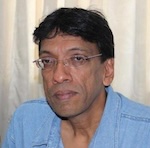
Jehan Perera
The abiding memory I have of Uvindu is on a road in the vicinity of Lake House. Those were fraught days. The atmosphere was loaded with tension. There was a large and noisy protest taking place. The occasion for the protest was the assassination of Lasantha Wickrematunge, editor of the Sunday Leader newspaper. Lasantha had just exposed the scandal of the MIG fighter jet purchase which the new government has reopened.
I was at the protest at the Lake House Roundabout amidst a large crowd. I heard a voice from up high and looked up. On the front wheel of a stalled bus was Uvindu. The bus could not move forward because of the crowd of agitated protestors surrounding it. But the driver was angry and showed an inclination to get the bus moving. Uvindu later explained that he was not trying to commandeer the bus, but was urging the bus driver to be patient and avoid a disaster.
That image has remained with me because it captured something of Uvindu’s character. He was not someone who stood at a distance from events, observing them with detached interest. His commitment to media freedom and political causes was not merely professional. It was passionate. He entered the fray, spoke out and made his presence felt. In the case of the bus, he was being a peacemaker.
The next time I met Uvindu was after many years, in London. My wife Sumadhu and I, on a family visit, met him at a place not of his choosing. In the mid-morning hours, it seemed that a coffee shop was the most suitable place to meet. Uvindu and Sumadhu went back a long way as journalists. It was a warm reunion with a sober discussion on the prevailing political situation in Sri Lanka.
Uvindu was much mellowed compared to the impassioned young man who had hailed me from the bus. But he has retained his fiercely independent and iconoclastic nature which makes him a “Devil’s Advocate” of unpopular causes. He has never been one to accept an argument simply because it is fashionable, politically convenient or supported by those he considers his own.
That quality was evident even before the Colombo Telegraph came into existence. It is reasonable to think that the Colombo Telegraph’s guiding principle, In Journalism, Truth is a Process, reflects something of the person who created it. Truth, for Uvindu, has never been a matter of accepting the first explanation offered by those in authority. It requires questioning, investigation, persistence and the willingness to remain open to evidence, even when that evidence complicates one’s own position.
I am privileged to contribute to the Colombo Telegraph, which is a leading media forum for public intellectuals, academics and activists. Over the years, through his credibility and contacts, Uvindu has been uniquely successful in gathering together an impressive array of columnists who faithfully contribute to the Colombo Telegraph.
But the achievement is not simply that he has gathered writers. It is that he has created a space in which they can write. A good editor must possess an open editorial policy, and Uvindu has accommodated writers whose views do not always coincide with his own. He has understood that an independent publication cannot become merely an echo chamber for the opinions of its editor or its readership.
That openness is not always easy to sustain. The Colombo Telegraph generates a lot of commentary and for the most part Uvindu does not filter. That is also why the Colombo Telegraph has become an important forum for public discussion. Its articles address politics, economics, governance, democracy, corruption, development, international affairs and many other issues that matter to Sri Lanka and its people. It has provided space for arguments that might otherwise struggle to find a place in the mainstream media.
May Uvindu, my friend, and the Colombo Telegraph, to which I am proud to contribute, continue to long serve the cause of enlightened journalism, media freedom and economic, social, political and ethnic justice in Sri Lanka, even as, together, we reach out to a new and better world.