

By Sarath Dissanayake –

Sarath Dissanayake
The Paradigm Shift: A Reality Check
The eternal message of the Buddha is undergoing a global realignment and reality check that mirrors the foundational cosmic law of impermanence (Anicca). In essence, the global landscape of spiritual consciousness is experiencing a profound and paradoxical transformation. While the traditional strongholds of Buddhism in Asia increasingly grapple with a period of spiritual inertia and structural compromise, a vibrant dawn of a deeply conscious embrace of the Dhamma is quietly emerging in regions far removed from its historical cradle. From West Africa to the Americas and Western Europe, a new generation of practitioners is discovering the timeless relevance of the Buddha’s teachings. Yet, this global expansion stands in stark contrast to the internal crises unfolding within its ancient bastions, where the foundational practice of the Dhamma is overshadowed by institutional decay.
This article, which is the third in a series following “A True Buddhist: An Analytical & Pragmatic Critique of Buddhism” and “Spiritual Citadel: Sri Lanka as a Stronghold of Theravada Lineage,” explores the contrasting realities facing contemporary Buddhism. It examines the structural challenges within traditional monastic frameworks in Asia, highlights the vibrant, youth-driven awakening unfolding across the African continent, and outlines the critical path forward as the global Dhamma community prepares for the upcoming International Buddhist Conference, scheduled to take place in Colombo from 28 November – 02 December 2026.
The Fragility of Inherited Truth
For centuries, countries like Sri Lanka have been revered as the bastions of the Theravada tradition; serving as the very spiritual citadels that preserved the Pali Canon and nurtured the monastic lineage through immense historical adversity. Yet, an existential challenge has emerged from within this very preservation. When a profound philosophy transforms into a birthright or a cultural lineage inherited from one’s forefathers, it runs the risk of losing its experiential vitality.
In many traditional Asian societies, Buddhism has increasingly been treated as a cultural backdrop rather than an active, living guide for the mind. The foundational values of selflessness (Anatta), loving-kindness (Metta), and unconditioned generosity (Dana) are frequently overshadowed by the relentless pursuits of the modern era: the greed for capital, the lust for power, and the satisfaction of ego. Concurrently, the younger generation in Asia is drifting away from these traditional frameworks. Raised in a hyper-connected world, youth in countries like Sri Lanka are increasingly accustomed to an atheist or secular lifestyle, heavily patronized by a new wave of socialist critiques, neoliberal thinking, and skeptic westernized mindset. Because institutionalized religion has sometimes failed to address their modern anxieties directly, the youth are mistaking the cultural baggage of traditionalism for the actual philosophy of the Buddha.
Declining State Patronage for Buddhism in the Asian Landscape
Furthermore, across the Buddhist landscape, and most notably in Sri Lanka, this internal cultural disconnect is severely exacerbated by institutional failures at the highest levels of governance. Part of the problem can be traced directly to the declining trends of state patronage and a lackluster attitude toward the Dhamma. The constitutional guarantees that once secured a proud “pride of place” for Buddhism are being systematically eroded; the religion is slowly losing its foremost position due to a distinct deficit in state funding, a seeming lack of political will and institutional interest in protecting places of worship, and a failure to actively support Dhamma preservation. By treating the philosophy with political opportunism rather than genuine reverence, successive leaders have allowed this once-pristine philosophy to be relegated to a mere political tool, leaving the youth disillusioned and the future of the lineage deeply compromised.
Institutional Challenges: Prioritizing Practice Over Ritual
This internal decay is compounded by a profound fragmentation across the Sangha community, where the monastic order stands increasingly polarized by rivalry over trivial matters, institutional fraternities, political dogma, and hierarchical patronage. Deviating sharply from Buddhist strictures, some clergy pay mere lip service to those holding power, chasing favoritism, material gains, and personal status based on political whims.
This systemic non-adherence has opened the door for a widespread regression into blind faith, ritualistic practices, god-worshipping, and astrology, effectively displacing the rational path of self-inquiry. As self-appointed custodians lose devotion to the sublime spiritual values of the Buddha’s purest discourses, everyday followers face a grim reality. Seeing this visible decay and loss of acumen among monastics duty-bound to preserve the Dhamma with due decorum, the lay community is steadily losing faith. When the guardians of the text appear detached from its lived reality, it leaves a profound spiritual void, signaling an urgent need for radical inner reform before the heritage completely collapses into structural irrelevance.
A New Dawn in Africa: Awakening a New Generation of Seekers
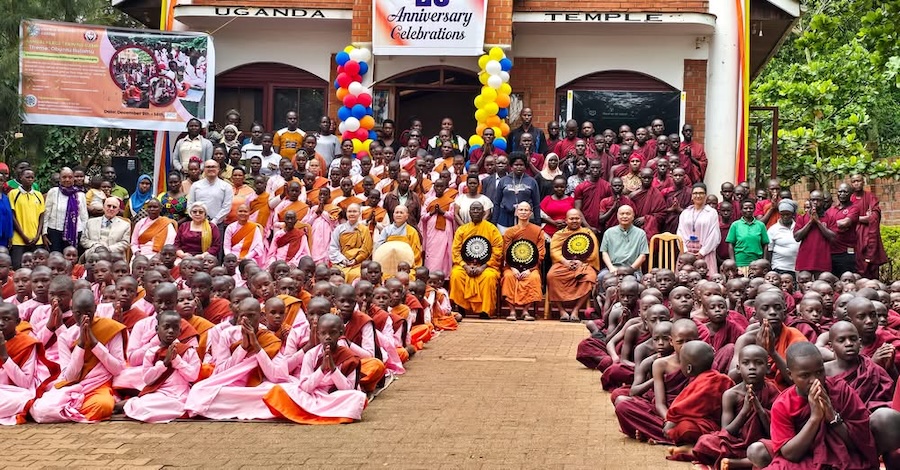
This striking divergence in the practice of the Dhamma is further highlighted by a profound generational contrast. In African nations like Uganda, Kenya, and South Africa, it is the children and youth who serve as the driving force behind the growth of local Buddhist communities, eagerly embracing meditation, mindfulness, and the ethics of the Dhamma as a foundational toolkit for their futures. This youth-driven vitality stands in sharp contrast to traditional Asian societies, where Buddhist temples are increasingly populated by the elderly and those in their twilight years who turn to the religion primarily for solace at the end of life.
Notably, the growing enthusiasm for Buddhist philosophy on the African continent is not a product of forced conversion or aggressive proselytization; rather, it represents a conscious intellectual and spiritual alignment with the core tenets of the Dhamma. African practitioners are drawn to the Dhamma primarily for its radical openness and intellectual freedom. Unlike dogmatic systems that demand blind faith, the Buddha famously encouraged followers to question everything, including his own words.”In a world of institutional decay, this invitation to analyze, test, and critique the very roots of the teaching resonates deeply with a new generation seeking an authentic way of life, one free from the constraints of rigid dogma and empty ritualism.
Dhamma as a Living Reality: The Case of the UBC
This global pursuit of an unburdened, authentic spiritual path finds a vibrant, real-world manifestation at the Uganda Buddhist Centre (UBC). Founded in 2005 by Bhante Buddharakkhita, the center quietly revolutionizes community outreach by beautifully integrating the Buddha’s core sermons with the rich heritage of African cultural values. By prioritizing humanitarian service alongside meditation, the UBC demonstrates how the ancient path remains deeply alive, offering a template of authentic Dhamma to modern seekers worldwide.
This seamless integration with local communities is achieved through vital humanitarian and educational services. Initiatives such as the Buddhist Peace School, the Buddha Medical Centre, and organic sustainable farming programs actively manifest mindfulness and compassion as transformative social forces. The Buddhist Peace School, in particular, rests on a unique three-pillared foundation: the Buddha’s teachings, African traditional wisdom, and the secular educational curriculum. By nurturing children in an ethical learning environment, the center ensures that the next generation grows into conscientious, peaceful citizens, thus showing traditional strongholds how a humble Dhamma school can actively transform lives. (Link for UGC; the Ugandan Buddhist Center – https://ugandabuddhistcenter.org/)
The European and Western Search for Authentic Dhamma
The transformative vitality witnessed in African soil is part of a broader, global awakening that spans Europe, North America, and parts of Latin America. In these societies, where the exhaustion of hyper-capitalism and neoliberal isolation has reached a critical breaking point, the original Dhamma is increasingly approached as a vital corrective. Seekers across these continents are not adopting Buddhism out of mere cultural habit or inherited identity; they are turning to it as an existential necessity. By establishing independent meditation spaces, rigorously studying the early suttas, and anchoring mindfulness within modern healthcare and education, this global community is actively bypassing corrupted institutional frameworks. Even when introduced alongside contemporary wellness and secular spiritual practices, the underlying drive remains a reclamation of the Dhamma’s raw, experiential core.
This global shift offers a sharp mirror for traditional Buddhists in Asia, forcing a vital reflection: Why are those born outside the tradition practicing it with such rigor, while those born into it are letting it slip through their fingers? The international community is systematically stripping away historical accretions to find the unadulterated message of the Buddha, while traditional bastions risk retaining only the outer shell of ritualism.
The Colombo Conference: A Call for the Revival of Experiential Vitality
As Sri Lanka prepares to host the International Buddhist Conference in Colombo, the global delegation must look beyond mere celebration. This gathering cannot simply be an exercise in self-congratulation regarding historical preservation; it must be treated as a critical turning point for introspection and systemic revival. The influx of global perspectives, particularly the fresh enthusiasm from Africa and the analytical rigor from the Western and Latin American landscapes should serve as a catalyst to reawaken traditional strongholds. To achieve this, the conference must establish a definitive path forward:
Dismantle Commodity and Ego: The traditional community must actively purge the tendencies toward greed, power-seeking, and hierarchical egoism that obscure the eternal message of the Dhamma.
Engage the Modern Youth: Monastic and lay leaders must move away from demanding blind allegiance to heritage and instead mirror the Dhamma’s inherent openness, allowing the younger generation to question, debate, and experience the teachings directly.
Foster Global Exchanges: Traditional bastions should actively support and learn from emerging centers of consciousness like the Uganda Buddhist Centre, recognizing that the true survival of the Dhamma depends not on geographic boundaries, but on pure practice (patipatti) and realization (pativedha).
Conclusion
The future of the Dhamma hinges not on the preservation of rigid structures or the survival of politicized institutions, but on a return to its timeless, practice-oriented foundations. As traditional bastions face structural crises, the eternal message of the Buddha continues to transcend geographic and cultural boundaries, demonstrating an innate capacity for self-renewal. This sacred dispensation belongs to no single nation, race, or lineage; it belongs to all sentient beings capable of suffering and awakening. Its decline in traditional Asian strongholds and simultaneous rise across East Africa, Europe, and the West serves as a vivid reminder of the cosmic law of impermanence (Anicca).
While the flame may flicker in its traditional home, a remarkable dawn of consciousness is taking place across the African continent. For a land historically burdened by severe geopolitical, economic, and social extremes, the Buddha’s Majjhima Patipada—the Middle Path—offers a liberating blueprint for moderation. By rejecting both systemic deprivation and hyper-consumerist indulgence, the Dhamma is being embraced not as a foreign religion, but as a universal science of the mind that fosters communal healing, psychological resilience, and a profound global consciousness.
If ancient strongholds do not shake off their complacency, the spiritual center of the Buddhist world will naturally migrate to where the ground is fertile, open, and hungry for truth. As we approach the International Buddhist Conference of 2026 in Colombo, let us resolve to look past inherited pride, remember our true roots, and ensure that this ultimate path of moderation and mental freedom remains a living, breathing reality for the entire world.
Author’s Note: This is the third article of a three-part series compiled in the run-up to the International Buddhist Conference (IBC), scheduled for 28th November – 02nd December 2026, in Colombo, Sri Lanka.
References:
A True Buddhist: An Analytical & Pragmatic Critique of Buddhism (https://www.colombotelegraph.com/index.php/a-true-buddhist-an-analytical-pragmatic-critique-of-buddhism/)
Spiritual Citadel: Sri Lanka as a Stronghold of Theravada Lineage (https://www.colombotelegraph.com/index.php/the-spiritual-citadel-sri-lanka-as-the-stronghold-of-the-theravada-lineage/)
*The writer is a retired Ambassador and former Foreign Ministry Spokesman He can be reached at schandrad@hotmail.com
Sarath / November 12, 2026
(Author’s Note: Completing the Trilogy Ahead of Colombo 2026)
Dear CT Readers,
1. Published above is Part III, concluding my three-part series on the timeless relevance of the Buddha’s
teachings ahead of the International Buddhist Conference (IBC) in Colombo, Sri Lanka (November 28
– December 2, 2026).
2. To explore the complete trilogy in the Colombo Telegraph:
• Part I (Oct 10, 2026): “A True Buddhist: An Analytical & Pragmatic Critique of Buddhism” – Beyond
Blind Faith: Examines Buddhism not as rigid dogma, but as a practical, empirical science of the mind.
• Part II (Oct 16, 2026): “The Spiritual Citadel: Sri Lanka as the Stronghold of the Theravada Lineage” –
Sacred Stewardship: Traces Sri Lanka’s enduring historical legacy as the ancient custodian
preserving the pure Theravada dispensation.
• Part III (Nov 11, 2026): “Buddhism in Transition: Institutional Challenges & Global Awakening” –
Inertia and Renewal: Confronts structural challenges in traditional Asian strongholds while
celebrating the Dhamma’s vibrant embrace across Africa, Europe, and the West.
3. May this series inspire candid introspection and keep the path of moderation a living reality as
global delegates gather in Colombo.
With Metta,
Sarath Dissanayake
/