

Film Review by Vipula Wanigasekera –

Dr. Vipula Wanigasekera
There are some voices that belong not merely to a singer, but to an entire generation. Milton Mallawarachchi’s was one such voice. For many of us who grew up listening to Sinhala music in the 1970s and 1980s, his songs were part of our everyday lives. We sang them at school, at competitions, at social gatherings and simply among friends. His voice became part of our memories.
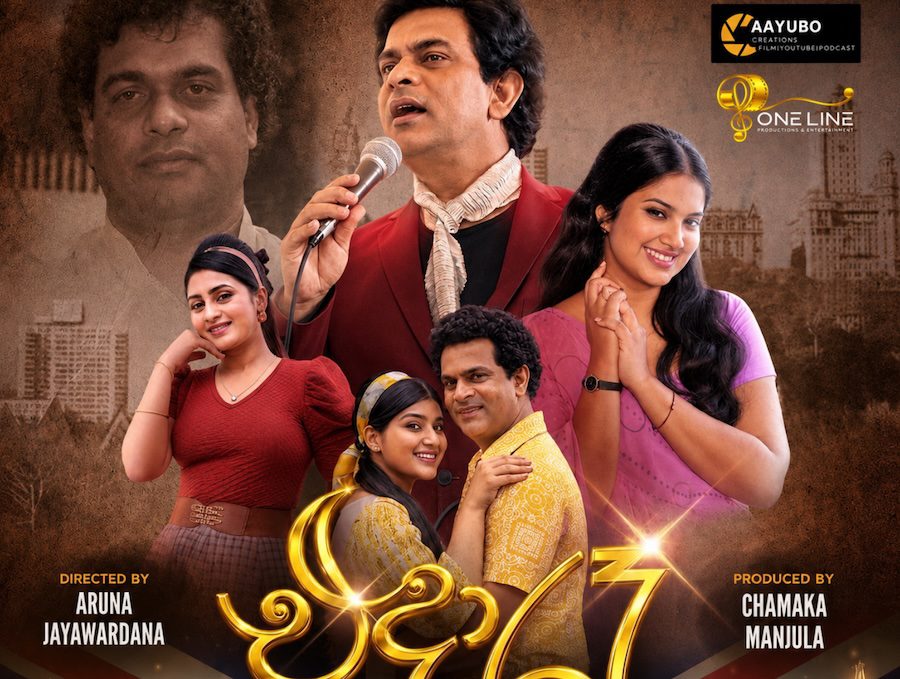
That is why watching Eda Raa – One Voice, Million Hearts, directed by Aruna Jayawardana, is not merely watching a film. It is, in many ways, travelling back into an era that shaped us.
The film attempts the enormous task of portraying the life, rise to fame and personal struggles of Milton Mallawarachchi. With a running time of approximately two hours and twenty minutes, it is an ambitious production that reconstructs not only the singer’s life but also the cultural and musical environment in which he became a national icon. Mallawarachchi was an extraordinarily prolific artist, with a career spanning several decades and hundreds of recordings.
For me, one of the most remarkable aspects of the film was Roshan Ravindra’s portrayal of Milton. There were moments when I genuinely mistook Roshan for the real Milton. This was not simply because of the make-up or physical resemblance. It was his acting-the posture, the mannerisms and particularly the way he stood almost motionless while singing-that brought Milton back to life. That stillness was characteristic of the Milton we knew and heard.
The film also opened my eyes to some of the realities and complexities of the music industry of that era that many of us simply never knew. We saw the struggles behind the fame, the relationships, the disappointments and the pressures that accompanied success. When I heard of Milton’s untimely death in 1998, at the relatively young age of 53, while he was still such a dominant presence in our musical world, it was genuinely heartbreaking.
The scale of Eda Raa deserves special recognition. Going back in time, recreating an earlier Sri Lanka, constructing period sets, identifying the right songs from the hundreds Milton recorded, and portraying contemporary singers, musicians and personalities must have been an enormous undertaking. The filmmakers have accomplished what could easily have appeared to be a mission impossible.
The continuous presence of Milton’s songs throughout the film is, in my view, entirely appropriate. After all, this is the story of a singer. His music should not merely accompany the story; it should tell the story—and in many places, it does.
Yet, precisely because the film is so powerful, I feel the producers could have exercised slightly greater restraint in three areas.
First, the film sometimes carries a continuous undertone of melancholy. Milton’s life certainly had its agonies, but allowing more lighter and more celebratory moments ( there were a few here and there) might have created greater emotional balance.
Second, the repeated visual references to liquor and cigarettes, even if historically accurate, may not always have been necessary. Cinema is not simply a reproduction of reality. Sometimes artistic interpretation is more powerful than literal representation.
Third, some of the darker realities could perhaps have been suggested through rumour, implication and subtle dialogue, rather than being shown directly. A little mystery might have protected the artistic quality while still communicating the complexities of his life.
Nevertheless, Eda Raa is an impressive cinematic achievement and, more importantly, a valuable cultural document. It reminds an older generation of what we once cherished while introducing younger generations to the man behind a voice they may have heard without knowing his story.
And there is an interesting irony as we look at Milton’s journey from today’s perspective. In his era, a talented singer needed producers, record companies, radio, television and the approval of powerful people in the industry to reach a mass audience. Today, social media has changed that equation. A talented artist with a voice, a basic recording device and creativity can reach millions directly—and sometimes become popular overnight.
That may be the greatest lesson Eda Raa leaves us with: technology changes the path to fame, but a truly memorable voice can transcend generations.
*Writer is a former Diplomat, Director General of Tourism Authority, Currently a Lecturer in Commerce, Author, You tuber and meditation/Reiki Healer