

By Mahil Dole –

Mahil Dole
The cascading collapse of Sri Lanka’s national electricity grid on Saturday, 17 October 2026, was more than a technical failure. For several hours the island was without grid power after instability in the transmission network around midday. The National System Operator began restoration using available hydro resources, with partial supplies returning to several districts by afternoon and fuller recovery targeted for the evening. Rooftop solar owners were asked to disconnect, and major water treatment plants temporarily halted operations.
From a national security standpoint, electricity is foundational infrastructure. When it fails at scale, the effects reach command and control, hospitals, water supply, communications, transport nodes, financial platforms, and the operational readiness of security agencies. Even a relatively short outage reveals the margin that separates normal functioning from systemic strain. The fact that a demonstrated vulnerability could again place the entire country in darkness within a short interval raises a further question: whether the risk was adequately visualised and treated as a standing contingency after the comparable failure of February 2025.
What the Event Revealed
The precise trigger remains under investigation. Early indications point to system instability, possibly compounded by a preceding technical issue at a Kotmale facility and by the “Sunny Saturday” dynamic, high rooftop solar output on a bright day coinciding with lower weekend demand. Sri Lanka’s installed solar capacity now exceeds 3,000 MW against typical daytime demand of 2,000–2,500 MW. When non-synchronous generation forms a large share of supply, conventional synchronous plants that provide system inertia are often minimised. A modest disturbance can then produce voltage or frequency deviations, large-scale inverter disconnections, and a cascade that outruns under-frequency load shedding and other controls.
This mechanism is not new. On 9 February 2025 a similar islandwide blackout followed a minor substation fault while solar supplied more than half of demand. Expert analysis attributed the scale of the collapse to low system inertia. Recommendations that followed included updated inverter settings, selective curtailment, and plans for battery storage and pumped hydro. Some steps were taken. Yet the recurrence within twenty months shows that the deeper lesson, high penetration of inverter-based generation without matching grid strength and controllable resources creates a system prone to rapid cascade, was not closed with sufficient speed or institutional force.
The Intelligence and Security Dimension
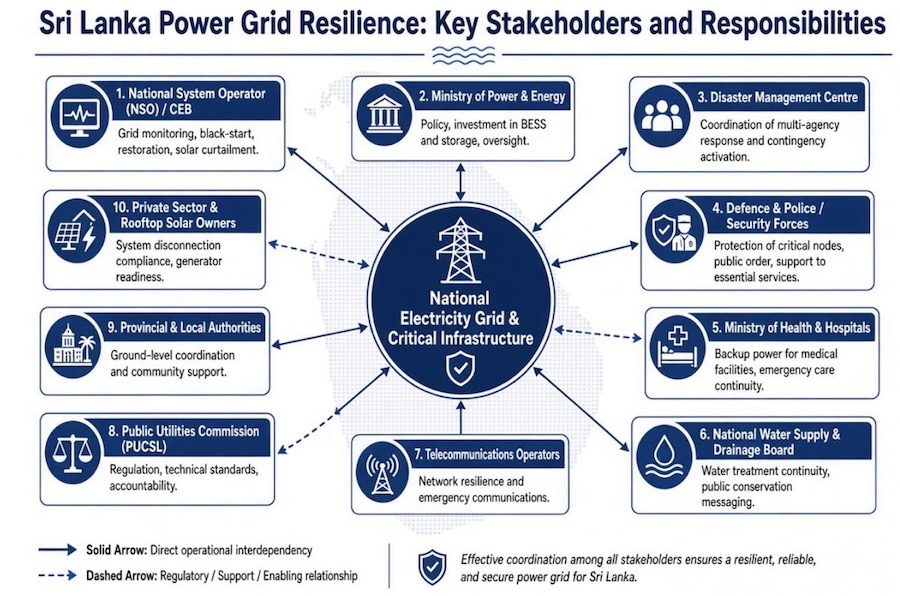
Intelligence agencies are not grid operators. They do not manage frequency control, inertia, or solar curtailment; those remain the responsibilities of the National System Operator, the energy ministry, and the regulator. Their proper role is to identify vulnerabilities in critical infrastructure that could be exploited, to provide early warning of deliberate threats (cyber intrusion into control systems, physical sabotage, or hybrid operations timed with technical failure), and to contribute to whole-of-government risk assessments that treat cascading infrastructure collapse as a national security contingency.
If the demonstrated risk of a rapid, island-wide blackout under high-solar, low-inertia conditions was not adequately captured, escalated, and followed through after February 2025, that constitutes a gap. The shortfall is more likely one of default than design: sectoral silos in which energy planners focus on generation targets while security structures focus on kinetic or foreign threats; critical-infrastructure protection that remains underdeveloped as a standing function; and lessons that are documented but lose urgency once power is restored. Joint exercising between system operators, intelligence, disaster management, defence, health, and water authorities appears limited. Once a vulnerability has been shown to be capable of darkening the country at once, failure to close it within a reasonable interval becomes a governance and security issue, not merely a technical delay.
Were We Ready?
Planning frameworks exist. Institutional disaster management plans cover the electricity sector. Under-frequency load shedding, black-start procedures, and protective systems are in place. System controllers have previously averted full collapses on comparable days, and battery storage and longer-term pumped-storage projects are advancing. These are real assets. Readiness, however, is measured by outcomes. The second major cascading failure in less than two years indicates that contingency arrangements have not kept pace with the generation mix. Distributed solar remains only partially visible and controllable in real time. Critical facilities continue to rely heavily on local diesel generators whose fuel logistics and endurance have not been systematically stress-tested. The temporary halt at major water plants illustrated the tight interdependency of utilities and the narrow surplus available for public-health continuity. Clear, pre-agreed decision authorities and practised multi-agency protocols for a prolonged outage are not publicly evident. In short, technical tools exist, but the broader contingency architecture required to prevent or rapidly contain a national cascade remains incomplete.
Economic and Perceptual Consequences
The direct costs of a multi-hour islandwide outage include unserved energy, temporary business interruption, generator fuel, and secondary effects on water supply and logistics. Earlier events of this nature have been estimated to cost several billion rupees once both utility losses and wider productivity impacts are counted. A Saturday outage reduces the absolute figure relative to a weekday, yet the cumulative damage from recurring reliability problems is larger. Sri Lanka is still consolidating recovery from the 2022 crisis. Investors in manufacturing, information technology, business-process outsourcing, and tourism treat infrastructure reliability as a basic condition. Repeated failures raise operating costs, complicate financing, and can slow the return of higher-value activity.
International coverage of the October outage has so far been largely factual, noting the grid trip, the possible contribution of excess solar, and the earlier 2025 incident. Recurrence itself, however, enters the record. Neighbouring countries and external partners assess state capacity partly through the performance of basic infrastructure. A pattern of cascading failures linked to unmanaged renewable growth, without commensurate investment in storage and grid flexibility, can reinforce perceptions of institutional lag and influence investment and financing decisions.
Closing the Gap
The appropriate response is not to reverse the energy transition. Renewables reduce fuel-import dependence and carry strategic value. The requirement is to match the speed of capacity addition with the physical and institutional capacity to operate the system securely, and to treat the residual risk as a standing national contingency.
Priority steps include faster deployment of grid-scale battery storage and other resources that restore inertia and provide fast frequency response; enforceable technical standards for inverters together with better real-time visibility and control of distributed generation; strengthened black-start and selective islanding capabilities for hospitals, security nodes, water plants, and key communications; and regularly exercised whole-of-government plans that integrate the system operator with intelligence, defence, police, disaster management, health, and water authorities. An independent technical review of the 17 October event, comparable to the process that followed February 2025, would identify remaining gaps and create accountability for implementation. Intelligence and security structures should maintain an updated assessment of critical-infrastructure cascade risks so that known vulnerabilities do not remain unaddressed between incidents.
Conclusion
The islandwide power failure of 17 October 2026 was contained in time and is being restored. It nevertheless reconfirmed a structural vulnerability in infrastructure that underpins national functioning. The interval between a demonstrated technical warning and effective systemic remedy is itself a security gap. In a system where high solar penetration can, under certain conditions, place the country in darkness at once, resilience requires continuous investment, joint exercising, and the willingness to close known risks before the next sunny low-demand day.
Sri Lanka has shown the operational ability to begin recovery promptly. The larger test is whether the lessons of 2025 and 2026 produce durable improvements in grid strength, contingency depth, and inter-agency readiness, including the intelligence community’s contribution to visualising and elevating critical-infrastructure risks. Electricity reliability is not solely an economic or engineering matter. It is a standing component of national security. Treating it as such will better serve both the daily needs of citizens and the longer-term stability of the state.
*The writer is a Senior Superintendent of Police (Retd.), former Deputy Director in charge of the Counter Terrorism Desk of the State Intelligence Service, and author of Security Beyond Enforcement: Practical Approaches for a Safer Nation. Emai-mahildole54@gmail.com