

Having read a few tributes to the late Professor Thiru Kandiah (Thiru from here on) who passed away on 10th October in Perth, Australia, I thought that I will share some of my academic experiences with him.
I met Thiru in 1970 when I wanted to organize a forum in the University of Peradeniya for discussing scientific socialism. The project collapsed after the 1971 April insurrection, but the relationship developed into a close friendship with him and his family. We met almost weekly between 1974 and 1984, often over dinner at his home standing alone off Galaha Road on the other side of the university sports grounds, until I left for the UK and Thiru for Singapore sometime after.
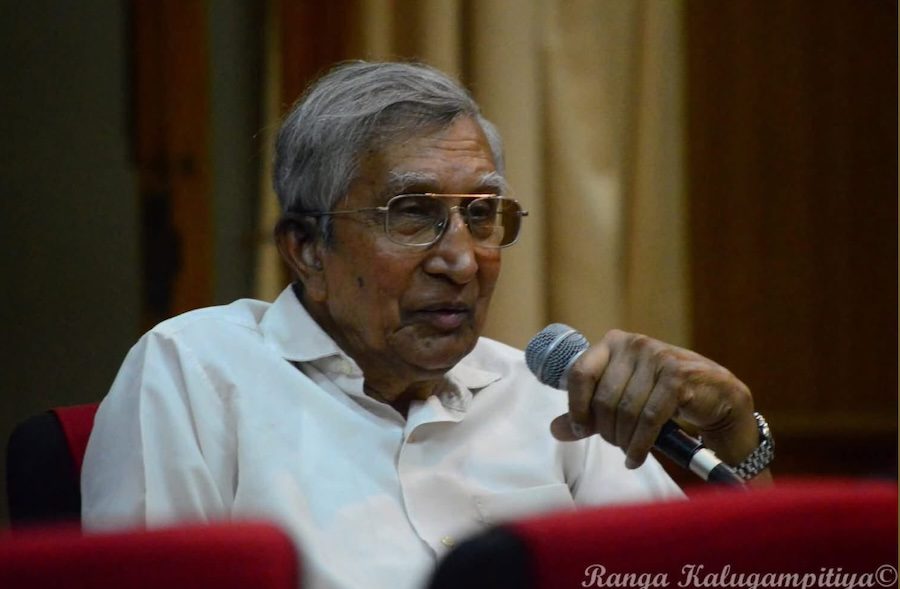
Professor Thiru Kandiah | Photo Credit Ranga Kalugampitiya
Thiru had many interests in life besides teaching of English and research in linguistics. He had active interest in theatre and music which brought some very remarkable people to his home including the outstanding surgeons Mark Amerasinghe and Barr-Kumarakulasinghe, both of whom as a matter of principle would not do private practice while in public service. I also met several other remarkable people at his home besides his many adoring students. He was an enthusiastic gardener who maintained a beautiful rock garden on the side of his house.
His ways were simple and he cared for people. His care and kindness are things that anyone who had dealings with him could not have missed. I vividly remember his picking me up to visit students who were hospitalized after the police attack on students who laid siege to the Senate Building in the morning of 12th November 1976 when a student was killed by a stray police bullet. While Thiru and I had reservations about the strike, we were among the few academics to visit the injured students.
Turning to my academic dealings with him, I should say that I have the dubious distinction of being the only non-linguist to co-author a research paper in linguistics with him. Thiru was perhaps the only academic who had time for me to discuss problems of modernity in Tamil. I was keen on introducing a few new consonant symbols and diacritical markers for vowels for writing foreign names correctly in Tamil. I had written in Tamil on the subject and, as expected, conservative opinion backed by irrational arguments was hostile.
Thiru told me that Tamil scholarship was by and large reluctant to modernize Tamil and that a scientifically argued case presented in English will help rational discussion, as people who argue foolishly in Tamil do not like to look foolish to scholars from other communities. Meantime, he challenged me to address other demands of modernity like developing an efficient typewriter keyboard design and writing in flowing hand (cursive script) which will help writing legibly at speed. He cleaned up my text for style and content and helped me to publish my piece on cursive script in a reputed Indian journal in linguistics.
As for the paper on script modernization, Thiru’s intervention expanded what would have been a six or seven page article into a 46 page document. He insisted on justifying every argument with reference to tradition as well as modern Tamil, to provide a historical perspective and to argue that the proposals would not only to allow correct rendering of foreign names but also accommodate many new words that are now part of the language that are articulated correctly in speech but not in writing. Thiru’s input was substantial and he had spent tens of hours on it besides long discussions with me which educated me on some aspects of linguistics and phonetics. It took much persuasion on my part to make him my co-author. He agreed eventually for an unselfish reason I think. Having his name as co-author did play a role in the publication of the paper in a highly regarded Indian journal.
I was perhaps one among the many beneficiaries of his generosity with time.
Not many know that Thiru also had a rough time in the university as a victim of academic mischief in the mid-1970s. He had interesting ideas about teaching English as a second language. One was the use of current news in teaching. So his team of teachers in the English Language Teaching Unit created a bank of sentences which were used in teaching grammar and composition. One of the sentences was “Mrs Bandaranaike had an operation”. Someone either seeking to curry favour with high-ups in government or as an act of mischief reported to the Ministry of Education that teaching of English has been used to humiliate the Prime Minister.
What could have been resolved with a call for explanation and an apology for unintended offence was blown into a full inquiry into all the sentences. Thiru expected his colleagues to accept collective responsibility. But that did not happen, and he became the target of the inquiry. Although he was eventually cleared of offence, the process hurt him emotionally as it also led to some strained relationships. That I am sure was not the only occasion when he paid a price for his beliefs and forthrightness.
His view of language was that it was a democratic institution that cannot be rigidly rule bound. This outlook probably made him a champion of the notion of multiple Englishes. He along with several Asian scholars upheld the view that the versions of English spoken in the former colonies are unique languages in their own right and have developed into entities with their respective national identities. His concept of ‘Kaduwa’ (English as referred to commonly at the time) elaborated on the role of English as a weapon of power over non-speakers of the language.
I would add here that Lankan English like the class that uses it extensively can be located in society in the same way as the bourgeois elite of former colonies who dominate over the oppressed classes while being victims themselves of neocolonialism.
Thiru would also accept any colloquial language as one on par with the standard language, with its own set of grammatical rules, word stock and potential to communicate complex ideas.
Interestingly, Thiru left Peradeniya around the same time as I did (1984) and rejoined Peradeniya around the same time as I did (1998). While I got academically lazier in the past decade or so, Thiru kept himself busy to his last breath.
Happy memories of Thiru, Indranee, Niranjan and Shivanthi and their hospitality during my Peradeniya years linger on.