


Dr. Murali Vallipuranathan
The remarks recently delivered by Dr. S. Arivalagan, Senior Lecturer at the University of Jaffna, at the National Intellectuals Organization (NIO) conference regarding Sri Lanka’s ethnic conflict and political history demand rigorous critical scrutiny. When an academic addresses public policy and national history from the podium of an intellectual forum, the discourse must be firmly anchored in objective historical evidence rather than tailored to fit the partisan propaganda or convenient historical erasures of a ruling political movement.
This response is offered not merely to engage in polemics with Dr. Arivalagan, but out of an urgent necessity to sensitize the southern ruling elite and southern intellectuals to the living realities, historical grievances, and collective perspective of the Tamil people—perspectives that continue to be trivialized or dismissed under simplistic, sanitized political narratives.
Below, I delineate the primary substantive flaws and fallacies in his address.
Screenshot
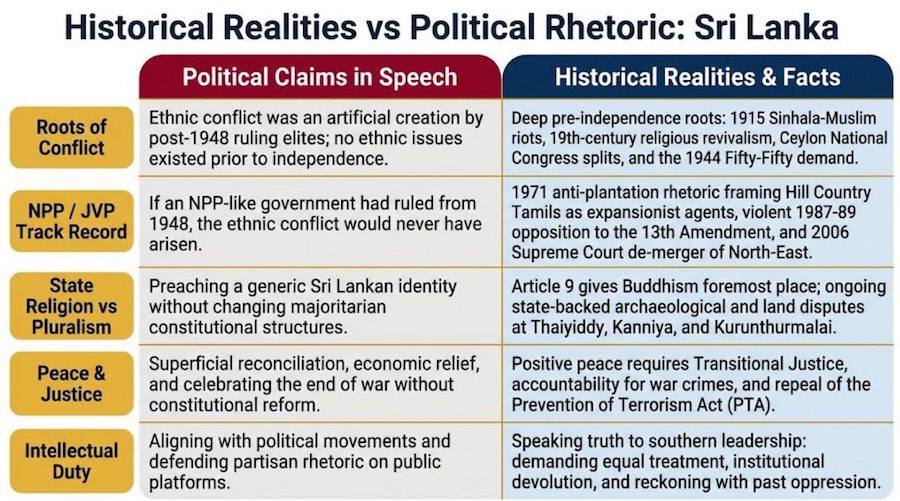
1. Pre-Independence Ethnic Cleavages and the 1915 Pogrom
The assertion that “prior to independence, or at the time of independence, there was no ethnic problem in Sri Lanka, and that it was an artificial construct invented post-1948 by elite rulers” collapses under the weight of basic documentary history.
The 1915 Anti-Muslim Riots: Thirty-three years prior to independence, the 1915 anti-Muslim riots engulfed the island, causing widespread loss of life, desecration, and destruction of property. This horrific episode remains undeniable historical evidence that sectarian, ethno-religious rivalries and chauvinistic majoritarian impulses were deeply entrenched well within the colonial period.
Identity Politics and Representation Disputes: The religious revivalist movements of the late 19th century laid the ground for modern ethno-national identity politics. The fissures within the Ceylon National Congress in the 1920s, the fierce disputes over communal representation surrounding the 1931 Donoughmore Constitution, and G. G. Ponnambalam’s advocacy for balanced representation (“Fifty-Fifty”) before the Soulbury Commission demonstrate that profound structural and political antagonisms predated post-colonial self-rule.
While post-independence regimes systematically exploited and escalated majoritarian chauvinism for electoral gain, claiming that ethnic tensions did not exist prior to 1948 is an absolute denial of historical fact—tantamount to the classic Tamil proverb of trying to hide an entire pumpkin in a plate of rice.
2. The Anachronism: “Had the NPP Existed in 1948, There Would Be No Conflict”
Projecting a 21st-century political platform backward to 1948 without situating historical developments in their distinct socio-temporal contexts is an unscholarly anachronism. More crucially, the historical record of the Janatha Vimukthi Peramuna (JVP)—the core ideological and organizational backbone of the National People’s Power (NPP)—on the Tamil national question and devolution of power cannot simply be airbrushed:
Stigmatization of Up-Country Tamils: In Rohana Wijeweera’s foundational “Five Lectures” during the 1971 insurrection, the Up-Country Malaiyaha Tamil estate workforce was explicitly characterized as an instrument of “Indian expansionism.”
Violent Resistance to Devolution (1987–1989): During the second southern insurrection, the JVP waged a ferocious armed campaign against the Indo-Lanka Accord and the Provincial Council system under the 13th Amendment, framing regional devolution as a treasonous conspiracy to divide the island.
De-merger of the Northern and Eastern Provinces: It was the JVP that filed the fundamental rights petition in the Supreme Court in 2006, resulting in the judicial de-merger of the temporarily unified Northern and Eastern Provincial Council, actively dismantling what the Tamil people regard as their contiguous traditional homeland.
To claim that a political tradition that spent decades violently and judicially opposing regional autonomy would have averted the ethnic conflict had it governed in 1948 is an exercise in political fiction.
3. Multi-Ethnic Republic or Sinhala-Buddhist Hegemony? Ongoing Encroachments in the North-East
While Dr. Arivalagan advocates for an umbrella “Sri Lankan identity,” he skirts a fundamental structural question: Is the JVP/NPP genuinely prepared to accept Sri Lanka as a secular, pluralistic, multi-ethnic state where all communities enjoy equal constitutional standing?
The Constitutional Contradiction: Article 9 of the Constitution accords Buddhism the foremost place and mandates the state to protect and foster the Buddha Sasana. The present NPP administration has signaled no willingness to repeal Article 9 or establish a secular, egalitarian framework; on the contrary, assurances persist in the south that Buddhist pre-eminence will remain uncompromised.
Structural Sinhalisation and Land Grabs: The “foremost place” doctrine is not merely symbolic text; it continues to manifest on the ground in the North and East through systematic cultural and territorial incursions:
Tissa Vihara in Thaiyiddy, Jaffna: Erected and expanded on seized civilian lands;
Kanniya Hot Springs and Shivan Kovil, Trincomalee: Attempted state takeover of the historic sacred site under the pretext of archaeological conservation;
Kurunthurmalai Aadhi Shivan Temple, Mullaitivu: Construction of a Buddhist stupa carried out in open defiance of magistrate court injunctions.
In all these instances, the majoritarian, assimilationist state apparatus operates unabated, with the current administration failing to halt the process. Preaching a common “Sri Lankan identity” on public platforms while leaving institutionalized Sinhalisation intact on the ground represents a blatant double standard.
4. Positive Peace Requires Transitional Justice and Demilitarization
A genuine state of Positive Peace cannot be achieved merely through the absence of active warfare (Negative Peace) or through transactional economic developmentalism.
Accountability for Past and Ongoing Violations: Credible, independent inquiries meeting international standards must address war crimes, enforced disappearances, and egregious human rights violations perpetrated by state organs. Justice and truth for victim communities are non-negotiable foundations of real reconciliation.
The Prevention of Terrorism Act (PTA) and Surveillance: The ongoing reliance on the draconian Prevention of Terrorism Act (or proposed alternative counter-terror regimes of equal severity), sustained high-density militarization, and the ongoing surveillance of civil society activists in the North-East preclude genuine reconciliation. Any discourse on “national unity” that bypasses accountability and human rights protections remains mere administrative rhetoric.
5. Deferring Devolution: The Fallacy of “Trust First, Power-Sharing Later”
The argument that “reconciliation and trust must be built first, and devolution considered only thereafter” is simply a recycled iteration of the southern establishment’s seventy-year-old delaying tactic—prioritizing functional integration over constitutional restructuring.
Devolution of power is not a philanthropic concession dispensed at the discretion of majoritarian benevolence, nor is it a privilege conditional upon sentimental camaraderie. It is a fundamental constitutional guarantee essential for preserving the political integrity, physical security, and self-governance of minority national communities within a plural society. Postponing political solutions indefinitely behind nebulous promises of economic relief has failed repeatedly throughout our post-independence history.
6. The Misattributed Lee Kuan Yew Quote
The claim that Lee Kuan Yew once aspired to “turn Singapore into a Colombo” is a persistent urban myth of Sri Lankan political rhetoric. In his memoirs, The Singapore Story, Lee Kuan Yew did not cite Ceylon as an aspirational benchmark, but as a tragic cautionary tale—a stark illustration of how a promising country can squander its human and economic capital through toxic communalism, majoritarian appeasement, and short-sighted populist promises. Academic ethics require that verified historical facts take precedence over popular political folklore.
7. Trivializing Cultural Rights and Collective Memory as “Distractions”
Equating state-sponsored provocations in the south (such as those led by Gnanasara Thero) with the memorialization of Thileepan in the North, and dismissing both as “artificial distractions” unrelated to the daily livelihoods of ordinary people, demonstrates a disregard for minority cultural rights and collective grief.
Subordinating civil, historical, and national identity rights entirely to materialist economic grievances repeats the classical dogmatic error of reducing structural ethno-national oppression purely to a “class question.” For victimized communities, the right to memorialize their dead and protect their cultural heritage is inextricably linked to their fundamental dignity and survival.
8. The Responsibility of the Intellectual
Intellectuals and academics bear a profound ethical duty. Rather than ascending political stages to rationalize official party doctrine, a genuine intellectual must speak uncomfortable truths to both their peers in academia and the southern political leadership.
If sustainable peace and a lasting constitutional settlement are to take root, southern society must acknowledge past state-inflicted atrocities, reverse historical injustices, and commit to institutional equality. Reducing the national ethnic question to a minor electoral variable or an economic byproduct directly undermines the path toward a just society.
Conclusion
There is no dispute that Sri Lanka requires systemic governance reform, the eradication of institutional corruption, and sustainable economic revitalization. However, real transformation cannot bypass the ethnic question. It must commence with an honest reckoning with historical realities, an explicit recognition of Sri Lanka as a pluralistic and multi-ethnic state, an immediate halt to ongoing land grabs across Thaiyiddy, Kanniya, and Kurunthurmalai, and the implementation of authentic transitional justice.
A “national reconciliation” that manipulates history, retains draconian security laws, and implicitly preserves Sinhala-Buddhist hegemony cannot deliver enduring stability.
Finally, while I contest Dr. Arivalagan’s political and historical analyses, I categorically condemn the personal vitriol, ad hominem attacks, and character assassination directed at him and his family across social media. The fundamental standard we instill in collegiate debaters remains paramount: ideas must be met with counter-arguments, never with personal abuse. This civic norm applies equally to academic debates, journalism, and public discourse.
(Note: For documented historical background on state archaeological overreach and land appropriation in the Northern Province, see the analytical report: Thaiyiddy Issue Explained in Tamil.)
Author Note & Disclaimer: Dr. Murali Vallipuranathan is a Visiting Lecturer at the Universities of Colombo and Peradeniya, a Senior Specialist at the Ministry of Health, and a Council Member of the Sri Lanka Medical Association. The views expressed in this article are offered in a spirit of civic and social responsibility to advance reconciliation, human rights, social justice, and accountability in Sri Lanka, and do not reflect the official positions of any affiliated institution.