

By Gayanga Dissanayaka –

Gayanga Dissanayaka
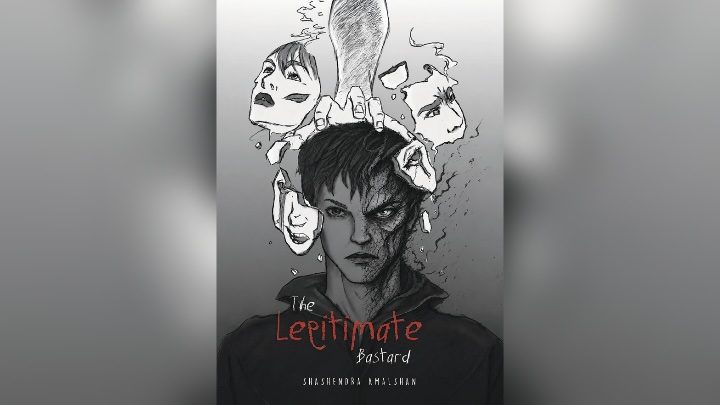
When Shashendra Amalshan picks up a novel, he looks for human stories and characters to fall in love with. That was precisely the spirit in which a long, fifteen-year journey of story creation began. Shashendra did not set out on a crusade to raise awareness about marital rape laws. In truth, when the first lines were penned, he was not even aware that the legal framework failed to criminalise marital rape in our country. His goal was far simpler: to tell the story of a young boy who witnesses his mother being sexually assaulted by his own father, and to trace how that haunting childhood memory shapes the rest of his life. Whatever social issues the narrative eventually confronted emerged organically, as direct consequences of the boy’s lived experience. Today, Shashendra is the author of the novel, “The Legitimate Bastard” published through The Jam Fruit Tree Publications.
In the early stages of writing, the narrative was headed down a very specific path. The initial plot aimed for a dramatic climax: a child prosecuting his own father in a court of law. It felt like a compelling premise, full of natural tension and courtroom chaos. But when the author shared the outline with a friend studying at the Law Faculty, the entire foundation crumbled. His friend delivered a stark reality check: under the current legal system, marital rape is not recognised as a crime.
“I found that to be shocking. And just like that, the entire plot I had in mind came crashing down as well,” said Shashendra. “I didn’t know where the story should head to or what the boy in the story should do, so I stopped writing. A part of me wished the laws would come, so I could do my research and write that story. But sadly, we still have not.”
It took the persistent encouragement of one of his friends years later to finally pull the manuscript back out of the drawer. “Even then, I had no idea how it would end. I just kept writing, following the boy through what he was going through,” said the author. “In a way, I was like a reader discovering the story as I wrote it, without knowing where it would lead. It was only after I had written around 160 pages that I finally figured out the ending. Once I did, it became easier to direct the story towards that ending.”
Shashendra mentioned how reading this book is not meant to be an easy or comfortable experience. Because as a reader, you are plunged into their world, and you are only a passive observer with no power to do anything about what the characters are going through. “It’s like having free licence to roam into the deepest corners’ of the characters’ minds. You see everything with such vivid detail, but you cannot do anything about it, other than maybe follow through their journey,” said Shashendra.
If someone wants to understand the legal specifics surrounding marital rape, a quick search provides the facts easily enough. Over 150 countries worldwide have criminalised non-consensual sex within marriage. Realising that one’s own country remains part of the shrinking minority that has failed to pass such laws was alarming to Shashendra. The author explained how while legal reform alone cannot eradicate abuse overnight, a clear law establishes a vital baseline: it signals that non-consensual sex is a crime regardless of whether a marriage certificate exists. Without that legal boundary, a marriage certificate functions almost like a licensed exemption.
While social media and public forums discuss these issues endlessly and in detail, a novel on this topic operates differently. It bypasses technical arguments and puts the reader directly inside the emotional reality of someone living through the ordeal. It offers the closest possible glimpse into another person’s internal world. “And of course in a novel, a writer can offer characters some form of a redemption arc or at least a sense of closure. Sadly, real life does not offer that,” said the author.
Domestic violence narratives frequently center on the woman’s experience, highlighting her direct suffering and survival. While those stories are crucial, this novel deliberately shifts the focus to the child’s perspective, exploring a layer of domestic trauma that remains far less discussed.
“I know most writers tend to glamorise writing as this passionate thing they do. But most of the time, I wish I was anything but a writer. The more I write, the deeper I tend to delve into darkness itself,” Shashendra recalled. The process began years ago with poetry and short stories, which initially felt therapeutic for him, a way to clear heavy thoughts out of the system. “But when you continue doing that for a long time, you just don’t know where that abyss of darkness ends. You just find new ways to articulate that darkness better and you keep digging deeper into an abyss of darkness with no bottom. Then that darkness begins to devour you and maybe even define you. I honestly don’t know whether that’s healthy or not,” he said.
Shashendra mentioned how certain parts of the story were originally written as poems. “I have a lot of respect for poets, but when you write poetry, you often use metaphors, imagery, symbolism and leave it for the reader to read between the lines or interpret,” he noted. “What happens then is that people sometimes end up appreciating the lines and the creativity of the writer without necessarily truly understanding what the writer is trying to say with the words. Also, poetry is read and appreciated amongst poetry communities only.”
In a way this is what made him want to write the story as a novel. He told himself that he is not going to be poetic, and there won’t be any sugarcoating either. It would be raw, explicit even, and more importantly real. “I wanted anyone who picks up the book to be able to follow the story, understand it and maybe even be moved by the story,” said the author.
Releasing such a raw work into the world naturally brings a profound sense of vulnerability. A writer never knows how an audience will react, or whether readers will have the strength to delve into a story that refuses to look away from hard truths. Yet, seeing the physical book published brought primarily a feeling of relief to him. In a life crowded by competing responsibilities, so many poems, short stories, and half-finished scripts remain stored away in drawers, getting this single story completely told and published gave Shashendra a sense of having finally done something that mattered.
Now that it is out in the open, the story no longer belongs to a drawer or a private manuscript. It stands entirely on its own, compelling readers to look directly into a dark corner of human experience that society too often pushes aside. In doing so, it serves as a stark, unforgettable reminder of the truths we can no longer afford to ignore.
Rajash / November 10, 2026
I was browsing Colombo Telegraph, looking for new comments and articles, when I came across this headline:
“Outside The Protection Of The Law: The Legitimate Bastard”.
For a moment, I thought it was about Gnanasara Thero and the ongoing comedy in Anuradhapura.
What a disappointment!
/