

By Rajan Philips –

Rajan Philips
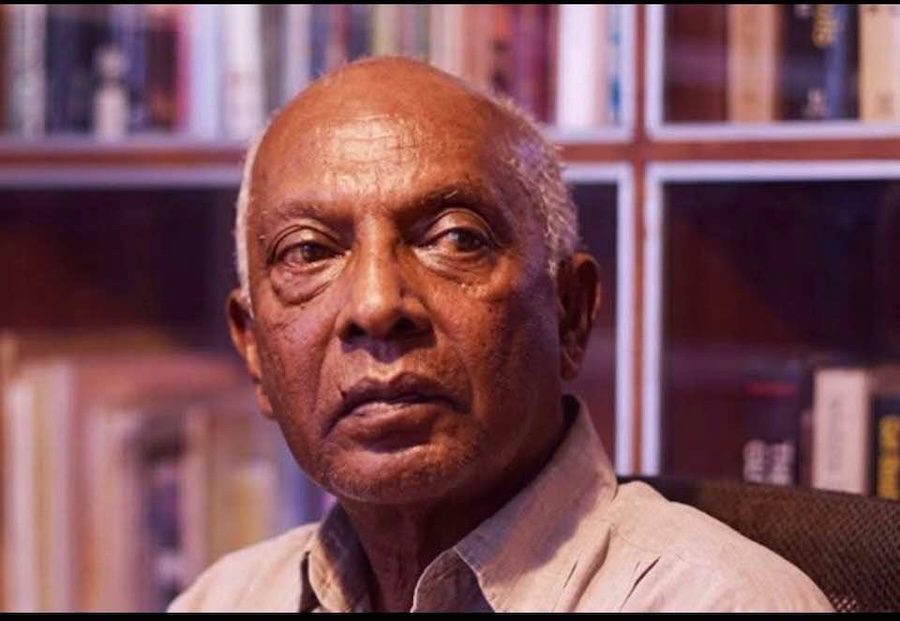
Lal Wijenayake, veteran lawyer and consequential left leader, passed away in Kandy, on Saturday, October 31. He was 87 and in good health for his age. He had his constitutional walk around the lake on Friday, but took ill a day later, and got admitted to Asiri Hospital where he passed away peacefully. His sudden death came as a shock to everyone who knew him and knew of him. Living cricket legend Kumar Sangakkara who had known “Lal Mamma” from his childhood days as his father’s professional colleague and family friend, paid his tributes in an emotional social media post. President Anura Kumara Dissanayake travelled to Kandy on Sunday to pay his last respects to the veteran Samasamajist who had played an unassumingly facilitating role in transitioning the rebellious JVP outfit of the 20th century into a democratic NPP political force in the 21st century.
Lal Wiajenayake
A native of Kandy, his early life was set on the tea plantations where his father worked as an Apothecary. He became conversant in Tamil and cultivated a lifelong belonging to estate life and the women and men who work there. He studied at the Kandy Dharmaraja College where he has been feted as one of its outstanding products. From Dharmaraja he secured admission to the new Science Faculty at Peradeniya and earned his degree in the Physical Sciences in 1965. He took to teaching after Peradeniya, switched to Law later and became an advocate in 1969.
Lifelong LSSP Member
Lal joined the Lanka Sama Samaja Party Youth League as a university student. Lal and Kumar David were the two youngest delegates at the historic 1964 LSSP Conference that ushered in the era of coalition politics. Through all the vagaries and vicissitudes that followed the 1964 parting of the ways, Lal Wijenayake and Professor Vijaya Kumar (who joined the LSSP a year or two later) have kept their LSSP Membership intact, and have been, besides all their other contributions at the national level, the two most endearing and engaging personas of progressive politics in Kandy. Lal spent his last days trying to convene a gathering of old LSSPers and other left-minded people to find new common ground for future political action.
The roots of his progressive outlook and politics are not difficult to discern. He grew up on the very sites of plantation capitalism under colonial rule. He saw firsthand his father diagnosing and dispensing medication to tea workers on the estates. The forties were years of war, economic depression and the malaria epidemic. They were also years of incipient politics inspired and organized principally, if not solely, by the LSSP. Dharmaraja College itself was a fertile terrain for social awareness and political inspiration. One of the first generation Buddhist Theosophical schools established at the height of colonial rule to impart national education in the English medium, Dharmaraja College was in the forefront of fulfilling that mission.
Lal’s many contributions to law, politics and society were felicitated in a book of tributes compiled by Prof. Liyanage Amarakeerthi and formally released at the Dharmaraja College Auditorium on 30 April 2021. More than his politics and law, he was appreciated as a writer, collector of works of art and books, and as a mentor to young people whom he encountered. He was a close friend of George Keyt and recipient of some of Keyt’s inspired paintings. He was also close to Ediriweera Sarachchandra and Gunadasa Amarasekara.
One of his early stints as a lawyer was as a Junior Lawyer to the formidable S. Nadesan Q.C. in the Criminal Justice Commission trials during the United Front Government. Defending civic rights, human rights and minority rights became the passion of life, and this was not in spite of his political affiliations but because of the principled premise of his politics and affiliations. He was the lawyer of first resort for dismissed workers and dispossessed farmers. He would also be the advocate of last resort, arguing fundamental rights cases in the Supreme Court.
Post 1977 Politics
After the 1977 electoral wipeout of the Left, Lal was among those who committed themselves to the slow building of a progressive counter to President Jayewardene’s UNP juggernaut. There were many points of confrontation – trade unions, privatization of education and transport, re-privatization of the estates, orchestrated riots, political arrests, and the referendum chicanery. The government prevailed in every one of them using every trick and brute force.
The first real break for the progressives came with the elections to the controversially created Provincial Councils. The SLFP and the JVP, the latter very violently, opposed both the Provincial Council system and first set of PC elections in 1988. The only opposition to the UNP was organized by the fledgling United Socialist Alliance (USA), comprising the Chandrika Kumaratunga faction of the SLFP, the LSSP and the CP. The USA alliance vigorously supported the 13th Amendment and its enabling of the Provincial Council system.
Lal Wijenayake led the slate of USA candidates in the Central Province and became Leader of the Opposition to the UNP Provincial Government in Kandy. There was not much the opposition could do with the UNP using Provincial Councils not as units of devolution but as instruments of party control. Yet the Provincial Councils provided the platform for the USA progressives to organize their forces, including the SLFP, into a new and broader alliance – the People’s Alliance (PA).
From PA to NPP
When the next round of PC and national elections came in 1994, Candrika Kumaratunga and the People’s Alliance she led were ready to throw the UNP out of office. The UNP had by then grown old after 17 years in office, and the people had gotten tired of it. With the SLFP back in the alliance the LSSP and the CP were crowded out by the SLFP numbers.
Yet Lal and others soldered on championing national reconciliation and constitutional reform. He was part of perhaps the most extensive political outreach in the south, launched to promote the promise of peace and explain the purpose of devolution. That outreach, in which the late Tissa Vitarana played a major role, has had its effects. To her credit, Chandrika never wavered from the outreach goals even though she failed to implement them. There have been palpable changes in the political mindset and attitudes among Sinhalese in the south.
There was growing support for peace, sympathy for the plight of the people caught in the LTTE-Army crossfire, and greater support for a political solution instead of warring over sovereignty and self-determination. Federalism, the dreaded ‘F’ word of the 20th century, is no longer a taboo in political table talk. Intellectually, it has become possible to see federalism and unitarianism not as polar opposites but as defining a continuum with a range of possibilities in between. The most surprising development is the evolution in judicial thinking – to the point of opining that it is not unconstitutional to advocate for federalism in Sri Lanka in spite of the unitary constitution.The political corollary of these changes is the 13th Amendment to the Constitution and the Provincial Councils, even though they had preceded the PA, the outreach movement and judicial evolution.
In the long hindsight of history, credit for implementing both in the most hostile of circumstances belongs to the executive persistence of President JR Jayewardene. Alas, his UNP successors and others after 1994 have betrayed the spirit of devolution and strayed away from the terms that define it. The violent intransigence of the LTTE and the military response under the Rajapaksa regime, with the JVP in tow, took the country on a violent detour to the 2009 denouement.
No sooner, the Rajapaksa presidency dissolved into decadent infamy. The constitutional symptom of the decadence was the 18th Amendment. 18A became the touchstone for leftists who had remained in the PA after Mahinda Rajapkasa became president, to reconsider their alliance. Lal Wijenayake, Vijaya Kumar, Jayampathy Wickremaratne and others broke ranks with those in the LSSP who chose to remain with the Rajapaksa government.
Lal became active in the legal challenges against 18A and against the impeachment of Chief Justice Shiranee Bandaranaike. He was a founder member of Lawyers for Democracy, now Lawyers Collective, and a central figure in the organization’s efforts to defend the rule of law, the independence of the judiciary and the constitutional protection of the rights of all Sri Lankans. Politically, Lal joined forces with Sobitha Thera’s movement to abolish the executive presidency and supported the common presidential candidacy of Maithripala Sirisena in the 2015 presidential election.
Sirisena went on to defeat Mahinda Rajapaksa, the first and the only incumbent to lose a presidential election. The Sirisena presidency, rather the Sirisena-Wickremasinghe yahapalana diarchy, secured the passage of 19th Amendment and rescinded 18A. The diarchy also initiated an elaborate process towards achieving constitutional reform. Lal Wijenayake chaired the Public Representations Committee on Constitutional Reform and produced a comprehensive document after meticulous consultations with multiple stakeholders throughout the country.
The mountain of reports that Lal and others produced went nowhere as Sirisena was out of his constitutional depth and Ranil Wickremesinghe took everyone for a ride while keeping his options open to run for president again. Neither man was under any serious pressure to terminate the executive presidency after the unfortunate death of Sobitha Thera in November 2015.
As frustrations with the barren politics of Sirisena and Wickremesinghe grew, people like Lal, Vijaya Kumar, Kumar David, Uvindu Kurukulasuria and others saw a new avenue for progressive politics in the JVP emerging under the new leadership of AK Dissanayake. This avenue opened up the opportunity for a broader alliance which materialized in the formation of the National People’s Power movement. It is fair to say that as a non-JVP member, Lal Wijenayake did the most towards the genesis and growth of the NPP. His was a selfless contribution without any quid pro quo for reward or recognition.
Lal was a senior member of the NPP’s Executive Committee and did his part quietly without fuss of fanfare. He kept his independence and equanimity even after the NPP’s historic victories in the 2024 presidential and parliamentary elections. When the brouhaha over the 22nd Amendment hit the political fans, Lal Wijenayke spoke his mind even though he could not sway the mind of the government. He did not leave the NPP as he did at the time of the 18th Amendment. He knew the difference between the two: 18A was a mortal crime, 22A is a venal sin.
Lal Wijenayake ran the long political marathon, passed many a milestone, and has earned his rest. He is survived by the promises he stood for: reforming the executive presidency, restoring elected provincial councils, and a Sri Lankan state that is congruent with the plurality of the island’s people. They await to be honoured and not betrayed.