

By Vijaya Kumar –

Prof. Vijaya Kumar
He has been an active leftist throughout his adult life for nearly sixty five years. He was one of youngest delegates to the 1964 conference of the Lanka Samasamaja Party (LSSP) while still being an undergraduate at the Peradeniya campus and President of the Peradeniya Student Union. From then on, he was a loyal Party member spending several of those years as a member of the LSSP Politbureau, until the Party leadership decided to suspend him and the most active members at that time because they criticized the behaviour of its two MPs including the Party leader who had voted for Mahinda Rajapaksa’s 18th Amendment against the decision of the Party.
Lal was elected as a member of the Provincial Council of the Central Province for three terms and was the leader of the Opposition during his first term. His foray into electoral politics was based on his thinking that the Provincial Council system could help solve the national question of Sri Lanka. He worked hard as a Provincial Council member to make devolution work but his efforts were frustrated by the sweeping powers of the Executive President and the strategies used by Cabinet Ministers to gradually transfer more and more of the powers of the Provincial Councils to the central government.
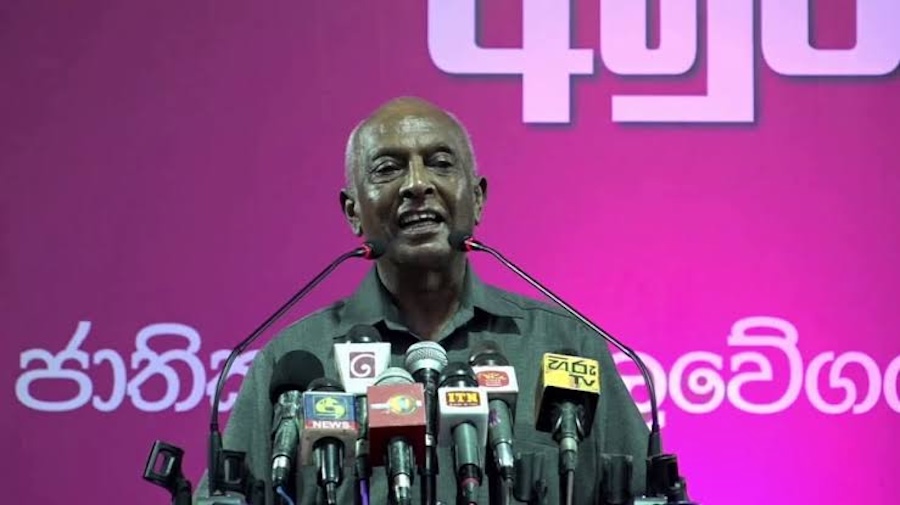
Lal Wijenayake
After being suspended by the LSSP, he continued his left politics by leading our dissident group first into Sobitha Thero’s National Movement for a Just Society which helped mobilize the forces that helped to overthrow the Mahinda Rajapaksa regime and later as the United People’s Power into the National Peoples Power where he was both a member of the Executive Committee and Leadership Council. During the Yahapalana Government, we successfully campaigned for the 19th amendment which curbed Presidential powers, reimposed term limits for presidents and established independent Commissions. We naively believed that the Maithripala government would abolish the Executive Presidency for which we had campaigned and enact a new Constitution which would contribute to solving the national question through effective devolution while guaranteeing all our citizens their human rights in a just society based on the rule of law. He gladly took on the Chairmanship of the twenty membered Public Representations Committee on Constitutional Reforms appointed by Ranil Wickremesinghe in 2016 and was able in less than five months to present a comprehensive report covering the views of hundreds of our citizens across the country on the form a new Constitution should take. However his hard work was frustrated by Ranil’s unwillingness to proceed further on constitutional reform and the tensions between him and President Maithripala Sirisena which ultimately ended the Yahapalana government.
Throughout his adult life, Lal showed himself to be scrupulously honest and spent much of his own money fighting elections against better endowed UNP MPs and provincial councillors who had accumulated substantial funds through the corrupt ecosystem tacitly encouraged by J.R.for that very purpose. He was also steadfastly loyal to the principles of samasamajism which with his legal background made him a committed fighter for human rights, the rule of law and the devolution of power. He also took a leading role in several trade unions, where his professional knowledge as a lawyer was utilized to fight on working class issues and help individuals to legally confront injustice from errant employers. Having been born in an estate where his father was the Apothecary, he held a special place in his heart for the problems of the estate worker.
Having entered the Peradeniya Campus from Dharmaraja College, he completed his degree in physical science there and then went on to do a bachelor’s degree in law at the Colombo campus of the University of Ceylon. He was the lawyer in high demand for fighting cases involving left political issues and trade union disputes in Kandy for nearly sixty years, mostly offering his services pro bono. He was suspended by the party briefly for appearing as a Junior to Advocate Nadesan for some of the accused in the 1971 insurrection case but the Party later accepted his position that as a lawyer, he is bound to provide his services if requested and revoked his suspension. He legally intervened to prevent several anti-people measures. Some examples are his successes in preventing the implementation of a World Bank proposal to introduce a Water tax and in forestalling J.R.’s plan soon after the 1977 election to evict land grantees, who had been granted land by the Sirima government. He never hankered after political privileges or for privileged positions in his profession, maintaining close friendship with most of the leading politicians not only in other left parties like the Communist Party and the several breakaway groups from the LSSP but also those with alternative viewpoints including Vijaya and Chandrika Kumaratunga, Gamini Dissanayake, Maithripala Sirisena, Karu Jayasuriya and Ranil Wickremesinghe.
In the midst of his busy life, Lal the intellectual and lover of the arts found time to write four books, three on law and a book of Sinhala poems. He had close contact with the artistic greats of his time like Sugathapala de Silva and Dharamasena Pathiraja. During his younger days he had a large following of intellectually receptive young men in Kandy who would seek him out to discuss topics of political and international interest. In those days, the best place to meet Lal after work in the evenings would have been on Dalada Veediya where he could be seen with different members of this group carrying on a discussion. The day ended with them slowly gravitated to the White House restaurant nearby to continue their conversations while being hosted by Lal to a cup of tea.
Lal’s loss will be hard to bear for left politics in Kandy. It is our fervent hope that the Anura government, which has clearly brought about a decisive change in the political culture of the island by moving away from the family based corruption industry that Mahinda had set up will before the end of its term deliver on demands of the Sri Lankan public and the promises made to them to the abolish the Executive Presidency. We also hope that Lal’s comrades and the younger generation will consider this the first step and be spurred into fighting even harder to achieve the ideals he cherished throughout his life.