

By Sarath Dissanayake –

Sarath Dissanayake
Author’s Note: Having concluded a three-part curtain-raiser series for the upcoming International Buddhist Conference (IBC) in Colombo (November 28 – December 2, 2026), there was never any intention to add a fourth installment. Yet, the appalling events of November 12 within the hallowed precincts of Ruwanwelisaya compelled this unplanned postscript.
Unlike the earlier reflections in this series, which dwelt optimistically on the timeless wisdom and global awakening of the Buddha’s teachings, this concluding commentary is anything but rosy. It confronts a brazen act of sacrilege and a breach of sacred decorum at Sri Lanka’s most revered Buddhist shrine—a deeply troubling shock that has left the public conscience grappling with disbelief and pain of mind on the eve of welcoming the global Buddhist community to the island’s shores.
The disturbing footage emanating from the historic grounds of the Ruwanweli Maha Seya has sparked widespread public outcry and revulsion across all segments of the nation. To grasp the true gravity of this desecration, one must first appreciate the spiritual and historical weight of the ground on which it occurred.
A Sanctuary of Unmatched Reverence
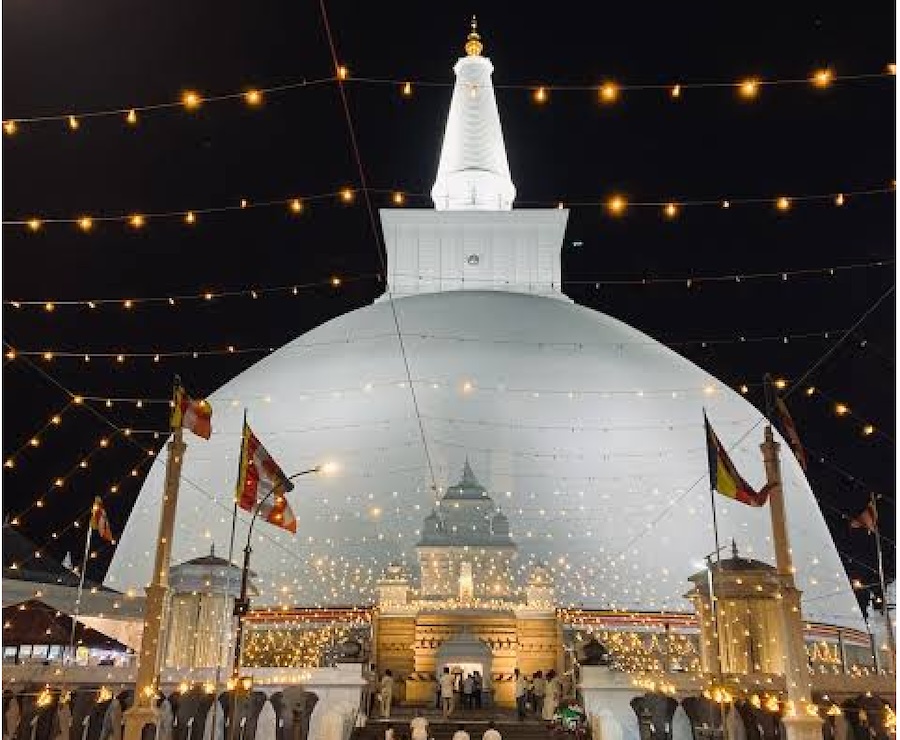
Anuradhapura, once the thriving ancient capital of Sri Lanka, stands as the historic cradle of Theravada Buddhism and a revered spiritual Therawada bastion for Buddhists worldwide. Designated as a UNESCO World Heritage site within the island’s Cultural Triangle, the Ruwanweli Maha Seya enshrines the largest concentration of the Buddha’s sacred relics anywhere on earth.
For over two millennia, its pristine white dome has risen against the sky of Anuradhapura as an unbroken symbol of serenity, devotion, and ancient heritage. Among Buddhists, this venerated shrine commands a reverence akin to what Mecca holds for Muslims or the Vatican for Christians. Pilgrims approach its courtyards in quiet humility, shedding worldly conflicts at the threshold of the Sacred Citadel. On November 12, however, this timeless haven of peace was shattered by raw street violence and vituperative fury, plunging the nation into a moment of profound moral reckoning.
Unchecked Violence on Sacred Ground
What unfolded in broad daylight near the Ruwanwelisaya Dansala area and the adjoining car park was an appalling spectacle that will scar the collective memory of law-abiding Sri Lankans for generations. At the center of the site, a group of Buddhist monks and laypeople had been staging a peaceful Satyagraha and fast-unto-death protest—opposing, inter alia, the proposed Anuradhapura Sacred City Development Plan and demanding the release of Venerable Galaboda Aththe Gnanasara Thera.
That peaceful vigil was abruptly shattered when, in full view of the public and a heavy police presence, a rival mob led by Rajanganaye Saddharathana—a controversial figure recently expelled from the Buddhist order following a disciplinary inquiry—descended upon the site. Saddharathana, in a live outburst, had laid bare his dubious intentions the day before the attack while rallying his followers—an escalation that bore all the hallmarks of a premeditated, stage-managed assault..
Within moments, the sacred precincts descended into chaos as the mob ran amok, mercilessly attacking the monks and laypeople in a brazen display of street grandstanding. Video footage broadcast nationwide captured men wielding wooden poles, plastic pipes, and ropes, swinging wildly just steps away from one of the world’s holiest shrines. By the time the dust settled, Saddharathana was hospitalized with head injuries and temporary structures were torn down while an aghast public looked on. Shockingly, in a travesty of justice, the very monks who were enduring the fast were assaulted and subsequently arrested by law enforcement, and later remanded by the courts, as though they were the instigators of the chaos rather than its victims.
Separating Legal Debates from Mob Law
Be that as it may, any fair-minded assessment of this outrageous sacrilege must separate the legal debate surrounding the monks’ demonstration from the sheer horror of the November 12th assault. One may hold serious reservations regarding the protesting monks’ refusal to comply with a Magistrate’s Court order to vacate the site. Likewise, the merits of the Anuradhapura Sacred City Development Plan and the constitutionality of a presidential pardon are complex issues that warrant rigorous scrutiny in the proper forums and at an opportune time. As many legal observers rightly emphasize, wearing a saffron robe does not place any citizen above the law or grant immunity from judicial directives.
Yet, that legal dispute belonged strictly in a courtroom, to be resolved through due process and judicial restraint. What cannot be justified under any pretext is allowing an outside mob—led by an individual notorious for vitriolic outbursts against the highest religious and state authorities—to march into a sensitive religious zone as if they were a law unto themselves. Permitting shameless street violence to overrun a sacred site crossed a line that no civilized society should ever tolerate.
The State’s Failure to Guard the Sanctum
Tensions had been simmering at the site for days, and public warnings had already circulated regarding the impending arrival of an organized group of agitators. Watching the video footage unfold rings alarm bells nationwide over the apathy and passive inaction of the police, whose fundamental duty is to maintain due decorum and ensure the tranquility and serenity that Ruwanwelisaya and the Sacred City of Anuradhapura deserve in the name of their noble spiritual heritage..
This brings us to a deeply troubling question echoing across living rooms, temples, and public squares throughout Sri Lanka: Where was the state when the sanctity of Ruwanwelisaya was being desecrated? Regardless of political persuasion, the primary concern for citizens of conscience is the brazen violation of a world-renowned Buddhist sanctuary—carried out in broad daylight without restraint. At the heart of the public’s indignation is not merely the brutality of the attackers, but the glaring failure of law enforcement—leaving any right-thinking person with an iota of decency to ask whether violent mobs are now above the laws of the land. The utter predicament of the monks and devotees caught up in the melee speaks volumes of the impunity with which the assailants carried out their dastardly act, raising far more disturbing questions than answers. What weighs heaviest on the minds of many is how a few hundred individuals armed with clubs could breach one of the world’s most sacred sites and unleash a violent assault while officers stood by seemingly helpless, hesitant, and painfully slow to prevent the clash from escalating.
Constitutional Stewardship and Sacred Trust
The gravity of this failure is especially poignant not for partisan reasons, but because of the sacred civic trust entrusted to the nation’s leadership. In the 2024 presidential and parliamentary elections, citizens across Sri Lanka gave the current administration a resounding, historic mandate and yearned for a peaceful country with freedom for all—a new era defined by institutional integrity, good governance, and the impartial enforcement of the rule of law. Above all, they placed their faith in the highest office of the Presidency—whose incumbent, upon assuming duties, stood before these very precincts of Ruwanwelisaya and took a solemn public vow to serve as the guardian of the nation’s heritage, upholding the constitutional duty to safeguard Buddhism while fostering the religious freedoms of all faiths in no uncertain terms.
Witnessing unchecked mob violence play out beneath the shadow of that same stupa strikes at the very heart of that social contract. When citizens watch armed crowds dictate outcomes in front of passive officers, public confidence in state institutions erodes rapidly. It fosters a dangerous perception that the law is applied selectively, and that the state is either unwilling or unable to shield its hallowed spaces from orchestrated chaos. When the institutions tasked with safeguarding public safety and constitutional sanctity allow a venerated sanctuary to be defiled with impunity, pledges of systemic reform ring hollow. Allowing such a revered place of worship to be desecrated through administrative negligence is a profound violation of that sacred trust—and those entrusted as the custodians of the state remain directly answerable to the people for how order was allowed to collapse at the foot of our holiest shrine.
Concluding Remarks and Key Takeaways
The gravest fallout from November 12th extends far beyond immediate arrests and police reviews of video recordings; it is a deep wound inflicted upon the spiritual conscience of the entire nation. Watching a Buddha statue hurriedly carried away from a dismantled hut and Buddhist flags trampled amid shouting crowds does not merely tarnish Sri Lanka’s historic stewardship and glorious legacy as the cradle of Theravada Buddhism—it demoralizes a peaceful populace that expects basic safety and decorum at its places of worship..
To salvage its moral authority and restore public trust, the state must act decisively on four fronts:
# Conduct an Uncompromising Inquiry. Expose who instigated and mobilized the mob that marched into the protest site.
# Account for Policing Failures. Explain why foreseeable warnings were ignored and how an armed crowd was allowed to breach a high-security sacred precinct.
# Enforce Impartial Justice. Prosecute every individual who wields a weapon, regardless of affiliation, rather than stopping at the remand of fasting monks.
# Safeguard Sacred Sanctuaries. Establish strict protocols ahead of the IBC to ensure mob interference never again enters designated heritage zones.
Ruwanwelisaya has endured for over two millennia, outlasting dynasties, invasions, and political turmoil. Its white dome will continue to shine long after the actors of this shameful chapter are forgotten. Yet, for those living today, November 12, 2026, must serve as a sobering wake-up call. Sacred heritage cannot be protected by constitutional clauses alone, nor can the rule of law survive on campaign promises. Until those responsible for bringing violence to the doorstep of the Buddha’s relics are held fully accountable, a dark shadow will remain over the Sacred City and the nation as a whole—and over the conscience of those entrusted to guard it.
“ May the blessings of the Noble Triple Gem be with all sentient beings, and may the eternal truth of the Dhamma prevail forevermore “ .
Author’s Note: The 1998 Colombo Buddhist Summit
The author served as a committee member on the Taskforce appointed to convene the founding International Buddhist Conference (Summit) hosted by Sri Lanka in Colombo from November 10 to 14, 1998. Held under the theme “The Timeless Message of the Samma Sambuddha” to mark the 50th Anniversary (Golden Jubilee) of Sri Lanka’s independence, the landmark 1998 gathering was jointly organized by the Ministry of Buddhasasana and the Ministry of Foreign Affairs, co-chaired by the late Ministers Lakshman Jayakody and Lakshman Kadirgamar. The unanimous mandate produced at that 1998 Colombo conference directly catalyzed a coordinated diplomatic campaign led by Foreign Minister Kadirgamar, culminating in the United Nations General Assembly adopting Resolution 54/115 without a vote at its 54th session in December 1999 to formally recognize the International Day of Vesak. While the inaugural summit took place in Sri Lanka, its permanent secretariat was subsequently established in Thailand, with international summits rotating globally thereafter.
“All tremble at violence; all fear death. Putting oneself in the place of another, one should not kill nor cause another to kill.” — The Buddha, Dhammapada (Verse 129)
References
- Part 1: True Buddhist: An Analytical & Pragmatic Critique of Buddhism (https://www.colombotelegraph.com/index.php/a-true-buddhist-an-analytical-pragmatic-critique-of-buddhism/)
- Part 11: Spiritual Citadel: Sri Lanka as a Stronghold of Theravada Lineage (https://www.colombotelegraph.com/index.php/the-spiritual-citadel-sri-lanka-as-the-stronghold-of-the-theravada-lineage/)
- Part 111: Buddhism In Transition: Institutional Challenges & Global Awakening (https://www.colombotelegraph.com/index.php/buddhism-in-transition-institutional-challenges-global-awakening/)
*The writer is a retired Ambassador and former Foreign Ministry Spokesman He can be reached at schandrad@hotmail.com
Sarath / November 20, 2026
Author’s Note / Update: For the benefit of readers following this issue, it has since been reported that Ven. Rajanganaye Saddharathana Thero was arrested on November 18, 2026, and remanded until November 26 on the orders of the Anuradhapura Magistrate’s Court.
/