

B.G. Wimalarathana Banda
The Ruwanweli Maha Seya stands as one of the most sacred Buddhist monuments in the world. Buddhist history records that Gautama Buddha, during his third visit to Sri Lanka, arrived at this very site and entered into a state of deep meditative absorption (SAMADHI). According to historical accounts, Arahant Mahinda Thero, who arrived in the country during the reign of King Devanampiya Tissa, identified this location and prophesied that a great “DAGABA” (stupa) would one day be built here. Furthermore, Buddhist history tells us that the construction of the Ruwanweli Maha Seya was initiated by King Dutugemunu in the 2nd century BCE and since he was unable to complete the construction of the stupa during his lifetime, that the remaining work was completed by his successor, King Saddhatissa.
Although some politicians, in the recent past, have desecrated this sacred ground by using it as a venue for their presidential swearing-in ceremonies, there is no record in recent history of any bloodshed and any other such violent ever occurring at such a hallowed site.
Tarnishing the sanctity of the monastic order, a group of monks, accompanied by a handful of opportunistic politicians, marched approximately 175 Kilometres, chanting slogans such as “Justice for the Robe” (SIWURATA YUKTHIYA) and “Do Not Lay Hands on the Robe,”(SIWURATA ATHA NOTHABANU) they staged a “SATYAGRAHA” (non-violent protest) in front of the Presidential Secretariat and later within the Vihara Mahadevi Park, ostensibly to “protect the robe.”
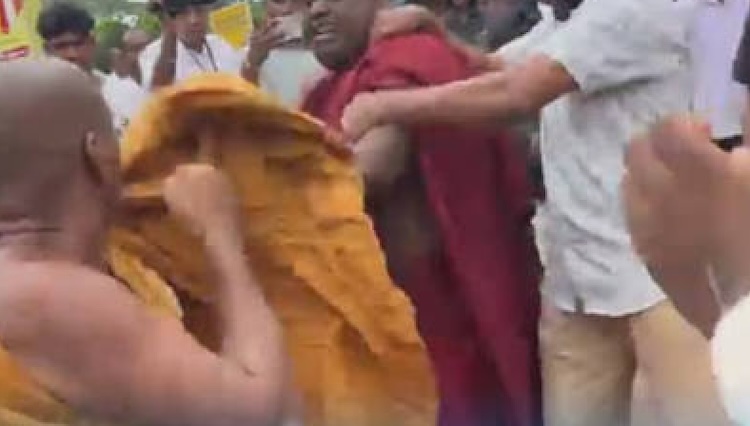
Yet, in a stark contradiction, at the scared city of Ruwan Vally Maha Seya, they proceeded to strip off these very robes, leaving themselves half-naked and thereby desecrating the sacred garment. Wielding clubs, engaging in violent brawls that left heads split open and behaving like underworld thugs, they defied court orders, refused to obey police officers, and showed utter contempt for the laws of the land, all while attacking one another.
This sacred site became the scene of bloodshed as a result of a “satyagraha” staged by a group of Buddhist monks who were demanding the immediate withdrawal of the ‘Anuradhapura Sacred City Development Plan’, introduced by the government, and the immediate release of Galaboda Aththe Gnanasara Thero.
This group of venerable monks carried out this “satyagraha”, which led to bloodshed, ignoring the Committee, that has been already appointed by the Government, consisting of over 30 experts, including the Acting ATAMASTHANADHIPATHI, who are possessing a mature understanding of the subject, to study the matter in detail and submit a report.
It may be possible, that this group of venerable monks who carried out this “satyagraha” possess a deeper understanding of the subject matter than the experts appointed to the committee. However, even a small child would understand that the issue should have been resolved, not through a satyagraha that led to bloodshed, but in a strictly peaceful manner, with the knowledge and consent of their own senior monks.
Yet, what are these, a few groups of Revered Buddhist monks, who constantly advise us to resolve issues through “Metta” (loving-kindness), “Karuna” (compassion), “Mudita” (sympathetic joy) and “Uppekha” (equanimity), actually doing? Are they not, under the guise of the noble concept of “Satyagraha” sowing anger, hatred, and jealousy among all citizens, both Buddhists and non-Buddhists alike?
Furthermore, if we look back at the recent past, approximately during the last five to six months, we can observe several unethical actions taken by this group of venerable monks.
When the government introduced the 22nd Amendment, one group of monks, ostensibly followers of the Buddha, opposed it under the banner, “Do not touch the independence of the judiciary,” while sowing seeds of anger, hatred, and jealousy. Meanwhile, another group of monks stood in favour of the 22nd Amendment. What kind of liberation do these monks, all followers of the same Buddha, hope to attain by becoming so deeply divided, forming opposing factions, and spreading hatred and anger? And what kind of Dhamma are they preaching to us, the Buddhists?
According to a recent judgment delivered by a three-judge bench of the Supreme Court, the presidential pardon granted to Galaboda Aththe Gnanasara Thero, in May 2019, has been declared null and void, possessing no force or effect in law. The Supreme Court issued this ruling during the hearing of fundamental rights petitions filed by Dr. Paikiasothy Saravanamuttu and Sandya Eknaligoda.
In connection with the disappearance of journalist Pradeep Ekneligoda, while legal proceedings were underway following the production of a suspect before the Homagama Magistrate’s Court in January 2016, Galagoda Aththe Gnanasara Thero, who was neither a respondent, a party, a witness, nor an individual summoned by the court in the Pradeep Ekneligoda case, entered the courtroom and acted in a manner that obstructed the judicial proceedings.
According to reports, Gnanasara Thero committed several offenses. The Thero obstructed judicial proceedings by addressing the presiding Magistrate directly; he attempted to order the Magistrate to grant bail to the suspects; he disparaged the Senior State Counsel appearing for the prosecution by labelling him an “impotent state officer”; and he explicitly declared that he would not comply with the Magistrate’s orders. The Supreme Court determined that this aggressive conduct, constituted contempt of court. Consequently, the Court sentenced him to six years of rigorous imprisonment, with the sentences for the individual offenses to run concurrently.
The philosophy of the Buddha is a “VIBHAJJAVĀDI” (analytical) Doctrine. It is a philosophy that seeks to comprehend the Truth not by making sweeping or categorical judgments, but by breaking down matters into their constituent parts and analysing them individually. It is a doctrine that clearly elucidates “PAṬICHCHA-SAMUPPĀDA” (dependent origination), a concept rooted in the law of causality, which posits that attempting to prevent an effect is futile; rather, it is the underlying cause that must be addressed.
The sequence of events involving Gnanasara Thero should also be analysed in this manner, by breaking down the components, to arrive at the Truth. As the aforementioned points confirm, had the specific cause not been set in motion within the Homagama court complex, this particular outcome would never have befallen on Gnanasara Thero.
Therefore, is it possible, in accordance with the philosophy of the Buddha, for us, and in particular, for the Buddhist monks themselves, to disregard the pure Dhamma, which the venerable monks so frequently preach to us, simply because of the situation involving Gnanasara Thero, who has now become an accused before the law?
When the government introduced the 22nd Amendment, the very same venerable Buddhist monks who rallied against it, proclaiming, “Do not tamper with the independence of the judiciary”, are now demanding the immediate release of Gnanasara Thero, who was convicted by a Supreme Court ruling. How can this demand not be considered as an interference with the independence of the judiciary? It is a profound paradox.
The very President who granted this presidential pardon to Gnanasra Thero is now seeking forgiveness from the Buddhist clergy, claiming that the pardon was issued due to a “Technical Error.” What else can we do, we who elected such a President, but sigh in despair? This is a President who might well end up on a global “blacklist” for being the only head of state to exclude his own Prime Minister and Inspector General of Police from National Security Committee meetings.
The 175 Kilometres crisis arose when prison officials required Ven. Gnanasara Thero to remove his monastic robes and wear other attire while being produced in court from prison, evolved into a struggle demanding “justice for the robe.”
The venerable monks, who walked nearly 175 Kilometres demanding “justice for the robe,” ought to have, in an ethical manner, brought their protest to an end, once the government provided a solution acceptable to the leading monks (NAYAKA HAMUDHURUWARU). However, this group of monks subsequently altered the slogan to “Release Ven. Gnanasara” and initiated a satyagraha. It remains a question as to how ethical, logical, or consistent with the “Dhamma” (the Buddha’s teachings) this action is.
It is true that the “SIWURA” (monastic robe) is a garment. No doubt, it is a special attire worn by monks who have renounced lay life and dedicated themselves, whether in a forest hermitage, a temple, or a similar setting, to the realization of “Nirvana”, which is the ultimate goal of the Buddhist Philosophy.
Is an external party or group truly necessary to do justice to such a garment? Does an external party even possess the capacity to do so? Can justice, respect, or recognition be forcibly extracted, through long-distance marches, threats, intimidation, or the sowing of anger and hatred, rather than being earned through one’s own virtuous conduct and actions? Leaving aside the perspective of the venerable Buddhist monks, for us laypeople, this is entirely incomprehensible.
Responding to the notion that “The Sasana” will endure only as long as the “SIWURA” exists, the Late Professor Ven. Walpola Rahula Thero, in his booklet “Sathyodaya”, states, “I am aware that this view is voiced on every Buddhist platform. However, it is my understanding that this is a misconception. The “SIWURA” is simply a garment made by cutting white cloth into pieces, stitching them together, and dyeing it. If the “Sasana” were to perish merely due to the absence of such a garment, then the “Sasana” itself would be worth no more than a few rupees. The “Buddha Sasana” is, in essence, the Truth. How unreasonable is it to claim that the Truth would vanish simply because a specific type of attire no longer exists? Is the “Buddha Sasana” merely the sight of individuals moving about clad in yellow robes?” ………. “In later times, “They began to instil fear in people by asking whether the Sasana, could survive without us, without the robes………” (Refer to: Walpola Rahula Foundation – 2017 – Sathyodaya, p. 118.) – {Translated into English by this writer}
As Venerable Theros have preached to us, that anyone is capable of performing any action. However, even if an act is performed entirely of one’s own volition, one may still find the resulting outcome undesirable, simply because the outcome does not necessarily align with one’s aspirations. The result is always determined by the natural order of “Dhamma”, rather than by what we might personally desire. This has sparked curiosity among Buddhists, how is it that this eternal law of Dhamma does not seem to apply to the Gnanasara Thero who has been deemed an offender by the Supreme Court.
In recent times, various legal cases have been filed against some of our respected monks, ranging from instances of child abuse and rape to disputes over the ownership of high-value movable and immovable property. Whether viewed from a legal or a moral standpoint, such conducts are entirely unacceptable.
It is highly probable that the number of unreported incidents, involving rape, child abuse, and other forms of misconduct committed by these respected monks, far exceeds the number of cases that have actually been reported.
In this context, one is reminded of a verse (Dhammapada, Bhikkhu Vagga, 362.3) spoken by the Buddha regarding a certain monk. “He who is restrained in his hands, restrained in his feet, restrained in his speech, and possesses the highest restraint; he who delights in the concentration of his own mind and finds joy in solitude him, indeed, do they call a ‘Bhikkhu’ (monk).”
Venerable Mahanayaka Theros, as we have learned, the primary objective of the Buddhist Councils (“DHAMMA SANGAYANA”) was to address and resolve threats posed to the Buddhist Sangha and the Dhamma by individuals merely masquerading as ascetics, thereby restoring the purity of both the Sangha and the Buddha’s teachings.
It is our firm belief that we have reached an era where such a Buddhist Council is once again necessary.
It is indisputable that a vast number of Venerable Monks, reside in our country, who lead a monastic life entirely in accordance with the Buddha’s Teachings and who strictly observe the rules of monastic discipline (“Vinaya”). However, the conduct of a small number of Buddhist monks poses a significant obstacle to the progress of a Buddhist nation. Certain monks, who are otherwise held in high regard, strive to supersede state law with Buddhist Religious Law.
Buddhism is a philosophy held in the highest regard globally. Our venerable Chief Prelates have, on countless occasions, taught us that it is within the island of Sri Lanka that this Dhamma is preserved and sustained in an unbroken lineage. Looking merely at the few incidents mentioned above, it becomes evident that those who claim to be the ‘guardian deities’ (protectors) of this Dhamma are themselves, whether knowingly or unknowingly, acting in ways that drag the very same Dhamma toward destruction.
Throughout history, such obstacles were resolved by the Venerable Monks and the rulers of the state through Buddhist Councils (Dhamma Sangayana).
It is the earnest hope of the Buddhists in this Buddhist nation that the venerable Maha Nayaka Theros will not wait until a matter, which could have been resolved with ease, reaches a state where it can no longer be remedied, reminding the Sinhala Proverb “ Niyapoththen kadaa iwath kala haki dheya porowen wath kapaa iwath kala nohaki thththwayakatta path wena kal balaa nositinu”.
I believe that the shared aspiration of all Sri Lankans, both Buddhists and non-Buddhists, is that you, the Most Venerable Mahanayaka Theros, may turn your Dhamma-guided attention toward establishing such internal reforms within our country, without any further delay.