

By Mahil Dole –

Mahil Dole
The arrest of the Colombo North Quazi Court judge and his wife by the Commission to Investigate Allegations of Bribery or Corruption (CIABOC), on allegations of demanding and accepting Rs. 65,000 to expedite a divorce ruling, has once again focused attention on the integrity and effectiveness of the Quazi court system. Determination of guilt remains a judicial function; this analysis therefore confines itself to the systemic conditions that enable such allegations and the responsibilities that must now be exercised by the state, community leadership, and religious authorities. Failure to act will continue to erode public confidence and place unnecessary strain on social cohesion within a community that forms an integral part of Sri Lanka’s social and economic fabric.
Quazi courts operate under persistent practical constraints. Sittings are frequently congested and chaotic, with limited privacy, inadequate communication with litigants, insufficient time for considered hearings, and weak security arrangements. Parties often travel long distances at significant cost only to encounter repeated delays. Perceptions of unequal treatment according to social or economic status generate suspicion and confrontation. These conditions are not theoretical; they have been observed directly during sittings conducted as part of a structured case study. While such deficiencies explain public frustration, they cannot excuse the solicitation or acceptance of bribes. Any such practice undermines the purpose of the court, damages trust in matrimonial remedies that affect families and the wider community, and fuels external criticism.
This is not an isolated occurrence. Previous similar incidents, combined with the long-standing stagnation of reform under the Muslim Marriage and Divorce Act, indicate a deeper institutional weakness. Public outcry after each episode has not translated into sustained corrective action. The result is a progressive decline in confidence that carries consequences beyond the courtroom.
The Cost of Prolonged Delay
The reform of the Muslim Marriage and Divorce Act (No. 13 of 1951) has been under discussion for decades. Successive committees, including the Justice Saleem Marsoof committee (2009–2018), which produced detailed recommendations, and the 2020–2021 Advisory Committee whose report fed into a draft amendment bill, have completed their work only for progress to stall. In late 2025 the Ministry of Justice reconvened the advisory process and conducted public consultations from January to April 2026 on five core issues: minimum age of marriage, the bride’s right to sign her own documents, conditions on polygamy, the structure of the Quazi system itself, and the eligibility of women to serve as Quazis. More than seven months later, no public timeline exists for finalising the draft, securing Cabinet approval, or introducing a bill in Parliament.
These delays are not cost-free. Every year without a modernised framework leaves litigants exposed to the very conditions that breed suspicion, delay, and opportunities for irregular influence. Matrimonial disputes that could be resolved under clearer, more professional procedures continue to congest courts, heighten confrontations, and erode trust. The absence of a predictable legislative path also signals to the community that systemic problems will be managed rather than resolved, deepening the very uncertainty that threatens social cohesion and, over time, national unity. When institutions that govern family life remain unreformed for decades, the cumulative damage is measured not only in individual cases but in declining confidence in the rule of law within a significant segment of the population.
Responsibilities of the State
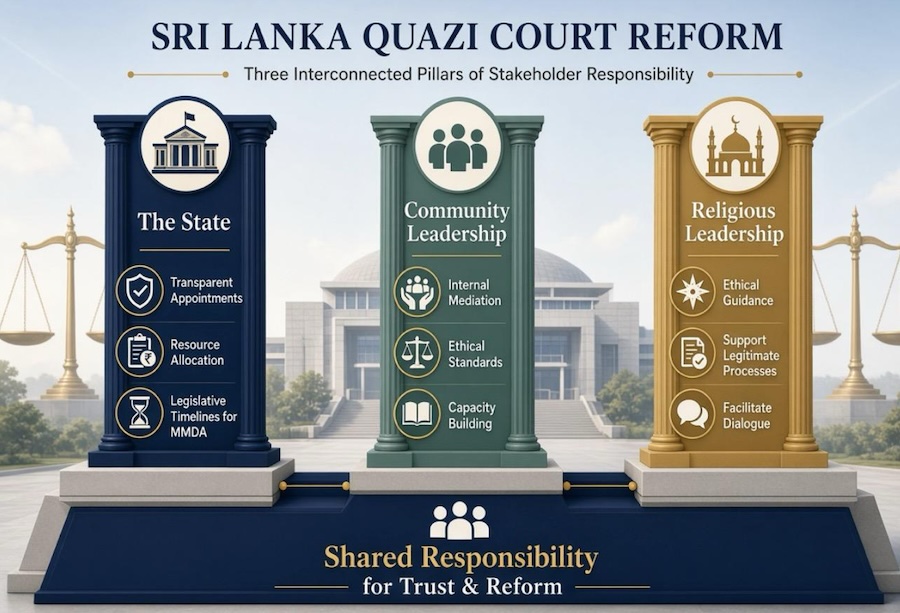
The state bears primary responsibility for the structural framework. Appointments of Quazi judges must be transparent, merit-based, and subject to clear criteria of competence and integrity, with effective oversight by the Judicial Service Commission. Day-to-day administration falls to the Ministry of Justice, which must ensure adequate resources, improved physical facilities, security, and reasonable remuneration that reduces vulnerability to external pressure. Legislative reform of the MMDA can no longer remain indefinitely deferred. After years of consultations and multiple committee reports, the public is entitled to a clear statement of the current status of the draft bill and a defined timetable for Cabinet and parliamentary consideration. Prolonged uncertainty in family-law institutions that serve a significant segment of the population risks complicating national unity and security; proactive governance is therefore both a legal and a strategic necessity.
Responsibilities of Community Leadership
Community organisations, including those involved in social and religious affairs, must move beyond reactive condemnation. They should establish or strengthen internal mediation and dispute-resolution mechanisms that can resolve many matrimonial issues before they reach court, thereby reducing caseloads and opportunities for irregular influence. Leadership should promote ethical standards among those who interact with the courts, support whistle-blower protections for genuine complaints, and invest in practical capacity-building rather than publicity-oriented projects that yield limited results. Accountability within the community itself is essential; external criticism will continue to exploit any appearance of internal indifference.
Responsibilities of Religious Leadership
Scholars, mosque authorities, and religious organisations have a distinct role in reinforcing the ethical foundations of the system. Islamic teachings clearly prohibit both the giving and the acceptance of bribes as forms of unjust consumption of wealth. Religious leadership should consistently articulate these principles in practical terms, encourage community members to pursue remedies through legitimate channels, and support reforms that strengthen rather than undermine the integrity of family-law institutions. They are also well placed to facilitate dialogue between litigants and the courts, reducing confrontations and fostering a culture in which trust is restored through demonstrated fairness rather than through informal payments. Cleaning one’s own house remains a prerequisite for credible engagement with wider societal concerns.
Proactive Measures for Immediate Consideration
A coordinated response should include the following steps:
• A joint review by the Ministry of Justice and the Judicial Service Commission of appointment procedures, remuneration, facilities, and security in Quazi courts, with published findings and timelines.
• Immediate public disclosure of the status of the post-2026 consultation process and a firm legislative schedule for the MMDA amendment bill.
• Establishment of community-based mediation panels, supported by religious and civic leaders, to handle preliminary matrimonial disputes.
• Mandatory orientation and continuing professional development for Quazi judges and court staff on procedural fairness, ethics, and case management.
• Creation of accessible complaint and monitoring mechanisms that allow litigants to raise concerns without fear of reprisal, linked to independent oversight.
These measures are neither radical nor unprecedented; comparable improvements have been implemented in other specialised jurisdictions. Their absence, after decades of deliberation, has allowed recurring problems to persist and compound. The present moment, marked by public attention and an incomplete but active reform process, offers an opportunity for decisive action. Shared responsibility exercised proactively by the state, community leadership, and religious authorities can restore confidence, protect the rights of families seeking fair remedies, and reinforce the stability that benefits both the Muslim community and the nation as a whole.
( This article draws on the writer’s direct experience as a member of law enforcement, a masjid trustee, and a member of the Sri Lanka Wakf Board)
*The writer is a retired Senior Superintendent of Police, former head of the counter terrorism desk at the state intelligence service, a former member of the Sri Lanka Wakfs Board, and the author of “Security Beyond Enforcement: Practical Approaches for a Safer Nation” (2026). Email-mahildole54@gmail.com