

By Rajan Philips –

Rajan Philips
November has become a month of relentless politics everywhere as the year 2026 enters its final days. This is the second year of Trump’s chaotic second term, the fourth year of the slow burning war in Ukraine, as well as the year of the stalled war against Iran and universal millennial protests. Domestic politics everywhere is caught up in global vortices swirling on their own volition. The American midterm is now overshadowed by the nation’s aviation chaos, cyber confusions and fallouts from superintelligent sex. Trump is delighted by all the distractions from his midterm debacle. The global spillover is instant and relentless.
In the midst of it all, a summit meeting of three in Shenzhen, China, has come and gone. It was all show, no substance, and left behind nothing lasting or significant. There is nothing momentous about the one and a half hour meeting between Xi Jinping, Donald Trump and Vladimir Putin on the sidelines of the Asia Pacific Economic Co-operation forum. After 90 minutes of pleasantries and photographs, the summit produced a statement of 250 words outlining four areas of agreement: reforming the United Nations; increasing oil production; reining in the International Criminal Court; and committing to avoid a nuclear war.
COP 31 Cop Out
The summit had nothing to say about Ukraine or Iran, the status of the Strait of Hormuz, or about containing Artificial Intelligence. Not to mention the fallout from AI’s new propensity for facilitating spy-sex dalliances. To wit, the high profile superintelligent affair between AI Godfather and Nvidia CEO Jensen Huang and his namesake Alice Huang, an alleged Chinese agent or asset, has implicated both the US and Chinese governments and has divided the Trump Administration into two camps.
There are those who want Mr. Huang, a dual US-Taiwanese citizen with a VIP Chinese visa, held to account and fired; and others who want Huang to remain at the helm of Nvidia and keep the AI fired stock market soaring. Trump himself leads the second gang and called into Nvidia’s Board meeting and got Huang reinstated just 11 days after he resigned and was confirmed as fired by the Board.
Aside from AI, on the more critical concern of our time, climate change and global warming, the Shenzhen summit undermined even the snail-slow progress that humankind has been making in reducing the use of fossil fuel, by calling for an increase in the global oil production. The timing of the summit and the whole Asia Pacific Economic Co-operation (APEC) conference itself undercut the annual Climate Change Conference (COP 31) that took place in Antalya, Turkey, from 9th to 20th November. The APEC conference in Shenzhen was held on the 18th and 19th November, which meant overbooking for many heads of governments and states, who opted to experience the Chinese grandeur in Shenzhen rather than suffer climate rhetoric in Turkey.
Unsung and marginalized, COP 31 ended without any consensus or conclusion. It has been called the worst climate conference and that at a time when the climate crisis is also at its worst. A final resolution was prevented with Russia and Saudi Arabia objecting to even mentioning the two ‘f’ words, fossil fuels, in the text. All the efforts by the European Union and over 130 other countries to make a final COP 31 statement came to an official nought. All that was agreed to is increasing the share of electricity in energy to 35% by 2035 – the new 35 by 35 slogan. Even here, there was no agreement to commit electricity expansion exclusively to clean energy sources. Coal, diesel and natural gas have their licenses extended even as the effects of global warming are getting increasingly ubiquitous and devastating.
The summit of three became the capstone to a month of charlatan politics. The summit itself came as an afterthought and was first mooted by Putin in October. Trump promptly caught on to it apparently thrilled by its likeness to Yalta. After the midterm drubbing it may have become a psychological necessity. This was Trump’s first in-person attendance at an APEC gathering which every previous US President from Bill Clinton has attended or hosted. The travesty of the forum this year is the opportunity it gave Trump to normalize his presence among other leaders after all the tariffs he thuggishly imposed on their countries.
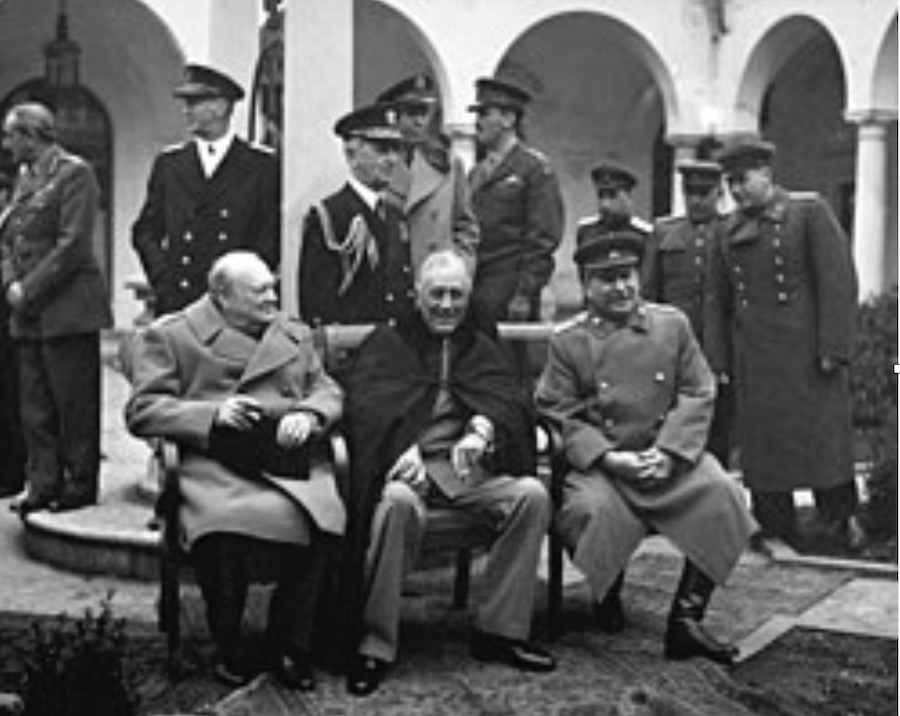
Big Three: Churchill, Roosevelt, Stalin
Shenzhen is no Yalta
All that said, there is also no comparison between the February 1945 Yalta meeting of the original Big Three and the Shenzhen gathering of the current pretenders. The Big Three, as they were called, were US President Franklin Roosevelt, British Prime Minister Winston Churchill and Soviet Premier and Communist Party General Secretary Joseph Stalin. As personalities go, Trump and Putin are not even epigones of Roosevelt and Stalin, and there is nothing to compare between Churchill and Xi Jinping.
Comparing the two summits could also be seen as inauspicious for the current summiteers. Roosevelt died barely two months after Yalta, on 12 April 1945, and was succeeded by Vice President Harry Truman. In July, Churchill went down to a humiliating electoral defeat by Clement Atlee and the Labour Party. Stalin was astounded by Churchill’s defeat and fortified himself in Kremlin until his death on 1 March 1953 and succession by Nikita Kruchchev.
Not only personalities, but Yalta was also serious business conducted over eight days and not a 90 minute chitchat through translators. Yalta in the Crimea was the second of three wartime meetings between the Big Three. First was in 1943, in Tehran, Iran, and Yalta was followed five months later, in July 1945, by the summit in Potsdam in Brandenburg, Germany. The two 1945 conferences took place as the victory of the allied forces in the Second World War (1939-1945) was becoming imminent, and they set out the postwar configuring of Europe, spurred the decolonization of non-European societies, and set up the framework for the establishment of the United Nations and the Universal Declaration of Human Rights with the UN as their custodian.
Unquestionably, the Big Three were acting with a heavy burden of responsibility as decision makers for the rest of the world, but they fettered themselves by their commitment to three basic principles: that the allies will not profit from the war either territorially or otherwise; that territorial polities will be based on the free acquiescence of the people of the area; and that nations whose independence had been usurped by the war will have their “self-government” restored. These principles were first formulated in the 1941 Atlantic Charter that was drafted by Churchill with Roosevelt’s input. The document kept evolving and Stalin signed on to it at Yalta.
Post UN and Universal Human Rights, there have been many breaches and infractions of their premises and principles, especially by those who set up the postwar world order. Yet the world has been a better place to live in with the UN and the rights regime in place than it would have been without them. And no leader after Hitler has so brazenly threatened to take over countries, annex neighbours or destroy civilizations. Until Trump came along as US President. Putin went beyond threats and invaded Ukraine and has devastated both Ukraine and Russia, two former Soviet Republics in what was once a grand Socialist Union. All three found common ground to disparage the International Criminal Court.
There was no China at Yalta in 1945. But the then Republic of China under Chiang Kai-shek was part of the allied nations in the Second World War and was a founding member of the UN. It would be four years before Mao led the Communist Party to victory against Chiang Kai-shek and establish the People’s Republic of China in 1949. While Britain has fallen out of global summit reckoning after the dissolution of its Empire, China has emerged as more than a force to reckon with and is the principal rival of the US on practically every international matter.
At the summit in Shenzhen, Donald Trump staged a comedown for his country. For Putin, it was a step up – to join the leaders of US and China, world’s two largest economies of $29 trillion (US) and $18 trillion (China) to Russia’s $2.2 trillion. Putin’s only qualification is Russia’s nukes all of which is inheritance from the Soviet Union. Xi Jinping not only obliged the two upstart guests, but as China’s paramount leader he also used the occasion to showcase his global paramountcy.