


By Raj Sivanathan –

Raj Sivanathan
For decades, Sri Lankan politicians have used the word federalism to frighten Sinhala voters. They have portrayed the sharing of power as a threat to the country’s unity and to the security of the Sinhala people. That fear has helped centralise power, but it has not resolved the conflict between communities or created a stable foundation for national development.
Sri Lanka needs an honest conversation about how power is organised—and who gets to make decisions. The question is not whether one community should rule over another. It is whether citizens in every part of the country should have a meaningful say in the decisions that affect their lives.
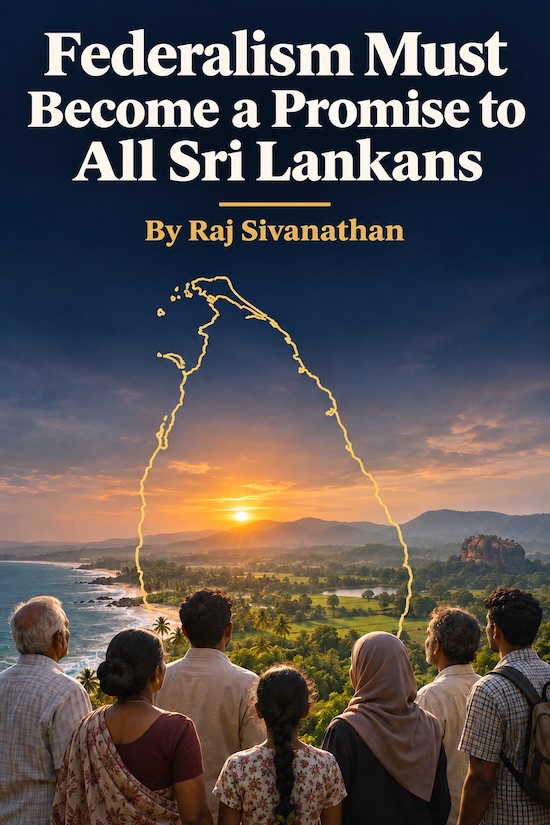 Sri Lankan Tamils are not outsiders or a threat to Sinhala people. They have deep roots in this island and belong here as fully as any other community. Cultural and family ties with Tamil Nadu do not make Sri Lankan Tamils less Sri Lankan. A community’s connection across a border is not proof of disloyalty.
Yet Tamil concerns about land, language, security and political representation have too often been treated as threats to the state. When those concerns go unanswered, distrust grows. That distrust then becomes an obstacle to reconciliation, investment and cooperation. Tension between communities will remain a national problem as long as people believe that the state protects one community’s interests while dismissing another’s.
Devolution should benefit every region
A practical way forward is to make the sharing of power meaningful for all regions. Sri Lanka could strengthen its existing Provincial Councils or consider another regional structure. Whatever the design, each region should have clear responsibilities, adequate resources and accountability to its people.
This idea can speak directly to Sinhala voters: devolution is not a concession made only to Tamils. Sinhala-majority provinces also need the ability to address local priorities, encourage investment, improve services and hold local leaders responsible for results. When people see regional government working for their own communities, power-sharing may become easier to understand as a democratic tool rather than a communal demand.
That is the promise behind the phrase “power to the Sinhala people first, followed by Tamils.” It should mean that Sinhala citizens, too, must experience the benefits of devolved government—and that no one should be asked to accept a system designed only for another community. It must not mean that Tamil rights can be postponed until the majority is ready. A fair constitutional settlement must protect every community and every region at the same time.
Learn from Australia, but build a Sri Lankan system
Australia offers useful lessons, though Sri Lanka should not copy its model wholesale. Australia’s Constitution establishes federal and state governments and sets out their relationship. Its Senate gives each state equal representation, regardless of population, helping ensure that national decisions reflect the interests of the states as well as the population as a whole. (Parliament of Australia, “The Constitution” and “About the Senate.”)
Sri Lanka has its own history, geography and political realities. But the principle is relevant: a country can remain united while constitutionally sharing responsibilities between national and regional governments. The aim should be to decide which powers belong at the centre, which should be exercised regionally, and how disputes between levels of government will be resolved.
Sri Lanka already has Provincial Councils under the Thirteenth Amendment. The Constitution provides for a Provincial Council for each province, with specified areas of responsibility. (Parliament of Sri Lanka, “13th Amendment.”) The public should be able to judge devolution by how it works in practice: whether elected councils can deliver services, whether their finances are transparent, and whether people can hold them accountable. That requires holding Provincial Council elections and clarifying the powers and funding available to elected administrations.
A second chamber could also give regions a stronger voice in national lawmaking. Its design should ensure that it contributes to scrutiny and consultation, rather than becoming another arena for political patronage. At the same time, Sri Lanka should reduce the excessive concentration of executive power and strengthen Parliament, independent institutions and democratic oversight.
Put national issues beyond election tactics
The government has an opportunity to advance constitutional reform and fulfil its commitments. It should not use national questions simply to reassure one section of the electorate, nor should opposition parties undermine every proposal for short-term advantage. A constitutional settlement needs sustained discussion, public participation and support that can outlast a change of government.
A new administration should not spend its term taking revenge on its predecessors while the country’s economic and social problems deepen. Sri Lanka needs policies that continue across governments and that encourage people in every region to contribute to recovery. That includes fair and transparent decisions about land, forests, coastal areas and religious affairs, as well as the release of privately owned land still occupied by the military.
Devolution alone will not solve the economic crisis. But concentrating decisions in Colombo can leave regional needs unseen and local opportunities unrealised. Empowered, accountable regional governments could help develop industries, infrastructure and services suited to their communities. The North and East, like other regions, should be able to contribute fully to national recovery.
A stronger union through shared power
Sinhala people should not have to fear that recognising Tamil rights will diminish their own. Nor should Tamils have to rely on the goodwill of a changing central government to protect their dignity and interests. Constitutional guarantees can give both communities greater confidence in the state and in one another.
The choice is not between unity and devolution. It is between a union sustained by shared consent and one held together by concentrated power and unresolved grievances. Sri Lanka should draw lessons from federal systems such as Australia while designing arrangements suited to its own needs: meaningful powers for every region, elected regional institutions, fair representation at the centre and limits on executive power.
Federal power should belong to Sinhala people and Tamil people alike. When every region can govern responsibly and every community has a secure place in the country, power-sharing can strengthen Sri Lanka—and give its people a better chance to live together without fear.
Rumble 2026 / November 28, 2026
Article vase making A “Symmetrical Federal/Devolved Union” ?
Based on your reference materials and Sri Lanka’s geopolitical position, the most durable long-term solution is one united Sri Lankan nation governed through symmetrical constitutional power-sharing across all nine provinces:
1. One Sovereign Foreign Policy & Defense: National defense, maritime security, foreign affairs, currency, and international trade treaties remain strictly under the central government so Sri Lanka speaks with one unified voice in Indian Ocean geopolitics.
2. Genuine Self-Rule for Every Province: All provinces—Sinhala-majority and Tamil/Muslim-majority alike—receive clear constitutional authority over local land, policing/law-and-order, education, health, and regional economic development, backed by transparent fiscal transfers and regular elections.
3. Institutional Checks at the Center: Replacing unchecked executive presidency with a second parliamentary chamber (Senate) where every province has fair representation ensures that no central government can arbitrarily override regional rights, and no region can secede.
In short: keeping Sri Lanka territorially one united country while replacing centralized Colombo rule with shared constitutional federalism removes the ethnic fault lines that foreign powers exploit, strengthens democratic accountability for Sinhala and Tamil citizens alike, and gives Sri Lanka the internal cohesion needed to navigate Indian Ocean power politics safely.
/