

By Harsha Gunasena –

Harsha Gunasena
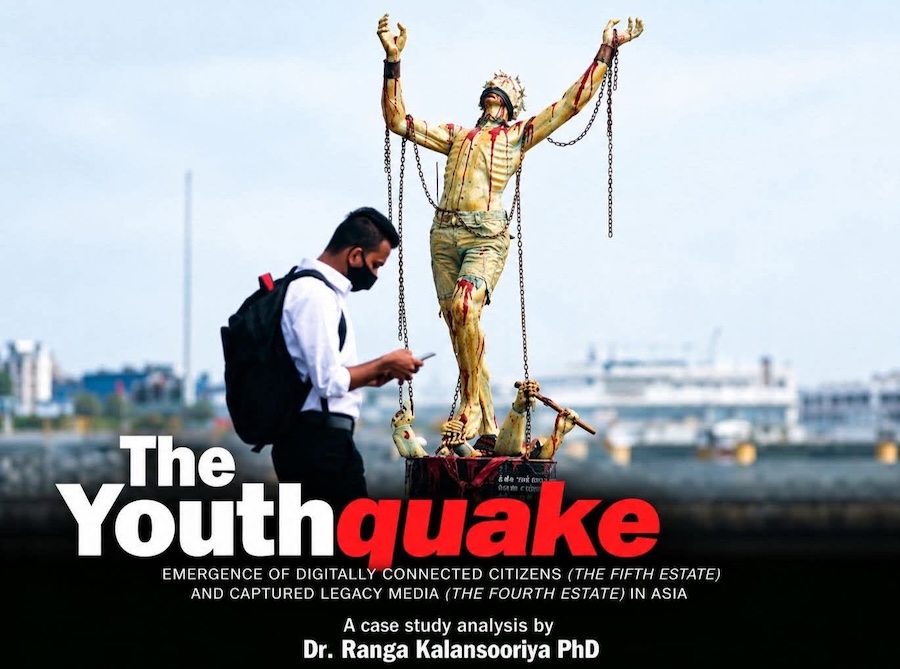
I have read the Youthquake, A journalistic narrative based on case studies from Indonesia, Sri Lanka, Nepal, Bangladesh and Myanmar of emergence of digitally connected citizens and captured legacy media written by Ranga Kalansooriya and his all-female battalion of journalists, Eva Danayanti of Indonesia, Mandana Ismail Abewickrema of Sri Lanka, Nazia Afrin Monami of Bangladesh, Sonia Awale of Nepal and Naw Betty Han of Myanmar. At the event of launching the book I had a chance to have a chat with Sonia Awale and get the signature of her and of Ranga Kalansooriya in my copy of the book.
This is not a review of the book for which I am not competent enough but I penned down my thoughts after reading the book.
It was stated in the book, “Moreover the intention of this book is not to analyze the reasons behind those youth upheavals and examine the political dimensions surrounding those mass protests through academic filters. We have that task to political and social scientists. Being media people, our scope is different” Therefore, although the background of the writeup was the youth uprisings of the respective countries, the focus of the book was the influence of the Fifth Estate to those uprisings.
Prior to the French Revolution, the French Society was rigidly divided into three hereditary social classes. Those were First Estate which was the Roman Catholic Church, Second Estate which were aristocrats who held high government, judicial, and military positions and Third Estate were the commoners comprising roughly 90% to 96% of the population including wealthy merchants (bourgeoisie), urban laborers, and impoverished rural peasants. In the 18th century the Press was identified as the Fourth Estate. In the 1960s alternative/underground press was identified as Fifth Estate and later this was expanded to internet-based media, bloggers, and citizen networks.
Some of the names of the writers including mine have Sanskrit origins. Democracy was thrust upon us in this part of the world. We have not fought for it like the people of the UK or France. Our culture by and large is collectivist rather than individualist which is the dominant trait in those countries who fought for democracy. Democracy in essence is not just the rule by majority it is rule by the majority without compromising the basic rights of the minority. The second part is not easily digested in the collectivist societies. This is the root cause of most of the problems we face.
That is why the governments are not toppled by street protests in the countries of advanced democracies. Yet there are street protests. Sometime back Emmanuel Macron, French President held several meetings arguing with the street protestors to make his point. That is democracy evolved from the French Revolution and we are still in the same level.
We had democracies in this part of the world 2600 years back. Licchavi Republic was located in present Patna of India close to Bangladesh and Nepal. The foundation of the Licchavi Republic was built on collegial governance, collective decision-making, and a federation-style union. This was an aristocratic democracy. According to Maha Parinibbana Sutta of Theravada tradition of Buddhism, the Buddha outlined seven principals of non decline of the Licchavis. The first two were (i) meting frequently and regularly and (ii) convening, acting, and dispersing in unity and harmony.
The emphasis was frequent and regular meetings in unity and harmony. Most probably the decisions were unanimous and consensus was the key. This is also democracy but more suited for a collectivist culture.
When western originated democratic systems are applied in collectivist eastern countries what happens is this. When the governments are powerful it would lead to autocracies and when the governments are weak it would lead to anarchies. This phenomenon can be observed in the recent and not so recent history of our region with special reference to Bangladesh.
The reason is that the basic rights of the minorities whether it is political, ethnic, religious or any other are not cared in these democracies which are ruled by the majorities. The majority is of the view that the minority is not in our ‘group’ and hence it is fine to be hostile against them. Japan is also a collectivist country but the so called ‘in group’ is the entire nation.
In the history of the mankind, we have gone through different advancements in the area of information. Fourth Estate was one of the significant advancements. Youth were there over millennia. The significance here is youth coupled with the technology. This happened previously as well. Arab spring was spearheaded by the millennials using technology.
The first country affected by the Arab Spring was Tunisia. Autocratic leader was overthrown; they had a fragile democracy; and now the country is having another autocratic leader. In Egypt the leader was overthrown. Muslim Brotherhood came to power. Thereafter there was a military coup and autocratic leader came to power. In Libya autocratic leader was overthrown and a failed state was immerged. In Yemen the autocratic leader was overthrown and there is a civil war continuing to date linking regional powers.
These countries, due to long dictatorships, did not have strong institutions or alternative leaders or strong civil societies.
I have translated the book titled ‘From Dictatorship to Democracy- A conceptual framework for liberation’ written by legendary Gene Sharp to Sinhala my native language. Sharp in the tenth chapter of the book described the groundwork for durable democracy. He explained that a durable democracy cannot be established by just overthrowing a dictatorship.
Myanmar is the closest model which suits Sharp’s book. Sharp identified 198 methods for political defiance but Myanmar has now passed that era and the country is engaged in a civil war. Five years back I have written an article about Myanmar ( https://www.colombotelegraph.com/index.php/mismanaged-ethnic-conflicts-resultant-tragedies-of-myanmar-sri-lanka/) and suggested “the world should move forward in the direction of recognizing the parallel civilian government, Committee Representing Pyidaungsu Hluttaw” with the note China and Russia were backing the regime.
I am happy to note that Naw Betty Han in her chapter of Youthquake stated, “ This Federalist Synergy has shattered the military’s century old divide and rule strategy as Bamar youth now fight and bleed alongside ethnic comrades for a common federal democratic future”
“By prioritizing values of inclusivity, gender equality, and ethnic justice, GenZ has fostered a sense of national unity that previous generations struggled to achieve”
In fact, as explained in my article the previous generations refused the national unity and it was the root cause of the problem.
As she mentioned referring to 2015 transition, “top leaders became trapped in a cycle of compromise, seemingly forgetting the sacrifices made in the name of revolution”. Had they refused the power sharing with the Army at that time with the whole world backing them, I do not know, the situation may have been different. I used the word they since I am not bold enough to blame Suu Kyi not for any thing else but for sheer respect.
In Aragalaya of Sri Lanka President Gotabaya Rajapaksa had not used any power against the demonstrations, quite contrary to the stance taken by Prime Minister Sheikh Hasina. Initially it was a peaceful demonstration. I have spoken at the Aragalaya (https://www.youtube.com/watch?v=5lPdA_tFNM0) What I have said was in contrary to the previous armed struggles Sri Lanka has experienced Aragalaya was peaceful. Since the grievances of the youth which led to the struggles were not addressed by the subsequent governments, I was expecting with fear that another armed struggle would immerge. Therefore, what was happening was acceptable. Since we were non-violent the President should be given an exit route. When the situation intensifies the exit route would be only the saving of life.
However when the goons of former president Mahinda Rajapaksa attacked the Aragalaya, situation became violent and reciprocal actions taken by the persons affected has taken few lives with a lot of damages to the houses of the government politicians. I disassociated with the Aragalaya. At one point in addition to the Presidential Secretariat and President’s official residence, the Parliament also on the verge of a siege. Later the President resigned and transition has taken place in accordance with the constitution.
In Nepal and Bangladesh the situation was different. Interim governments were appointed and the countries came back to the main stream of democracy.
I was worried whether there would be military takeovers in these two countries particularly in Bangladesh due to the previous such tendencies. Soniya Awale stated in her chapter “there were rumours of military take over and the king making a comeback” Fortunately this did not happen.
Why? Unlike in the countries of Arab Spring, democracy in our region is getting established. Youth movements were also a part of democracy and there are well established institutions. Indonesia will never go back to Suharto era.
How ever the democracies will not be sustainable if there is no prosperity and also poverty is not eradicated. For that respective governments should apply appropriate economic policies. Piggybacking the idea of catching thieves like in Sri Lanka is certainly not enough.
Reading this book, the Youthquake, was an interesting experience and I recommend to read this book. In my copy I have underlines and notes all over in the book.