

By Vishwamithra –
What is Art: “the response of man’s creative soul to the call of the Real.” ~ Ravindranath Tagore
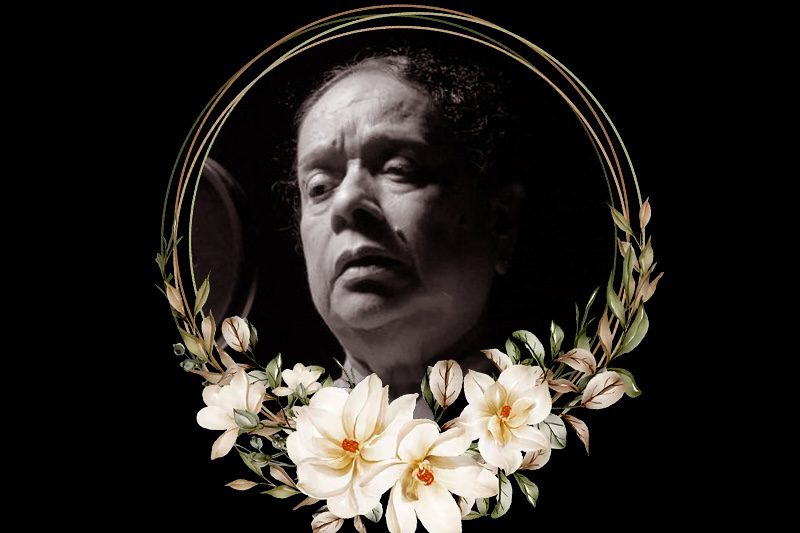
Nanda Malini was no ordinary artist. Hers was not a voice that merely entered the ear, delighted it for a moment and then disappeared into silence. It traveled farther, reaching the concealed chambers of the human heart and awakening memories that had long lain dormant. To hear her sing was often to feel that an intimate sorrow, an unspoken tenderness or a deeply buried indignation had at last found expression. She did not simply interpret songs; she inhabited them. Through her, words acquired flesh, music acquired conscience, and private emotion became part of a nation’s collective memory.
That incomparable voice was stilled on 20 August 2026, at her home in Nawala, only three days before what would have been her eighty-third birthday. Born on 23 August 1943, she departed after a career extending across nearly seven decades—a career that accompanied Sri Lanka through some of the most hopeful, troubled and transformative periods of its modern history. Her death at eighty-two brought to an end not merely the life of a celebrated singer, but an artistic era in which song could still command a nation to pause, listen and examine itself.
Born Mirihana Arachchige Nanda Malini Perera into a large family of modest means, she came from neither wealth nor privilege. Her father, Vincent Perera, was a tailor, while her mother, Liyanage Emily Perera, devoted herself to the home and the upbringing of their children. The family’s move from Lewwanduwa in Aluthgama to Kotahena brought the young Nanda closer to the cultural life of Colombo, but nothing in those humble beginnings foretold the place she would eventually occupy in the artistic history of Sri Lanka.
Yet talent, when joined by discipline and perseverance, has a way of overcoming the limits imposed by circumstance. In 1956, while still a young girl, she won a gold medal in a poetry-recitation competition at the Borella YMBA. That early recognition opened the doors of Radio Ceylon, then one of the most influential cultural institutions in South Asia. Radio in those years was not merely a source of entertainment. It entered homes as a trusted companion, carrying music, drama, news and literature into towns and distant villages alike. A voice heard over Radio Ceylon could become part of the emotional life of an entire generation.
The young singer came under the guidance of some of the most distinguished musicians of the period, foremost among them W. D. Amaradeva. She later pursued formal musical training at the Heywood Institute of Art and the Bhatkhande Music Institute in Lucknow, India. That training gave her voice its classical foundation, but scholarship alone could never explain its emotional power. Technique enabled her to control a note; experience taught her how to release the human truth concealed within it. Her artistry arose from the rare union of discipline and instinct, refinement and empathy.
A defining moment arrived with Ranmuthu Duwa, released in 1962 and remembered as Sri Lanka’s first full-length Sinhala color film. Its music, composed by Amaradeva, possessed a beauty that has outlived the novelty of color and underwater cinematography. In “Galana Gangaki Jeevithe,” Nanda Malini sang with Narada Disasekara the words of Chandraratne Manawasinghe. Her work in the film earned her the Best Female Singer award at the inaugural Sarasaviya Awards in 1964 and announced the arrival of an extraordinary new voice.
The opening line has never lost its lyrical beauty:
Galana gangaki jeevithe, dayālu lōkaye…
Life is a river flowing through a world of compassion…
It was an extraordinarily fitting beginning to her artistic journey. Life, in that image, is not a lake held motionless within protective shores. It is a river—restless, vulnerable and always moving towards an unseen destination. It gathers joy and sorrow as it travels, nourishes some lives, overwhelms others and carries within its waters the memory of every landscape through which it has passed.
Nanda Malini’s own life followed such a course. Her voice flowed through the changing terrain of Sri Lankan history, gathering along the way the happiness of childhood, the tremor of first love, the dignity of motherhood, the anguish of poverty, the loneliness of women, the disillusionment of youth and the suffering of those whom society preferred not to hear.
She could sing of love without reducing it to sentimentality. In her voice, love became longing, restraint, separation, sacrifice and sometimes resignation. She could sing of a mother and make motherhood appear not as a decorative virtue but as a form of sacred endurance. She entered the emotional worlds of village women, abandoned wives, lonely girls, ageing parents and dispossessed people without condescension. Those who lived within her songs were not abstractions; they were recognizable human beings drawn from the roads, marketplaces, kitchens, fields and crowded buses of Sri Lanka.
This was one of her greatest gifts: she enlarged the moral boundaries of popular song. Through her interpretations, people who rarely appeared at the center of public life were granted dignity. The poor were not presented merely as objects of charity. Women were not confined to ornamental roles. Laborers, mothers, lovers, widows and the forgotten entered her music as complete human beings, each possessing an interior life worthy of recognition.
Her repertoire encompassed an extraordinary range. There were songs of childhood innocence, devotional serenity, romantic delicacy and profound social unease. “Ammawaruni,” associated with Yasa Isuru, became one of the most moving expressions of reverence for motherhood in Sinhala music. “Yowun Wasanthaye,” from Duhulu Malak, captured the fragile radiance of youth. Countless other songs revealed her ability to portray women’s lives with sympathy, intelligence and emotional depth. She could be tender without weakness, sorrowful without indulgence and restrained without becoming cold.
But Nanda Malini’s importance cannot be understood solely through the beauty of her voice. Her fearless expression of what she believed to be just, truthful and humane was no accident of art. It was central to her conception of the artist’s responsibility. She understood that music could console, but she also believed that it could question. It could expose the concealed wound, challenge the convenient lie and disturb the complacency of power.
This quality became especially apparent through her long association with Professor Sunil Ariyaratne. Their partnership produced some of the most intellectually and politically significant songs in modern Sinhala music. Ariyaratne’s words, frequently sharpened by social criticism, found in Nanda Malini a voice capable of carrying both their anger and their compassion. Even when the lyrics burned with indignation, her delivery retained its discipline. The force arose not from uncontrolled fury, but from moral conviction.
Her concert series became major cultural events. Sathyaye Geethaya, launched in 1981, carried its purpose in its name: “The Song of Truth.” It demonstrated that a concert platform could become a forum for reflecting upon injustice, human dignity and the responsibilities of citizenship.
Then, in 1987, came Pavana—“The Wind.”
The title now seems prophetic. A wind cannot easily be confined. It crosses guarded borders, enters through unseen openings and carries voices farther than authority intends. Pavana emerged during one of the darkest periods in Sri Lanka’s post-independence history. The country was wounded by ethnic conflict, political extremism, armed insurrection, state repression, disappearances and fear. The late 1980s were years in which many Sri Lankans learned to lower their voices, avert their eyes and conceal their grief for the sake of survival.
Against that atmosphere, Nanda Malini sang.
Her songs questioned injustice, hypocrisy, political violence and the destruction of youthful hope. They expressed the anger of those who felt betrayed by institutions that had promised dignity and opportunity. They mourned the expendability of human life and confronted the failures of a society in which the young could be sacrificed to competing forms of fanaticism and power. When Pavana was denied the ordinary avenues of state broadcasting, efforts to restrict it only deepened its symbolic force. Its songs traveled from person to person and from cassette to cassette, acquiring the private authority of forbidden truth.
One need not agree with every political implication of every song to recognize the courage behind the undertaking. Great art does not always provide comfortable answers. Sometimes its duty is to disturb the arrangement of our certainties. Nanda Malini accepted that burden. She refused to regard the artist as a pleasing ornament placed at the margins of society. For her, the artist was a witness—a person morally obliged to see, feel, remember and speak.
Her life unfolded alongside Sri Lanka’s larger historical journey. Born only a few years before independence, she belonged to a generation that matured amid the hopes of a newly sovereign nation. She witnessed the flowering of Sinhala cinema, the growth of national radio, the expansion of education and the search for an authentically Sri Lankan cultural identity. She also lived through communal division, insurrection, civil war, censorship, economic hardship and the repeated betrayal of public trust.
Throughout those changing times, her voice remained rooted in the cultural soil of the island. Classical training enriched it but never estranged it from ordinary listeners. Her language could be literary, yet its emotional meaning remained accessible. She demonstrated that refinement need not become elitism and that popularity need not require artistic surrender. The cultivated and the commonplace, the rural and the urban, the traditional and the modern could meet within a single song.
Over the years, her achievements were recognized through numerous Sarasaviya and Presidential awards. In 2017, the University of the Visual and Performing Arts conferred upon her an honorary doctorate. Yet awards, however distinguished, reveal only part of her achievement. No catalog of honors can measure the number of homes her voice entered, the grief it consoled or the memories it preserved.
Through the Nanda Malini Ashram, she also devoted herself to musical education, understanding that art survives not by fame alone, but through transmission—from teacher to student, breath to breath and generation to generation. A true artist does not merely occupy the stage; she prepares it for those who will follow.
Her influence extended far beyond performance. She transformed expectations of what a female singer in Sri Lanka could represent. She showed that a woman’s artistic voice could be authoritative without imitation, politically courageous without surrendering grace, and intellectually serious without losing emotional warmth. At a time when women in public life were often expected to remain agreeable, she proved that dignity and dissent could reside within the same voice.
And now that voice is still—but only in the physical sense.
The death of a great singer reveals the mysterious relationship between mortality and art. Breath ceases, the body returns to silence, yet the song continues. A recorded voice escapes the ordinary laws of time. It can enter a room decades after its singer has departed and make absence seem, for a few luminous moments, almost impossible. Generations yet unborn will hear Nanda Malini breathe between phrases, restrain a sob, release a note and carry a lyric towards its emotional destination. In that sense, the artist dies—and does not die.
Nearly seven decades after “Galana Gangaki Jeevithe” first flowed into the consciousness of the country, its central image returns with renewed poignancy. Life was indeed a river for Nanda Malini. It carried her from modest beginnings to the highest reaches of artistic distinction; from the innocence of early radio and cinema to songs that confronted the storms of history; from a young voice guided by masters to a revered artist who became a master in her own right.
If life is a river, death may be only the point at which it passes beyond our field of vision and enters a sea whose limits we cannot see. Nanda Malini devoted her life to the ultimate service of art—not art as decoration, vanity or escape, but art as truth, tenderness, remembrance and moral responsibility.
On 20 August 2026, the singer fell silent. But the river did not cease to flow. It moves still through the songs she left behind, through the lives she touched and through the conscience of a country whose beauty, suffering and undying hope she carried in her incomparable voice.
*The writer can be reached at vishwamithra1984@gmail.com