


By Rajan Philips –

Rajan Philips
The 2004 Asian Tsunami erupted the day after Christmas. Like the Boxing Day Test Match in Brisbane, it was a boxing day bolt for Indonesia, Thailand, Sri Lanka, India and Maldives. Twenty one years later, in 2025, multiple Asian cyclones hit almost all the old victims and added a few more, including Malayasia, Vietnam and Cambodia. Indonesia and Sri Lanka were hit hard both times. Unlike the 2004 Tsunami, the 2025 cyclones made landfalls weeks before Christmas, during the Christian Season of Advent, the four-week period before Christmas preparing for the arrival of the Messiah. An ominously adventus manifestation of the nature’s fury.
As the scale of devastation goes, no natural disaster likely will surpass the human fatalities that the 2004 Tsunami caused. But the spread and scale of this year’s cyclone destruction, especially the destruction of the island’s landforms and its infrastructure assets, are, in my view, quite unprecedented. The scale of the disaster would finally seem to have sunk into the nation’s political skulls after a few weeks of cacophonic howlers – asking who knew and did what and when. The quest for instant solutions and the insistence that the government should somehow find them immediately are no longer as vehement and voluble as they were when they first emerged.
NBRO and Landslides
But there is understandable frustration and even fear all around, including among government ministers. To wit, the reported frustration of Agriculture Minister K.D. Lalkantha at the alleged inability of the National Building Research Organization (NBRO) to provide more specific directions in landslide warnings instead of issuing blanket ‘Level 3 Red Alerts’ covering whole administrative divisions in the Central Province, especially in the Kandy District. “We can’t relocate all 20 divisional secretariats” in the Kandy District, the Minister told the media a few weeks ago. His frustration is understandable, but expecting NBRO to provide political leaders with precise locations and certainty of landslides or no landslides is a tall ask and the task is fraught with many challenges.
In fairness to NBRO and its Engineers, their competence and their responses to the current calamity have been very impressive. It is not the fault of the NBRO that local disasters could not be prevented, and people could not be warned sufficiently in advance to evacuate and avoid being at the epicentre of landslides. The intensity of landslides this year is really a function of the intensity and persistence of rainfall this season, for the occurrence of landslides in Sri Lanka is very directly corelated to the amount of rainfall. The rainfall during this disaster season has been simply relentless.
Evacuation, the ready remedy, is easier said than socially and politically done. Minister Lalkantha was exasperated at the prospect of evacuating whole divisional secretariats. This was after multiple landslides and the tragedies and disasters they caused. Imagine anybody seriously listening to NBRO’s pleas or warnings to evacuate before any drop of rainwater has fallen, not to mention a single landslide. Ignoring weather warnings is not peculiar to Sri Lanka, but a universal trait of social inertia.
I just lauded NBRO’s competence and expertise. That is because of the excellent database the NBRO professionals have compiled, delineating landslide zones and demarcating them based on their vulnerability for slope failure. They have also identified the main factors causing landslides, undertaken slope stabilization measures where feasible, and developed preventative and mitigative measures to deal with landslide occurrences.
NBRO has been tracking and analysing landslides in Sri Lanka for nearly three decades, and would seem to have come of age in landslides expertise with its work following 2016 Aranayake Landslide Disaster in the Kegalle District. Technically, the Aranayake disaster is a remarkable phenomenon and it is known as a “rain-induced rapid long-travelling landslide” (RRLL). In Kegalle the 2016 RRLL carried “a fluidized landslide mass over a distance of 2 km” and caused the death of 125 people. International technical collaboration following the disaster produced significant research work and the start of a five-year research project (from 2020) in partnership with the International Consortium on Landslides (ICL). The main purpose of the project is to improve on the early warning systems that NBRO has been developing and using since 2007.
Sri Lankan landslides are rain induced and occur in hilly and mountainous areas where there is rapid weathering of rock into surface soil deposits. Landslide locations are invariably in the wet zone of the country, in 13 districts, in six provinces (viz., the Central, Sabaragamuwa, Uva, Northwestern, Western and Southern, provinces). The Figure below (from NBRO’s literature) shows the number of landslides and fatalities every year between 2003 and 2021.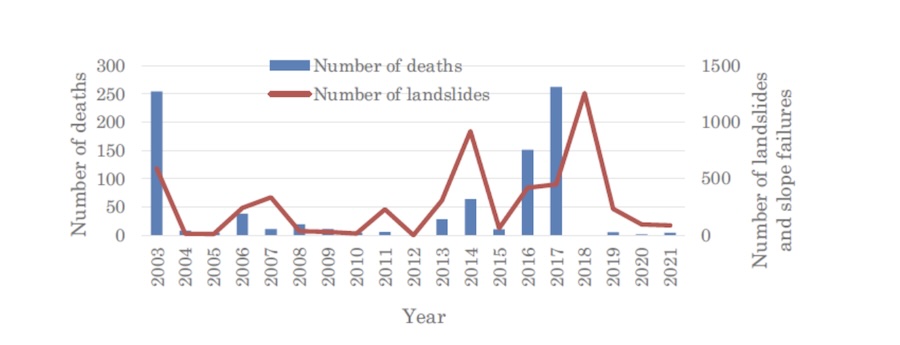
Based on the graphics shown, there would have been about 5,000 landslides and slope failures with nearly 1,000 deaths over 19 years between 2003 and 2021. Every year there was some landslide or slope failure activity. One notable feature is that there have been more deaths with fewer landslides and vice-versa in particular years. In 2018, there were no deaths when the highest number (1,250) of landslides and slope failures occurred that year. Although the largest number in an year, the landslides in 2018 could have been minor and occurred in unpopulated areas. The reasons for more deaths in, say, 2016 (150) or 2017 (250+), could be their location, population density and the severity of specific landslides.
NBRO’s landslide early warning system is based on three components: (1) Predicting rainfall intensity and monitoring water pressure build up in landslide areas; (2) Monitoring and observing signs of soil movement and slope instability in vulnerable areas; and (3) Communicating landslide risk level and appropriate warning to civil authorities and the local public. The general warnings to Watch (Yellow), be Alert (Brown), or Evacuate (Red) are respectively based on the anticipated rainfall intensities, viz., 75 mm/day, 100 mm/day; and 150 mm/day or 100 mm/hr. My understanding is that over the years, NBRO has established its local presence in vulnerable areas to better communicate with the local population the risk levels and timely action.
Besides Landslides
This year, the rain has been relentless with short-term intensities often exceeding the once per 100-year rainfall. This is now a fact of life in the era of climate change. Added to this was cyclone Ditwah and its unique meteorology and trajectory – from south to north rather than northeast to southwest. The cyclone started with a disturbance southwest of Sri Lanka in the Arabian Sea, traversed around the southern coast from west to east to southeast in the Bay of Bengal, and then cut a wide swath from south to north through the entire easterly half of the island. The origin and the trajectory of the cyclone are also attributed to climate change and changes in the Arabian Sea. The upshot again is unpredictability.
Besides landslides, the rainfall this season this season has inundated and impacted practically every watershed in the country, literally sweeping away roads, bridges, tanks, canals, and small dams in their hundreds or several hundreds. The longitudinal sinking of the Colombo-Kandy Road in the Kadugannawa area seems quite and unparalleled and this may not be the only location that such a shearing may have occurred. The damages are so extensive and it is beyond Sri Lanka’s capacity, and the single-term capacity of any government, to undertake systematic rebuilding of the damaged and washed-off infrastructure.
The government has its work cutout at least in three areas of immediate restoration and long term prevention. On landslides warning, it would seem NBRO has the technical capacity to do what it needs to do, and what seems to be missing is a system of multi-pronged and continuous engagement between the technical experts, on the one hand, and the political and administrative powers as well as local population and institutions, on the other. Such an arrangement is warranted because the landslide problem is severe, significant and it not going to go away now or ever.
Such an engagement will also provide for the technical awareness of the problem, its mitigation and the prevention of serious fallouts. A restructuring could start from the assignment of ministerial responsibilities, and giving NBRO experts constant presence at the highest level of decision making. The engagement should extend down the pyramid to involve every level of administration, including schools and civil society organizations at the local level.
As for external resources, several Asian countries, with India being the closest, are already engaged in multiple ways. It is up to the government to co-ordinate and deploy these friendly resources for maximum results. Sri Lanka is already teamed with India for meteorological monitoring and forecasting, and with Japan as well as Norway for landslide research and studies. These collaborations will obviously continue but they should be focussed to fill gaps in climate predictions, and to enhance local level monitoring and prevention of landslides.
To deal with the restoration of the damaged infrastructure in multiple watershed areas, the government may want to revisit the Accelerated Mahaweli Scheme for an approach to deal with the current crisis. The genesis and implementation of that scheme involved as many flaws as it produced benefits, but what might be relevant here is to approach the different countries who were involved in funding and building the different Mahaweli headworks and downstream projects. Australia, Britain, Canada, China, Germany, Italy, Japan and Sweden are some of the countries that were involved in the old Mahaweli projects. They could be approached for technical and financial assistance to restore the damaged infrastructure pieces in the respective watershed areas where these countries were involved.
Ajith / December 21, 2025
“Another Christmas, Another Disaster, Another Recovery Mountain To Climb”
We are good at responding to the immediate effect on one disaster ignoring all other disasters and the impact of the man made policies of the land. Sri Lanka has a history of only 75 years of governance after this island ruled by European governments for nearly for nearly 500 years. Even before that this island was not ruled by various invaders from the neighbouring India. We do not know whether the natives or aboriginals of this island ruled this country before the arrival of Mahinda from India.
In fact, there are only a few Sinhalese moved to North East until 1948. The 1881 census of population of the island was a clear understanding of the population distribution of different ethnicities in the island.
Since 1948, Buddhist took the government from the British in the independence but what happened is really is the change of management from British to Buddhists. Buddhist started the destruction of Sri Lanka in 1948, and now it almost brought to bankrupt and now it is impossible to recover from it because the the impact of Buddhism is unrecoverable. Why British moved to New Zealand and Australia and why did they did not move to India, Sri Lanka or Pakistan? The Religions is enough to do its work to destroy these islands.
/
SJ / December 22, 2025
“….after this island ruled by European governments for nearly for nearly 500 years. ‘
So well and so fairly and so very justly!
/
Ajith / December 22, 2025
“So well and so fairly and so very justly!”
What about the so fairly and so justly of SB?
/
SJ / December 22, 2025
You worship the white masters and can see no fault with their rule.
Stick to the point and do not take the usual escape route of going at a tangent.
/