

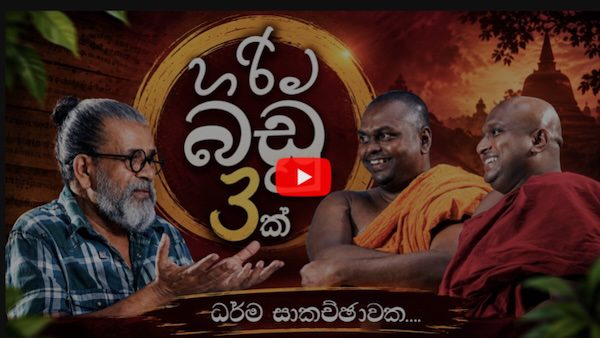
By Amarasiri de Silva –

Professor M.W. Amarasiri de Silva
The panel discussion hosted on Upul Shantha Sannasgala’s channel—featuring Ven. Kekirawe Sudassana Thero and Ven. Thiththagalle Anandasiri Thero—stands as a seminal document in the ongoing intellectual and cultural history of contemporary Sri Lankan Theravada Buddhism. Formally convened in response to inquiries and charges initiated by traditional monastic chapters accusing reformist monastics of distorting the Buddha’s teachings, the dialogue transcends a mere procedural defence. Instead, it expands into a sweeping, critical interrogation of Sri Lanka’s socio-religious landscape, institutional hierarchies, hermeneutical methodologies, and the democratic boundaries of religious discourse. By examining the core thematic nodes around which the exchange revolves, one uncovers a profound dialectic between the demands of textual orthodoxy, the realities of institutional preservation, and the imperative for rational, critical renewal within the Sasana.
At the heart of the dialogue lies a fundamental epistemological dispute concerning the definition of Right View versus Wrong View. The ten main topics and query points submitted to the panel focus on the allegations made by the monastic chapter (Nikaya) regarding the distortion of Buddhist concepts:
Sammā Diṭṭhi (Right View) vs. Birth Predictions — Does literal belief in birth prophecies, astrologers, and the thirty-two physical marks (puruṣa lakṣaṇa) align with Right View, or does it reflect Wrong View (micchā diṭṭhi)?
Authority and Status of the Tipitaka — Should the Tipitaka be viewed as an absolute, unalterable holy scripture like those in Abrahamic faiths, or as a historically developed canon open to critical analysis?
Primary Duty of a Bhikkhu — Is a monk’s fundamental purpose personal liberation (Nibbāna) and service to others, or compliance with institutional monastic hierarchies?
Monastic Privilege and Law Enforcement — Why does wearing robes accord monastics unearned social and legal immunity, such as exemption from police checks?
Legitimacy of Monastic Inquiries — Are formal Nikaya inquiries genuinely intended to protect discipline (Vinaya), or are they being used as tools for institutional censorship against reformist ideas?
Social Media Outrage and Online Bullying — How do digital algorithms and social media mobbing distort scriptural debate and fuel character assassination against reformist monks?
Reinterpretation of Canonical Figures — Can canonical narratives like that of Angulimala be reinterpreted allegorically and psychologically without being labeled as heresy?
Pluralism and Freedom of Expression — Is there sufficient democratic space in Sri Lanka for diverse, non-mainstream interpretations of Buddhist philosophy?
Personal Accountability in Public Discourse — Should individual speakers take sole ownership and liability for their views rather than shifting responsibility to media hosts or monastic bodies?
Resilience Against Institutional Opposition — How can reformist monastics maintain intellectual integrity, engage in long-term academic scholarship, and withstand institutional backlash?
The discussion opens with a critical evaluation of traditional biographical narratives surrounding the birth of Prince Siddhartha. Standard Theravada commentary, heavily influenced by later biographical works such as the Jātakanidāna and various post-canonical texts, describes the infant prince being examined by Brahmin astrologers who identified thirty-two major physical characteristics. Based on these marks, the sages famously prophesied a binary destiny: Siddhartha would either become a Universal Cakkavatti King ruling the secular world or renounce the household life to become a Fully Enlightened Buddha.
The participating monastics subjected this traditional narrative to rigorous rationalist critique, arguing that taking such mythological frameworks as literal historical fact undermines the core philosophical apparatus of early Buddhism. From a reformist perspective, attributing cosmic significance to physical marks or hereditary fortune shifts the locus of salvation from personal, empirical mental cultivation to deterministic, Brahminical sign-reading. When monastics and lay practitioners elevate hagiographical legend to the status of essential doctrine, they run the risk of mistaking cultural folklore for the liberating truth of Right View. The true core of Right View, as articulated in canonical texts like the Sammādiṭṭhi Sutta, consists of a clear comprehension of wholesome and unwholesome action, the Four Noble Truths, and the continuous operation of Dependent Origination.
However, a complete critical evaluation of this stance reveals a complex tension within the lived tradition of Theravada practice. Historically, devotional literature and hagiographical narratives served a vital pedagogical and psychological function. For the non-monastic lay community, narrative literature—replete with miraculous signs, cosmic alignments, and heroic prophecies—provides the conceptual framework required to generate faith. Faith in Theravada epistemology is not the antithesis of wisdom, but it’s necessary precursor; it settles the mind and creates the emotional foundation for spiritual practice. While the reformist impulse to strip away Brahminical accretions is academically and philosophically coherent, dismissing popular mythography entirely risks alienating lay followers whose religious engagement is mediated through narrative, symbolism, and devotional reverence rather than abstract philosophical analysis. The challenge for modern reformists lies in distinguishing between pedagogical myth and core doctrine without inadvertently destabilizing the devotional infrastructure that sustains the lay-monastic relationship.
Closely tied to the critique of birth narratives is an interrogation of the textual status of the Tripitaka itself. During the discussion, the interlocutors draw an explicit contrast between the textual ontology of Abrahamic religious traditions and that of the Theravada Buddhist canon. In traditions governed by a singular, unalterable divine revelation—such as Islam’s understanding of the Holy Quran—the text functions as the direct, literal, and eternal word of the divine, standing above historical context, textual criticism, or internal modification. The discussion emphasizes that applying such a rigid textual ontology to the constitutes a deep fundamental misinterpretation of how the Buddhist canon came into existence and how it was intended to function.
Historically and textually, the Tripitaka is an evolving body of oral material codified across successive Buddhist Councils, beginning at Rājagaha shortly after the Buddha’s Parinibbāna and continuing through the Fourth Council at Aluvihara in Sri Lanka, where the texts were first committed to palm-leaf manuscripts. The canon preserves various layers of historical development, incorporating regional dialects, pedagogical adjustments adapted to specific audiences, administrative rules formulated dynamically in response to specific monastic infractions, and later scholastic syntheses such as the Abhidhamma Pitaka and the commentaries composed by Acharya Buddhaghosa and others.
To treat the Tripitaka as a holy book in the dogmatic sense—where every stanza, commentary, and historical editor’s note is granted immutable, infallible authority—violates the spirit of the Buddha’s own epistemological methodology. In the Kālāma Sutta, the Buddha explicitly cautions against relying blindly on tradition, lineage, hearsay, scriptural authority, or the prestige of a teacher. Instead, texts are presented as pragmatic maps meant to be tested against individual experience and verified through the eradication of greed, hatred, and delusion.
The reformist effort to treat the Tripitaka as an open, historically contextualized library of spiritual tools rather than an unquestionable dogma provides a vital corrective to literalism. It allows contemporary practitioners to navigate contradictions between early discourse layers and later commentarial additions without falling into existential crisis or charges of apostasy. Yet, this critical freedom introduces its own systemic vulnerability: if individual interpretation completely supersedes textual authority without clear hermeneutical boundaries, the risk of subjective distortion increases exponentially. Striking a balance between historical-critical open-mindedness and fidelity to foundational principles remains one of the primary intellectual challenges facing contemporary Theravada scholarship.
A major theme running through the panel discussion is the definition of a bhikkhu’s primary obligation within the Sasana. The interlocutors argue that the contemporary monastic establishment in Sri Lanka has suffered a profound teleological drift, substituting institutional loyalty, political patronage, and sectarian preservation for the authentic goals of monastic life: personal spiritual liberation and altruistic service to humanity.
In early Buddhism, the monastic order was established as an intentional counter-cultural community designed to optimize the conditions for mental cultivation and moral purity. The Vinaya Pitaka outlines a framework aimed at cutting off social entanglements, luxury, and political ambitions, allowing the monastic to focus entirely on the dual training of tranquillity and insight. The monk’s service to the lay community was fundamentally spiritual and ethical; by embodying moral purity and offering the gift of the Dhamma, the monastic served as an unsurpassed field of merit for the world.
Over centuries of integration into the socio-political structure of Sri Lanka—a process solidified during the Anuradhapura and Polonnaruwa eras—the Saṅgha evolved into a powerful institutional landlord, political mediator, and cultural guardian. Monastic orders coalesced into distinct Nikāyas, such as the Siam, Amarapura, and Ramanya Nikayas, often aligned along caste lines, landownership patterns, and regional power centres. As the video discussion highlights, this institutionalization has created an environment where loyalty to the executive structures of a Nikāya frequently takes precedence over individual pursuit of the Dhamma. Monastics who challenge sectarian norms, critique political alignment, or re-examine canonical interpretations are quickly framed as institutional liabilities or internal dissidents.
The critique offered by the panellists calls for a radical return to soteriological fundamentals. They assert that a monastic’s legitimacy is derived not from institutional rank, administrative power, or corporate standing within a chapter, but from personal ethical purity, intellectual honesty, and dedication to the path of awakening. When institutional preservation becomes the ultimate goal of a monastic chapter, the Sasana loses its transformative power and degrades into a socio-political interest group.
Beyond theoretical and soteriological matters, the panel addresses the immediate, practical issue of monastic privilege and its impact on the rule of law in Sri Lankan society. During the dialogue, specific reference is made to the common societal habit of treating monastics with uncritical deference—exemplified by law enforcement officers routinely declining to stop, inspect, or hold accountable individuals wearing the saffron robe, even when legitimate suspicion exists.
This observation exposes a deep structural contradiction in modern Sri Lanka. The yellow robe, originally designed as a discarded rag signifying total detachment from ego, worldly status, and material wealth, has been transformed into a symbol of institutional authority and legal immunity. This feudal deference creates a culture of impunity where the robe functions as an impenetrable shield against civic accountability.
From an ethical and legal standpoint, granting monastics immunity from the law undermines the foundational principles of a secular democratic state, where all citizens remain equal before the law. More critically, it inflicts severe damage on the internal moral integrity of the Saṅgha itself. When moral rectitude is assumed purely based on external attire rather than verified conduct, the incentive for internal self-regulation disappears. The panel’s critique underscores that true reverence for the robe cannot be enforced through unquestioning societal compliance or legal exemptions. When the external status of the robe is weaponized to bypass civic duties or evade legal scrutiny, it corrodes public trust in the entire monastic order.
The immediate catalyst for the recorded discussion was the formal disciplinary proceedings and inquiries initiated by monastic chapters against reformist monks. The panellists offer a detailed critique of how institutional machinery—specifically the executive bodies of the Nikāyas—is used to silence philosophical debate under the guise of protecting the purity of the Sasana.
Historically, the administrative procedures of the Saṅgha were established by the Buddha to resolve genuine disputes regarding monastic discipline or doctrinal schisms. Proceedings were designed to be transparent, collaborative, and grounded in compassion, aiming for the reconciliation and rehabilitation of the monk rather than punitive exile. The criteria for determining whether a teaching was true Dhamma or non-Dhamma were explicitly qualitative, as articulated in the Gotamī Sutta: teachings that lead to dispassion, detachment, simplicity, content, and energetic practice constitute the true Dhamma, whereas those that lead to passion, bondage, and ambition do not.
The panel points out that modern monastic inquiries have strayed far from these original guidelines. Rather than evaluating whether a monk’s teachings cultivate dispassion and wisdom, contemporary trials often function as political courts aimed at enforcing doctrinal conformity and protecting the institutional authority of senior ecclesiastics. Monastics who employ modern historical-critical methods, critique popular superstitions, or challenge traditional commentarial authority are routinely threatened with disenfranchisement, loss of monastic status, or expulsion from their chapters.
This institutional suppression creates an environment of intellectual stultification. By treating honest theological inquiry and historical revision as existential threats, the monastic hierarchy stifles intellectual growth within the Saṅgha. The panel argues that a healthy religious tradition should not fear open debate. If reformist interpretations are inaccurate or scripturally unsound, they should be publicly refuted through transparent, evidence-based dialogue rather than suppressed through institutional coercion.
The discussion also explores how modern communications technology and algorithmic media platforms shape contemporary religious discourse. The interlocutors observe that public outrage against reformist monks is largely generated, amplified, and commercialized through social media platforms such as Facebook, YouTube, and TikTok.
In the contemporary Sri Lankan media environment, religious discourse has become deeply intertwined with the engagement economy. Social media algorithms are designed to maximize user engagement by prioritizing content that triggers strong emotional reactions—particularly outrage, tribal defensiveness, and moral indignation. When a reformist monk presents a complex, reinterpreted reading of a traditional Buddhist narrative, short, isolated audio or video clips are frequently extracted from their broader context and circulated online. These snippets are framed specifically to outrage traditional believers, driving viral engagement, comment-section conflict, and media traffic.
This dynamic distorts serious theological inquiry into digital tribalism. Complex textual, historical, and philosophical arguments requiring nuanced context are reduced to simplistic headlines designed for online outrage. Consequently, traditional monastics and institutional bodies often find themselves pressured by online mobs to take harsh punitive action against reformist voices to defend their public standing. The panel notes that this digital feedback loop destroys the reflective space necessary for meaningful Dhamma exploration, replacing contemplative inquiry with online harassment and character assassination.
A specific illustrative example highlighted during the discussion concerns the pedagogical reinterpretation of canonical figures, particularly the character of Angulimala. In popular Sri Lankan consciousness, Angulimala is viewed primarily as a literal, historical serial killer who wore a garland of fingers and was miraculously transformed by a single encounter with the Buddha, instantly attaining Arahantship.
While accepting the narrative’s emotional power, reformist monastics often employ allegorical and psychological frameworks to unpack the story’s deeper lessons. In these re-evaluations, Angulimala represents the human potential for total psychological transformation, demonstrating how even a mind deeply twisted by destructive ideologies can break free through the systematic application of awareness and wisdom. The story is used as a commentary on the power of social rehabilitation, structural conditioning, and the ultimate primacy of non-violence over punitive retribution.
The discussion emphasizes that reinterpreting canonical figures as pedagogical allegories is a long-standing tradition within Buddhist history, rather than a modern invention designed to destroy religion. Throughout the Pali Canon, the Buddha routinely took existing Brahminical rituals, deities, and allegories and completely redefined them in psychological and ethical terms. For instance, in the Sigālovāda Sutta, the ritual worship of the six physical directions is transformed into ethical duties toward six social relationships. Reformist monks who apply similar pedagogical reinterpretations to traditional narratives are continuing an established canonical methodology. However, when conservative institutions view these allegorical approaches as literal denials of canonical truth, a fundamental disconnect occurs between literalist traditionalism and psychological hermeneutics.
The dialogue hosted by Upul Sannasgala repeatedly links the internal struggles of the Saṅgha to the broader societal need for pluralism, democratic freedom, and freedom of expression in Sri Lanka. The participants argue that the health of a nation’s democratic culture can be measured by its tolerance for dissenting ideas within its dominant religious tradition.
In post-colonial Sri Lanka, Buddhism has held a unique, constitutionally protected status, formally enshrined in the Constitution, which obligates the State to protect and foster the Buddha Sasana while guaranteeing freedom of thought, conscience, and religion to all citizens. In practice, this constitutional protection has often been interpreted by conservative factions as a mandate to enforce ideological uniformity and shield popular Buddhist practices from critical examination.
The panel contends that transforming Buddhism into an enforced state orthodoxy contradicts both modern democratic principles and the core spirit of the Dhamma. A robust, mature democratic society must protect the space for intellectual critique, dissent, and philosophical re-evaluation. Suppressing dissenting views through institutional intimidation or state coercion breeds intellectual stagnation and dogmatic extremism. Allowing diverse perspectives on Buddhist philosophy to coexist openly enriches the intellectual life of the nation, fostering a resilient culture of debate capable of engaging with modern global thought.
An essential structural dimension of the exchange—and one that provides valuable insight into public intellectual discourse—is the clear boundary established between host Upul Sannasgala and the participating monks regarding personal accountability. Throughout the discussion, Sannasgala maintains a clear distinction between providing a neutral platform for open dialogue and endorsing the personal views of his guests. He explicitly states that while he is committed to providing a democratic forum where controversial, non-mainstream views can be voiced without censorship, the burden of intellectual defence, legal accountability, and scriptural justification rests entirely on the individual speakers themselves.
This distinction sets a healthy benchmark for public discourse in Sri Lanka. In a media landscape frequently dominated by sensationalism and partisan bias, establishing a clear line between host facilitation and speaker liability protects the platform’s role as a neutral space for ideas. It demands that reformist monastics step forward as independent intellectual agents who must take full ownership of their statements, present coherent arguments, and face public critique without relying on host protection or collective monastic immunity.
The discussion concludes with an exploration of the psychological, academic, and spiritual endurance required of reformist monastics who choose to confront established institutional hierarchies. Recognizing the immense personal, social, and institutional pressures facing dissenting monks, the interlocutors call for a steadfast commitment to intellectual integrity and long-term scholarship.
The path of religious reform has historically been fraught with personal risk. Monastics who challenge deeply entrenched traditional norms frequently face social ostracization, loss of material patronage, relentless media attacks, and formal ecclesiastical sanctions. In response to these pressures, the discussion encourages reformist monks to avoid slipping into defensive bitterness or withdrawing into isolation. Instead, it urges them to ground their work in rigorous, long-term academic scholarship—such as completing advanced research, publishing peer-reviewed studies, doing PhDs, and engaging with international Buddhist studies communities.
By anchoring their critiques in rigorous scholarship and exemplary moral conduct, reformist monastics build an enduring foundation that institutional coercion cannot easily dismantle. Intellectual resilience, sustained by a deep personal practice of the Dhamma, transforms individual dissent into a transformative force for long-term renewal within the Sasana.
When evaluated as a unified discourse, the panel discussion hosted on Upul Shantha Sannasgala’s channel offers a comprehensive diagnosis of the challenges facing contemporary Sri Lankan Theravada Buddhism. It brings into sharp focus the ongoing struggle between two fundamentally different views of the Sasana: an orthodox, institutional model focused on preserving heritage, textual literalism, and traditional authority; and a rationalist, reformist model dedicated to critical inquiry, sociological critique, and soteriological renewal.
The enduring value of this dialogue lies in its refusal to offer superficial resolutions to deeply complex issues. While the reformist stance provides an essential framework for clearing away historical accretions, addressing institutional corruption, and aligning Buddhist practice with modern democratic values, it must continually navigate the lived realities of a diverse lay community that finds profound meaning in devotional traditions. Ultimately, the discussion demonstrates that true preservation of the Buddha Sasana is not achieved through rigid censorship, institutional trials, or unthinking compliance. It flourishes through open, rigorous, and fearless engagement with the truth—an ongoing process of critical inquiry that honours the Buddha’s timeless invitation to come and see.
nancytwins17 / September 26, 2026
Buddhism in SL has never been the same as we presumed since Walpola Rahula wrote ‘Bhikkuwakagey Urumaya’. It gave rise to Eksath Bhikku Peramuna to get SWRD elected on an agenda based on hate, racism, and ethnocentrism. We never recovered. Mangala was correct to state that we do not have the ‘Triple Gem’ any more. The kind and gentle Sinhala ethos slowly eroded and has become a materialistic and selfish society. The Sangha is irrelevant in SL in general. Buddhism is surviving as a philosophy outside SL. If only people take a few moments to realize that there is no ‘I’, everything we know changes each moment, we came in with nothing and depart the same way, to act and behave accordingly, most of our problems will be resolved.
Consider your are lucky to be born in SL with the access to Buddha Dhamma. However, having the good karma to be born near the Dhamma is only half the battle.
/