

By Gayanga Dissanayaka –
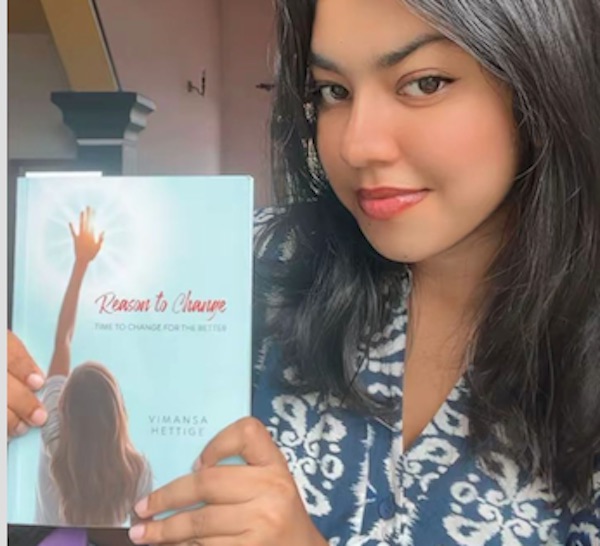
“I never really gave much thought about myself until I was twenty-three,” said Vimansa Hettige. “I guess it happens at different ages to different people. Some people realise that they want to do something with their lives at a much younger age. But for me it was twenty-three”. When Vimansa first decided to take this step, she didn’t know how or where to start. She was studying software engineering but was struggling to find interest in it. It was her cousin sister who suggested psychology because it felt fitting for her. “Sometimes people close to you know you better than yourself. After giving it some thought, psychology felt like a calling to me and I sensed it was indeed my forte, so I decided to pursue my higher studies in it,” said Vimansa. Today, she is a published self-help author of her debut book, Reason to Change.
Growing up, Vimansa was enrolled into an international school and again admitted to a government school. Vimansa recalls how this shift challenged both her English and Sinhala language skills. “I was a little lost and therefore education also became rather difficult. However, after I started my Higher National Diploma in Psychology, I had to learn everything in the English medium. At first, assignments were very difficult and I couldn’t read and understand them. But I had friends in my batch who helped me a lot. They would explain that to me in Sinhala and I would translate my assignments before I worked on them. But as time went, Vimansa’s writing skills slowly started to improve. She built up the confidence to talk and write in English even when she was making mistakes. She thanks her university environment for creating that confidence in her. “I remember getting merits and distinctions for my second semester and that was a huge improvement.”
In the past, Vimansa mentioned how she never realised the nature of her friendships and relationships properly. The biggest catalyst for change was her breakup. Vimansa recalled how her past relationship was toxic since she was with a narcissist. “When you stay with a narcissist, your personality also slowly becomes toxic until you yourself forget who you are. Back then, I had more weight, had a lot of acne, and was physically unhealthy. My appearance was vastly different because my body knew the unhealthy environment it was in and was actively rejecting it,” said Vimansa. “For two years after the breakup, my mind and body recovered vastly and it happened very naturally. When I realised that my mind is now clear, I decided that I should start something beneficial for myself and others. And within four years, a lot of changes took place. I was not at all a bright kid during my school years but I was able to pass my HND and get a second upper class for my BSc. Nothing in life happens step by step according to a timetable, it’s messy and takes unexpected roads but we can support ourselves by maintaining a certain discipline in our lives.”
During her higher studies, Vimansa realised that she has a knack of communicating well with people, understanding them and motivating them. This was due to her own past reasons that became catalysts of change in her life. ”You realise that much later, not at that moment. And as a psychology student, my purpose would be to help people improve their lives,” said Vimansa. “But you cannot fill another person’s cup when yours is empty so I wanted to do something that would fill my cup as well. I wanted to nurture others and in turn nurture myself in the process. If you possess something meaningful then you can definitely share that with the others. So writing a book felt like the best choice,” noted Vimansa.
“I simply published this book for people to understand their own pathways to change. It’s like different people dyeing their hair red. The colour would be the same but it would look different on every person because everyone would do it their own way,” noted the author. She further explained how we don’t only discover who we are through ourselves, but also through other people and our environment. Vimansa noted how from the day we are born, we speak the language that our parents spoke. We are still walking around learning new things and acquiring new habits into our daily lives, so building and changing thought patterns is entirely possible.
Something the author firmly believes in is the importance of creating core beliefs. She explained how if you are someone who has genuine love to offer, you have integrated love, trust, loyalty, honesty inside yourself which is why they come to play in your relationships even if the relationships turn out to be toxic. In the same way, she explains how if we also made sure to integrate qualities in ourselves such as mindfulness and discipline, overtime they became a part of our thought patterns. So the next time you find yourself stuck in negativity, even when you’re in deep despair, these qualities somehow surface and would stabilise you at the right time before letting you spiral. According to her, we have to make sure that your core beliefs and positive thought patterns save you at the end of the day.
“I believe in universal energy and I believe in faith. I also believe in manifestation and that we shouldn’t have doubts when we are embarking on something important,” said the author, “Thankfully, when I was working on this book, I had a clear mind to work on it. The only thing I had at the time was faith and I prayed five times a day. I did carry trauma from my past relationship and had triggers that I had to deal with. Trauma will never leave your body, you just learn to manage it. But because of the core beliefs I fostered in myself, I was able to manage them and focus on the book.”
However, negativity affects every single one of us. On such days, Vimansa gives herself a day or two to sit with the negativity. She tells herself that she’s allowed to cry, to doubt, to think about it. She would write about it in her diary and take that day to properly sit with the negativity. But from the next day onwards, she promises to stand up again. “I give myself time for my negative feelings but I don’t let it consume me, that discipline helps me a lot and it helps maintain the negativity in my life, because let’s be honest, you can’t wipe out negativity completely. Life is always a series of ups and downs and it’s two sides of the same coin.”
In Reason to Change the author has written a lot of psychology theories such as how to tackle negative thought patterns, utilising Cognitive Behavioural techniques, and practising mindfulness. A lot of self-discovery is discussed in her book as well, along with other subjects like building discipline, and the importance of a healthy sleeping schedule.
Since Vimansa first started her writing with university assignments, she started writing this book in a simple academic style as well which blended well with the self-help genre. “I realised that when you read a self help book like a novel it becomes rather boring and tedious, and everything becomes confusing after a while. So I decided to write a small story at the start of every chapter explaining the situation or context behind it and then started discussing the subject in segments, breaking them down to negatives, positives and step by step guide and tips on how to go about it. She listened to Rishab Rikhiram Sharma’s Sitar music throughout her writing journey of Reason to Change.
“When I first saw the book at The Jam Fruit Tree Publications, it took me by surprise. The question, ‘Did I write this?’ kept running through my mind. It was difficult to believe that I was the author of this book. I struggled to express my emotions – even my joy. But I knew that my inner child was proud, and sometimes that’s all that matters,” she said.
Vimansa added that most of us have reserved a huge part of our life to grief alone which is why even during joyful moments, it’s difficult for us to be happy. Negativity is easier to reside in, it eats at your confidence and knows exactly how to hinder your growth. Vimansa mentioned how we have to make sure to give joy a big part of our life. “Even in my book I have mentioned that we should celebrate even the smallest of our victories and improvements. After you train your brain to do this, you build a healthy armour around yourself,” she said. “My only hope is that my book would find its way to you and help you realise that you have so much untapped potential for positive change. If at least one word from Reason to Change helps my readers towards that goal, that is my purpose as a self-help author.”