

By Ranil Senanayake –

Dr. Ranil Senanayake
In April 2011 a paper identifying the most critical and valuable material in maintaining the life support system of the planet as its photosynthetic biomass, was published in Havana Cuba. Photosynthetic biomass refers to the green leaves of plants on land. The paper pointed to the need to consider the valuable ecosystem services such as the production of Oxygen, sequestering of Carbon and cycling of water carried out by the leaves of plants. This theme was again raised in 2015 when the Presidential delegation to the UN Conference for Climate Change (COP21) Paris 1-10 December 2015 issued a Sri Lanka Position Paper, which stated:
“We are aware that the critical Ecosystem services such as; production of Oxygen, sequestering of Carbon, water cycling and ambient cooling is carried out by the photosynthetic component of biomass. This is being lost at an exponential rate, due to the fact that these Ecosystem Services have not been valued, nor economically recognized. We would request the Intergovernmental Panel on Climate Change (IPCC) to examine the value of photosynthetic biomass.”
This statement was especially poignant in the light of subsequent economic studies that stated “Ecosystem services are the direct and indirect life-sustaining benefits nature provides to humanity, globally valued at roughly ($16) to ($54) trillion annually”.
These services are assigned as;
Provisioning Services: Tangible physical products obtained from ecosystems. Examples: Food, drinking water, timber, fiber, and genetic resources.
Regulating Services: The benefits obtained from the regulation of ecosystem processes.Examples: Carbon sequestration, climate regulation, water purification, flood control, and pest/disease control.
Supporting Services: Fundamental functions that are necessary for the production of all other ecosystem services Examples: Nutrient cycling, soil formation, and primary photosynthesis.
Cultural Services: Non-material benefits that contribute to human enrichment, mental health, and spiritual connection.
In such evaulations, the ecological basis of many of these services is photosynthetic biomass. It underpins all direct and indirect life-sustaining benefits provided by nature. Thus, ecosystem services begin at the initiation of primary productivity, where solar energy is harnessed to make the building blocks of life. A direct consequence of this action is to fix Carbon dioxide from and release Oxygen into, the global commons of air or the atmosphere. The Global Commons are the internationally recognized areas and systems that lie beyond national sovereignty yet sustain all human and ecological life. Traditionally, this concept includes the high seas, Antarctica, outer space, and the atmosphere. The legal recognition of the global commons is crucial because these spaces and systems cannot be effectively governed by individual states acting alone. Establishing the global commons as a political jurisdiction would create shared responsibility.
As our current economic model relies on the commons of air as the depository of the negative externalities of the market process, gasses such as CO2, CH4 and N2O produced by burning fossil fuels are now threatening to destabilize the atmosphere. The act of starting a car or getting on a plane means that the atmosphere will be expected to absorb the negative externalities.
The commons of air or the atmosphere of Earth consists of a layer of mixed gas (commonly referred to as air) that is retained by gravity, surrounding the Earth‘s surface. By mole fraction (i.e., by quantity of molecules), dry air contains 78.08% nitrogen, 20.95% oxygen, 0.93% argon, 0.04% carbon dioxide, and small amounts of other trace gases Air also contains a variable amount of water vapor, on average around 1% at sea level, and 0.4% over the entire atmosphere.
The atmosphere or the commons of air has enjoyed a period of relative stability in climate and atmospheric gas concentrations for a long time. Since the Holocene period, that began at the end of the last ice age about 12,000 years ago, ice core data reveal that levels of CO2 and CH4 in the atmosphere were relatively constant, at about 280 ppmv and 650 ppbv, respectively. Then, about 200 years ago. levels of both gases, as well as another greenhouse gas, nitrous oxide (N2O), increased rapidly. These increases, which coincide with the industrial revolution, were due to anthropogenic activity, including the burning of fossil fuels and enhanced deforestation and agriculture. The increases in these three greenhouse gases are the primary cause of the warming of the Earth by about 1oC over the past century. In addition, atmospheric oxygen has declined by approximately 0.1 % relative to its total concentration over the past 100 years. This reduction is largely driven by the combustion of fossil fuels, which consumes O2 and produces CO2. While the drop is scientifically measurable and trending downwards, the impact on ecosystems or on the physiological impact on human breathing has yet to be measured.
As the global commons is still both a concept and a legal frontier. It has been treated as the repository for all the unaccounted negative outputs of industry to be externalized into the Global Commons. This underpins the accounting acceptance of ‘negative externalities’ of industrial production and suggests a need for defining it as a jurisdiction, where humanity can build the institutions required to safeguard shared resources and systems vital to survival.
Trusteeship, common concern, common heritage, Earth-system law, and global administrative law represent distinct but complementary strategies for constructing such a jurisdiction. Together with emerging tools like ecocide prosecutions and judicial opinions, they show that while the global commons has yet to be fully recognized as a legal jurisdiction, the building blocks already exist. Harnessing them coherently could transform the global commons from a fragile metaphor into a governing reality.
It has been suggested that the Global Commons could be considered a repository or bank, structured using block-chain technology that recognizes any additionality to the existing capital, which can be a confirmed validated as a deposit; For example, Oxygen exists in
the global commons, what is externalized in the action of growing and nurturing a tree for crop or timber is a positive externality that can be a monitored, recorded and verified as an ecosystem service. In this way realizing value for ecosystem services could be seen as a transactable product and such deposits validated as a positive externalities added to the Global Commons of air.
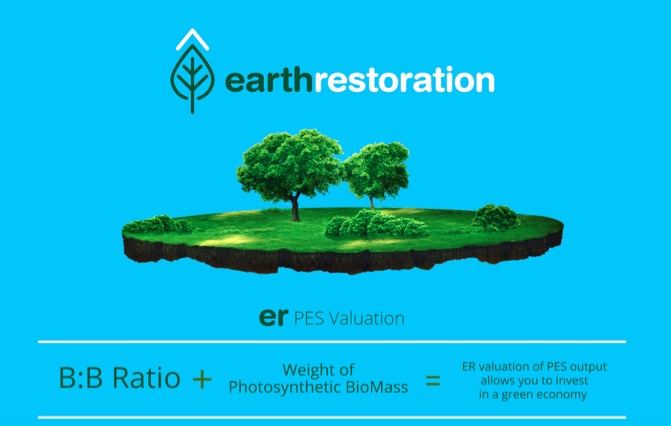
Using these concepts and building on Sri Lanka’s call at COP 21 on the value of recognizing ecosystem services to power a sustainable economy, a Sri Lankan startup Earthrestoration p/l has demonstrated the feasibility of the process using contract specific terms for growing new (units) trees on their lands while also practicing the principles of Analog Forestry for
improving climate resilience. The outcomes of this project demonstrated that each landowner was contracted to plant 10 tree units and how each enrolled smallholder farmer
was successfully encouraged to maintain the tree units in good health and in accordance with the LifeForce Tree Farming Contract — signified by the leaf mass accumulation on the tree over the contracted time (4 years). In return for their efforts an annual payment for the ecosystem services was verified for each tree unit and made to each smallholder farmer as an additionality. .Since 2016 it began working with a group of single women headed households in the north of Sri Lanka, to demonstrate the feasibility of producing
privately contracted, net Oxygen. The first completed Lifeforce contracts was in 2022 when the project gained recognition through the payments officialized by the then Prime Minister .hon. Dinesh Gunawardene, who made an official visit to the project site and handed payment to the farmers on behalf of the company. From the social – and economic standpoint the lessons learned from this Sri Lankan experiment clearly demonstrates a new paradigm to power economies through the validation of ecosystem services being ‘onset’ as a positive externality to the biosphere and our Global commons. Sri Lanka stands ready to justify the statement made to the world in 2015