


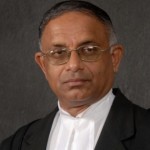
Dr. Jayampathy Wickramaratne PC
Speech made by Dr Jayampathy Wickramaratne PC at the launch of “Constitutional Conversations”
My Lord the Chief Justice, Your Lordships of the Supreme Court, Your Lordships the President and other Judges of the Court of Appeal. Justice Priyasad Dep, former Chief Justice, Honourable Attorney-General, Learned President’s Counsel, Mr Saliya Pieris and Prof. Dinesha Samararatne, Members of Parliament, both past and present, Mr Rajeev Amarasuriya, President of the Bar Association of Sri Lanka
Members of the Bar
Friends
Let me first, on behalf of Lake House Printers and Publishers and myself, thank you for accepting our invitation to attend this launch.
I will not say anything about the book but will leave that to others; Saliya and Dinesha have already done so. Thank you, Saliya and Dinesha, for your contribution.
Why do we need conversations about constitutional law and constitutional reform?
Sri Lanka, like most countries in the Commonwealth, is a common law country. Common law countries are distinguished by their reliance on judicial precedent and judge‑made law, which evolve through case‑by‑case reasoning rather than comprehensive codification. This tradition emphasises flexibility, judicial independence, and the adversarial process.
In common law countries, the legal community therefore has a vital duty to critique judicial decisions, as precedent-based systems rely on ongoing scrutiny to ensure fairness, coherence, and legitimacy. Without critique, judge-made law risks stagnation, bias (whether institutional, personal, or doctrinal), or detachment from evolving social values. A critique is a structured, analytical evaluation of a work, idea, or situation that highlights both strengths and weaknesses, aiming to provide constructive insights rather than mere fault‑finding. It differs from simple criticism by being more formal, balanced, and evidence‑based.
Critique ensures that precedents are tested, refined, or overturned when they no longer serve justice. It often inspires legislative intervention when judicial precedent proves inadequate. Critiquing judgments trains lawyers to think critically and equips them to argue for doctrinal changes. Transparent debate reassures citizens that judicial power is exercised responsibly. Critique allows courts in different common law countries to learn from each other’s reasoning.
“The law is what the last judge said in the last case” is a pithy way of expressing a feature of the common law—that the law develops through judicial precedent and that the most recent authoritative decision ordinarily represents the current law. There is no such thing as settled law; what appears settled remains so only until a later judgment unsettles it. An example would be helpful.
The makers of the Indian Constitution debated whether the exception to the protection of life and liberty should be limited to a procedure established by law or to due process of law. If it was according to procedure established by law, the legislature ought to be trusted not to make bad laws. If it were according to due process of law, the judiciary would have the authority to question a law on the ground that it is not good law and is not in consonance with fundamental principles. The Constituent Assembly consciously decided on ‘procedure established by law’.
Soon after the Indian Constitution was adopted, it was argued in A.K. Gopalan v Madras that the word ‘law’ in Article 21 meant the principles of natural justice. That argument was rejected.
But a quarter of a century later, in Maneka Gandhi’s case, the Supreme Court headed by Chief Justice Bhagwati laid down that any law which deprives a person of his life or personal liberty is invalid unless it prescribes a fair and just procedure for such deprivation. In short, the Court read ‘due process’ into Article 21 despite the Constituent Assembly’s conscious decision not to use the phrase.
In 1991, at the first SAARCLAW conference in Colombo, Justice Bhagwati, who had retired by then, spoke on Indian developments in public law. I asked him at question time how he did it in the face of that conscious decision by the Constituent Assembly. His response was that a country must keep pace with modern legal developments and that the people are entitled to benefit from them.
A few words about the influence of foreign jurisprudence. Some in the legal community are reluctant to draw on foreign jurisprudence, viewing it as incompatible with domestic legal traditions, or just because it is foreign.
Just two examples of how foreign jurisprudence has helped develop the law in Sri Lanka.
In India, the Supreme Court had given an expansive meaning to equal protection of the law by holding that ‘anything that is arbitrary violates equal protection’. In Elmo Perera v. Jayawickrama, Mr HL De Silva PC strenuously argued for a similar expansion. A full-bench, divided 6 to 3, declined, holding that the petitioner had not shown that there was unequal treatment. Justice Wanasundera, in his dissent, held that in the case of a person in a group, the comparison would be with the norm or protection applicable to the group.
In the landmark case of Jayasinghe v Attorney-General, Justice Mark Fernando went further and held that a violation of the norm would be a violation of equal protection, as judicial notice could and should be taken of the fact that the norm is ordinarily followed. That judgment has since been followed consistently. This was made possible because of developments in India.
As to the actions of state-owned companies and corporations violative of fundamental rights, our Supreme Court initially took a restrictive view, especially in Wijetunga v Insurance Corporation, Chandrasena v National Paper Corporation, and the five-member bench case of Wijeratne v People Bank, all three judgments penned by Chief Justice Sharvananda. He was supervising my doctoral thesis at that time and used to engage in lengthy discussions with me. I expressed my reservations on the correctness of the 3 judgments, and he was ready to listen. One day, he asked me to read Sukhdev v Bhagatram, a judgment by Justice Mathew, whom he held in high esteem. That judgment supported my line of thinking, and I included it in my draft, noting that our Supreme Court has taken a very narrow view. I remember making an ‘oral submission’ as if I was in Court before him. He listened and nodded occasionally. Just that.
Later, I was junior counsel to Mr Batty Weerakoon in a fundamental rights case against some corporation; we appeared for some Sama Samajist trade unionists who had a strong case. Mr NTS Kularatne, who taught me Local Government Law at Law College, appeared for the corporation and confidently cited the three judgments of Chief Justice Sharvananda that I mentioned. Addressing him, the Chief Justice said, ‘Mr Kularatne, do you want to proceed with that argument? I have reconsidered this issue, and I am prepared to write a judgment.’ Mr Kularatne back-tracked, much to my disappointment. We were denied a judgment on the issue which, I am sure, would have been a lucid one.
But very soon, Justice Atukorale, in Rajaratne v Air Lanka, adopted the views of Justice Mathew in Sukhdev v Bhagatram.
A law student from one of the universities interviewed me for an assignment she was working on. She was outspoken and told me that my critiques of judgments seemed measured, temperate, and overtly respectful of the courts. ‘You always say “I submit”, “it is respectfully submitted”.’ I explained to her that a critique of a judgment should not become a polemical exercise, as polemics are adversarial, rhetorical attacks aimed at winning arguments rather than at deepening understanding or improving the law. In the legal community, polemics risk undermining the credibility and constructive purpose of critique.
I took the example of my treatment of Namasivayam v Gunawardena, a judgment by Chief Justice Sharvananda in a case which I myself had argued. The Police officer concerned swore an affidavit to say that he boarded the bus in which the petitioner was travelling, ‘required’ the petitioner to accompany him to the Police Station for questioning, and ‘released’ him after recording his statement. The Chief Justice held that it amounted to an arrest as the Petitioner was deprived of his liberty to go where he pleased. I have described that part of the judgment as a watershed in the field of personal liberty in Sri Lanka, but was critical of another aspect of the judgment.
The petitioner was detained under a detention order under emergency regulations, but fresh orders were not made every month, which, I argued, made continued detention unlawful.
Section 4 of the Public Security Ordinance provides that the expiry or revocation of any Emergency Proclamation shall not affect ‘any offence committed, or any right, liberty or penalty acquired or incurred’. Chief Justice Sharvananda, referring to section 4, stated that the liability to be detained was a penalty incurred by the petitioner under the Emergency Regulations. So, monthly detention orders were unnecessary. I was appalled and said this in my draft chapter:
‘By no stretch of imagination could the liability of a person arrested under Regulation 18 to be detained be termed a ‘penalty’ incurred.’
Chief Justice Sharvananda went through that part, did not say a word, but struck off the words ‘by no stretch of imagination’ with a pencil. The message was clear: ‘Be temperate in the use of language, but you are entitled to critique my judgment’.
The book now reads: ‘It is respectfully submitted that the liability of a person arrested under regulation 18 to be detained cannot be termed a ‘penalty’ incurred.’ I learnt a lot.
Soon after the judgment, the Public Security Ordinance was amended to provide that fresh orders need not be made each time the emergency is extended.
Talking about critique, once when I met Justice Shirani Bandaranayake, she inquired about the progress of the second edition of my book, ‘Fundamental Rights in Sri Lanka’, which she knew I was working on. Among other things, I told her that I was critical of the three determinations on the freedom of religious propagation she had authored. Her response was: ‘Oh! That is alright, as long as you don’t call me names.’ Now, that is the correct spirit.
This book is not only about constitutional jurisprudence but also constitutional reform. I hope the reform process will benefit from my contribution.
I want to thank Lake House Printers and Publishers for a job well done.
Now that this book is finally out, I will rest for a few weeks and start work on the 4th edition of ‘Fundamental Rights in Sri Lanka.’
I thank you all again for your honourable presence.
nimal fernando / July 20, 2026
Dr. Jayampathy Wickramaratne PC,
–
You should have done all this while you had all the time with Ranil!
–
Why now?
–
What Lanka needed was ….. not constitutions, abolitions, you name it ……
–
What Lanka needed was one man with honesty of purpose.
–
Think about it!
–
Then sit back and enjoy life …… while he does his work.
–
If you don’t understand that …….. what is the use of all your learning?
–
–
You guys are the best at barking up the wrong trees ……… at least Native is clever enough to hide behind the tree!
/
Jayasiri Samarakoon / July 20, 2026
The constitutional reform process of 2015 did not go forward because of the rivalry between Sirisena and Ranil. Both are to blame. Jayampathy (whom I don’t know from Adam), Sumanthiran or any other single person could not be blamed for it.
/
Pandukabaya / July 21, 2026
No, you are wrong. It is because the 2015 constitutional reforms were driven by political opportunism that they stand as yet another example of failed constitution making in Sri Lanka. As much as politicians, opportunistic lawyers who jump at political command are to blame. Hugh time we called a spade a spade.
/
Jit / July 20, 2026
Dr JW, Please tell me, how many constitutions and amendments have we churned out since 1948? Twenty? Thirty, Fifty? And how many PhDs fellas were involved in this grand exercise — from Colvin to GLP to you and the rest? I don’t even have a count. How many did the colonial masters make? I believe one..two??
Yet, after producing all those impressive volumes of constitutional “wisdom” by the locals, we still drove straight off the cliff in 2022. The country became a den of thieves, a hive for drug barons and Godfathers. Land of lawlessness. Even the Justice Minister is entangled in ransom scandals!! So what exactly have these countless pundits, legal whizkids, and academics achieved over 78 years? Nothing but blunders and failures — despite our habit of boasting about crafting the “world’s best constitutions”.
If we genuinely want to clean up the mess, the constitution we already have is more than enough to enforce law and order and pursue economic progress with social justice. We had a much simpler one in the 50s and 60s yet the country was much stronger in democracy and judiciary than now. What happened after all those years? Please have a peaceful retirement Dr. JW! No need to waste everyone’s time writing yet another book.
/
SJ / July 21, 2026
“How many did the colonial masters make? I believe one..two??”
Five major constitutional reforms are on record.
/
The Truth / July 21, 2026
Jit, you are right !
Nothing wholesome can come out of these second hand intellectuals !
They are pretenders or fraudsters.
I think this author was helping Ranil to draft a constitution !
What happened to the constitution that Gota was preparing for the people ?
That was drafted by a KC ?
Is a KC better than a PC ?
/
Pandukabaya / July 21, 2026
Yes he made a living out of writing ‘no go’ Constitutions! Politically compromised clown first running to CBK’s commands and then Ranil’s! High flown talk but who can take him seriously with his political history?
This is an intellectually parched isle where not ‘second class’ but ‘no class’ political clowns are blown up like balloons! One prick is enough to deflate!
/
SJ / July 21, 2026
“That was drafted by a KC ?”
Was there any KC in this country since the coronation of QE2?
I do not know if KCs entered legal practice here since King Charles III.
/