


By Nandi Jasentuliyana –
A Life Devoted to Science and Service: The Story of Dr. Richard Gunasekera, featured in the film “The Story of Everything,” screened in theatres in Los Angeles
In an age when headlines are filled with conflict and uncertainty, it is both refreshing and inspiring to turn our attention to a life quietly yet powerfully devoted to human progress. Dr. Richard Gunasekera, a distinguished scientist and academic with deep Sri Lankan roots, has been featured in the internationally discussed intelligent design film “The Story of Everything,” recently screened in Los Angeles to an audience of scholars, filmmakers, and thought leaders. His appearance in this milestone production marks not only a personal achievement but also a proud moment for Sri Lankan-born professionals making an impact on the world stage.
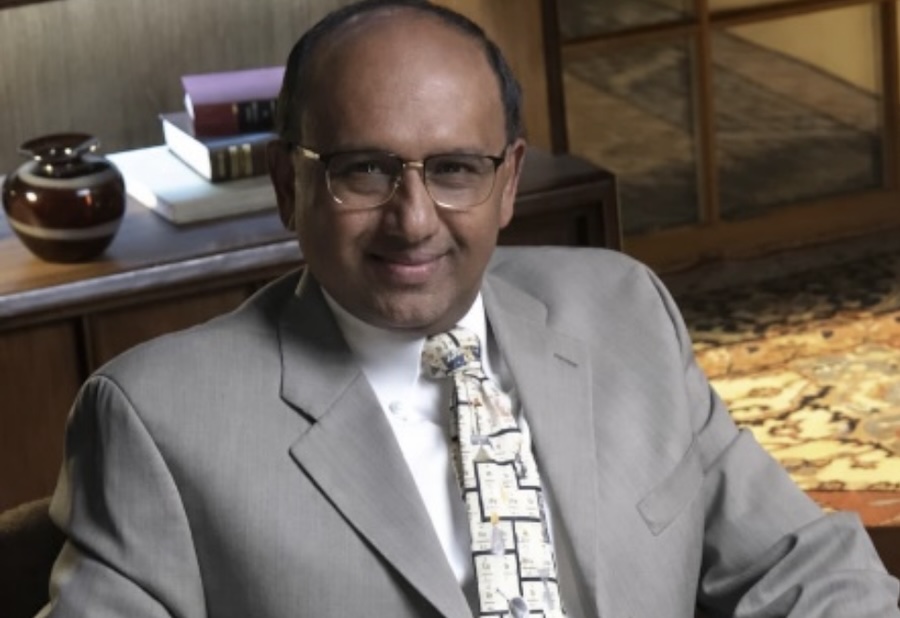
Dr. Richard Gunasekera
“The Story of Everything,” on screen in Los Angeles since April 1st, is an ambitious cinematic exploration of life, the universe, and the intricate patterns that weave them together. Rather than confining itself to a single narrative, the film dares to ask some of the most enduring questions of human existence: How did we get here? Why is the universe so finely tuned for life? Is there a deeper intelligence behind the complexity we observe in nature?
Into this conversation steps Dr. Richard Gunasekera, whose calm authority and measured scientific insight give the film both intellectual weight and human warmth. Trained in molecular biology and biochemistry, and widely respected for his research and teaching, Dr. Gunasekera brings to the screen the rare combination of rigorous scholarship and an open, reflective mind.
In “The Story of Everything,” guides viewers through the astonishing precision of biological systems—how cells communicate, how DNA stores and transmits information, and how minute changes at the molecular level can influence the course of life itself. Rather than resorting to technical jargon, he speaks in clear, accessible language, inviting the audience to see what he sees when he looks through a microscope: not chaos, but order; not randomness, but remarkable structure.
At the heart of his contribution lies a simple yet profound observation: the more we uncover about life’s inner workings, the more we are confronted with patterns that appear purposeful, coordinated, and astonishingly complex. While the film does not preach, it does present a compelling case that such complexity is not easily dismissed as a mere accident of nature. Dr. Gunasekera, without dogma or stridency, encourages viewers to keep an open mind, to consider that intelligence may be woven into the very fabric of reality.
The recent screening in Los Angeles brought together an audience that mirrored the film’s intellectual ambition. Scientists, students, artists, and members of the general public watched in attentive silence as the narrative unfolded. Many remarked on Dr. Gunasekera’s ability to bridge worlds: faith and reason, science and philosophy, East and West. He speaks as a scientist grounded in data, yet he never loses sight of the human longing for meaning.
His participation in “The Story of Everything” also highlights a broader story: the growing presence of Sri Lankan professionals in global conversations about science, ethics, and the future of humanity. In a world where narratives are often dominated by a few powerful voices, Dr. Gunasekera’s presence in this film is a reminder that insight and leadership can arise from every corner of the globe. It is a quiet yet powerful affirmation that our scholars, wherever they may live and work, can shape how the world thinks.
For readers of the Daily Newspaper, this achievement carries a special resonance. Many of us know the journey of leaving home, of pursuing higher education and professional opportunities abroad, and of striving to excel in demanding fields. Dr. Gunasekera’s appearance in an international film is not merely a personal triumph; it reflects the perseverance, discipline, and intellectual curiosity that define so many Sri Lankan families and communities.
“The Story of Everything” is not a film that offers easy answers. Instead, it invites serious, searching questions about origins, purpose, and destiny. Dr. Gunasekera embodies that spirit of inquiry. And in doing so, he models a way of thinking that is both scientifically responsible and deeply humane.
As the film continues to reach audiences beyond Los Angeles—through festivals, special screenings, and international distribution—Dr. Gunasekera’s contribution, by extension, will carry a part of our own island’s intellectual heritage to viewers around the world. Those who see the film will encounter a scientist who has mastered the language of modern biology yet still has the humility to acknowledge that there are mysteries not easily contained within formulas and equations.
From the dawn of human consciousness, we have looked up at the night sky and asked the most profound of questions: Where did it all begin?
Modern science tells us that the Universe, in all its vastness, emerged from an unimaginably hot, dense state nearly 13.8 billion years ago. In a fraction of a second, space itself expanded in what we call the Big Bang—not an explosion into empty space, but the birth of space and time together. From that searing cosmic fireball, energy cooled into matter, giving rise to the first simple particles, then atoms, and eventually the first stars. From this stardust, galaxies formed—billions of them—each containing billions of suns. Around at least one ordinary star, in an unremarkable corner of an ordinary galaxy, conditions allowed life to awaken and wonder about its own origins. The Big Bang theory was propagated by astronomers, Sri Lankan Chandra Wickramasinghe and his mentor, Prof Fred Hoyle of Cambridge University.
Religions and philosophies, in their own ways, have long spoken of a purposeful beginning, a cosmic order behind the apparent chaos. Today, science does not diminish that sense of wonder; it deepens it. To understand the origins of the Universe is to glimpse our own beginnings—and to recognize that we are, quite literally, children of the stars.
For young readers, students, and aspiring scientists, his journey offers an inspiring example. It shows that one can pursue excellence in research, engage with global debates, and still remain grounded in values of integrity, curiosity, and respect for differing viewpoints. It demonstrates that science need not close the door on wonder; in fact, it can open new doors to awe and reflection.
In a time when public discourse is often polarized and simplistic, “The Story of Everything” stands out as a thoughtful, carefully crafted work, and Dr. Richard Gunasekera’s appearance enhances its credibility and impact. It also reminds us that the quest to understand life and the universe is not a battle to be won, but a journey to be continued—with openness, courage, and a willingness to follow the evidence wherever it may lead.
As this film reaches wider audiences, one thing is clear: Dr. Gunasekera has not only contributed to a major international production, but he has also quietly affirmed something essential about who we are as a people, curious.
*Nandi Jasentuliyana – Former Deputy Director General, United Nations
old codger / May 15, 2026
“The Big Bang theory was propagated by astronomers, Sri Lankan Chandra Wickramasinghe and his mentor, Prof Fred Hoyle of Cambridge University.”
I do appreciate the author’s desire to promote the achievements of Sri Lankans, but the above statement is highly inaccurate.
From AI:
The Big Bang theory was developed over time by several scientists, rather than by one single person.
Key contributors
Georges Lemaître: A Belgian priest and physicist, he is often credited as the first to propose the idea of an expanding universe from a “primeval atom” in the 1920s.
Edwin Hubble: His observations showed that galaxies are moving away from us, supporting the expanding-universe idea.
Alexander Friedmann: Developed mathematical models of an expanding universe based on Einstein’s equations.
George Gamow and others later helped develop the theory further, especially the idea of the early hot, dense universe.
Fred Hoyle did not support the Big Bang theory.
He was actually a major critic of it and instead promoted the steady state theory, which argued that the universe has always existed in roughly the same form and that new matter is continuously created as it expands.
Chandra Wickramasinghe did not generally support the Big Bang theory.
He is best known for his work in astrobiology and panspermia with Fred Hoyle, and he was often associated with ideas that were critical of standard cosmology
/
LankaScot / May 17, 2026
Hello OC,
Yes you are right about Hoyle and Chandra Wickramasinghe regarding their Cosmology. Hoyle used the term “Big Bang in a disparaging way.
Dr. Richard Gunasekera (Biologist) is a Christian Apologist writing for the Channel (Discovery Institute) that produces Intelligent Design drivel. He also belongs to Biola University which is a premier, nationally ranked private evangelical Christian University located in La Mirada, California. Everyone (and I mean everyone) there (Staff, Professors and Students) is a professed Christian. Gunasekera has written a paper “Investigating Scientific Mechanisms of Divine Healing and Design”. The Title speaks volumes.
The Film “The Story of Everything” is based on Stephen Meyer’s book “Return of the God Hypothesis”. Stephen Meyer (Writer and Philosopher) is not a Scientist and neither is his buddy John Lennox (Mathematician). The Film disputes Naturalistic Origins of the Universe “revealing instead the “hidden hand” and intentional design woven into the fabric of the stars and the code of our DNA”. Personally I subscribe to the Theory that the universe has always existed in some form, much like Roger Penrose’s Conformal Cyclic Cosmology.
Here is Roger Penrose debunking Stephen Meyer – https://www.youtube.com/watch?v=6YvnnPzvaJs
By the way Login problem solved, was it CT Problem?
Best regards
/
old codger / May 17, 2026
LS,
I thought as much, from the over-the-top praise and the reminology used. Something of an advertorial for Creationism?
The login issue seems to have sorted itself, thankfully. Must have been a CT glitch.
/
SJ / May 18, 2026
LS & oc
You may not have heard much about the theory of Chandra Wickramasinghe (with Hoyle in the 190s I think) that bacteria came from outer space.
It made a stir for a while but like most bacterial infection it passed.
/
old codger / May 18, 2026
SJ
Yes, I remember that. Isn’t there a different theory now about the components arriving on comets?
/
LankaScot / May 18, 2026
Hello SJ/OC,
Now that we have found thousands of Exoplanets, the chances of life outside our Planet Earth are much higher. The chemical building blocks for life have been detected in many exoplanets and even planet-forming Disks – https://www.cfa.harvard.edu/news/key-building-block-life-discovered-planet-forming-disk
Chandra Wickramasinghe may not have been too far off – https://www.mpg.de/26040668/the-origins-of-the-chemistry-of-life-in-space
The problem that remains to be solved (among many others) is Abiogenesis. However many recent papers have pointed the way towards solutions –
https://febs.onlinelibrary.wiley.com/doi/full/10.1002/1873-3468.14507
Some Scientists have proposed Deep Ocean Hydrothermal Vents as possible candidates –
https://www.researchgate.net/publication/337015285_Promotion_of_protocell_self-assembly_from_mixed_amphiphiles_at_the_origin_of_life
Unfortunately a knowledge of Organic Chemistry would help in understanding the above paper, but the Abstract gives a good overview.
Best regards
/
SJ / May 18, 2026
oc
CW claimed that meteors brought them in.
Not too far I guess.
/
LankaScot / May 18, 2026
Hello SJ,
“It made a stir for a while but like most bacterial infection it passed”.
I think your sense of humour will fly straight over some people’s heads.
Best regards
/