

By Raj Sivanathan –

Raj Sivanathan
1. National Performance: Stability Amid Decline
Sri Lanka stands today at a critical and defining moment in its post-crisis recovery. The release of the G.C.E. Advanced Level 2025 results in 2026 has once again drawn national attention to the state of education and its role in shaping the country’s future. With 62.64 percent of students qualifying for university admission, the results present a picture that is both encouraging and cautionary. At first glance, the slight decline from the previous year’s estimated 65 percent qualification rate may raise concerns. However, such variations are not uncommon in national examination systems. They often reflect shifts in exam difficulty, student cohorts, and broader socio-economic conditions. What truly matters is the underlying strength of the system.
Despite economic instability, resource limitations, and social disruptions over recent years, Sri Lanka’s education system has remained resilient. More than six out of ten students continue to qualify for university admission, reinforcing the country’s long-standing reputation for strong educational outcomes. This consistency demonstrates that the foundation of the system remains intact, even under pressure.
Rather than focusing solely on the marginal decline, policymakers and stakeholders must recognise the stability embedded within these results. The national performance indicates that Sri Lanka still possesses a robust pipeline of educated youth, capable of contributing meaningfully to the country’s long-term development.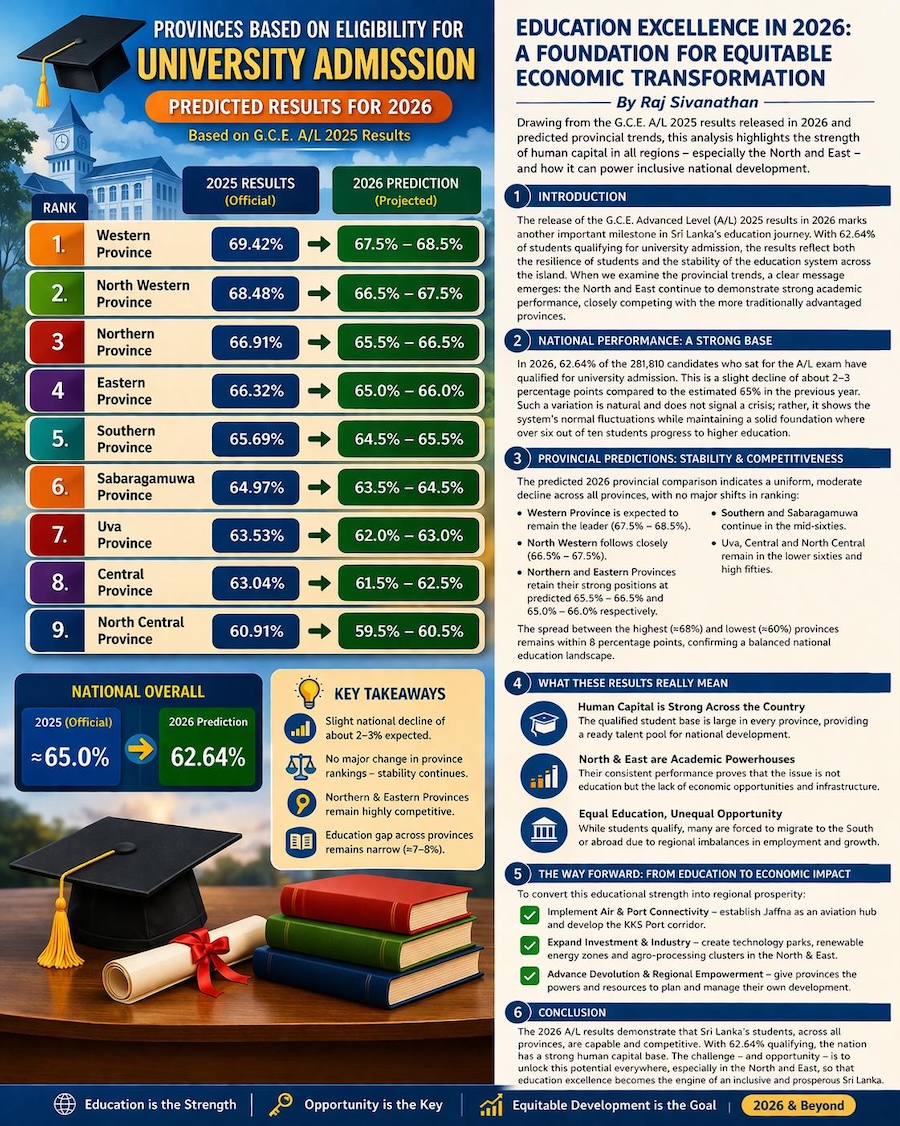
2. Provincial Performance: Balanced and Competitive
A deeper examination of provincial performance reveals a compelling and often overlooked reality. Contrary to common perceptions of regional inequality, Sri Lanka’s education outcomes are remarkably balanced across provinces.
The Western Province continues to lead, followed closely by the North Western Province. However, the most significant insight lies in the consistent performance of the Northern and Eastern Provinces, which maintain strong positions within the top four. These regions, once heavily affected by conflict and underinvestment, are now demonstrating academic achievements that rival the country’s most developed areas.
The Northern Province is projected to maintain a qualification rate between 65.5 and 66.5 percent, while the Eastern Province follows closely within a similar range. These figures are not anomalies. They represent a sustained trend of academic strength and resilience.
Equally important is the narrow gap between provinces. The difference between the highest and lowest performing regions remains within approximately 7 to 8 percentage points. This indicates that Sri Lanka does not face extreme educational disparities. Instead, it benefits from a broadly equitable distribution of educational outcomes.
This balanced performance challenges outdated narratives that certain regions are inherently disadvantaged in education. The data clearly shows that talent and capability are present across the entire country.
3. Equal Education, Unequal Opportunity
If educational outcomes are relatively equal across provinces, why does economic disparity continue to persist? This question lies at the heart of Sri Lanka’s development challenge.
The answer is not rooted in the education system but in the structure of economic opportunity. While students across the country are qualifying for higher education at comparable rates, access to employment, industry, and investment remains heavily concentrated in a few urban centres, particularly Colombo.
As a result, students from the Northern and Eastern Provinces are often compelled to migrate in search of better opportunities. This migration is not a reflection of educational weakness but a consequence of limited local economic prospects. Over time, this leads to a continuous outflow of talent from regions that are already in need of development.
This imbalance creates a cycle where education is decentralised, but opportunity is centralised. The benefits of a strong education system are therefore not fully realised at the regional level. Instead of becoming engines of growth, these provinces serve as suppliers of human capital to other regions and countries.
Addressing this imbalance requires a fundamental shift in policy thinking. It is no longer sufficient to focus solely on improving education. The priority must now be to align educational outcomes with economic opportunities across all regions.
4. The Way Forward: Linking Education to Economic Growth
The path forward for Sri Lanka lies in transforming educational strength into economic impact. This requires a strategic and coordinated approach that integrates infrastructure, investment, and governance.
One of the most critical areas of focus is connectivity. The development of Jaffna as a regional aviation hub has the potential to unlock new opportunities in tourism, trade, and business. Improved air connectivity can significantly reduce regional isolation and attract both domestic and international investors.
Similarly, the expansion of Kankesanthurai Port into a functional cargo gateway can position the Northern Province as a key logistics hub. By establishing direct trade links with South India and other regional markets, Sri Lanka can create new economic corridors that benefit both the North and the national economy.
Investment is another crucial component. Structured platforms that attract diaspora and foreign capital can play a transformative role. By establishing special economic zones focused on technology, manufacturing, and renewable energy, the country can create employment opportunities that align with the skills of its educated youth.
Equally important is the need for effective governance and devolution. Provincial administrations must be empowered with the authority and resources to design and implement development strategies tailored to their unique contexts. Decentralised decision-making can lead to more efficient and responsive economic planning.
Ultimately, the goal is to create a system where education and opportunity are aligned. When students are able to find meaningful employment within their own regions, the benefits of education are fully realised, leading to sustainable and inclusive growth.
The 2026 A/L results reaffirm a fundamental truth. Sri Lanka’s strength lies not in its geography but in its people. Across all provinces, students continue to demonstrate the capability, resilience, and determination needed to succeed.
The challenge now is to ensure that this potential is not wasted. By bridging the gap between education and economic development, Sri Lanka can move towards a future that is not only prosperous but also equitable. The time has come to move beyond traditional models and embrace a new vision—one where every region contributes to and benefits from national progress.