

By Sarath de Alwis –

Sarath de Alwis
“The Monk neither constructs in his mind, nor wills in order to produce, a state of mind or body or the destruction of any such state. By not so willing anything in the world, he grasps after nothing; by not grasping, he is not anxious; he is therefore fully calmed within.” — Majjhima Nikaya*
The ‘comic opera’ Colombo’s Green Heart “Vihara Mahadevi Park’ is a stark pointer to the bizarre and dangerous cultural crossroads at which we have arrived.
Ven. Kotapola Rahula Thero, a senior prelate of the Kotte Sangha Sabha, was an early participant. He initially described this saffron shindig as a righteous Satyagraha for the “protection of the robe.”
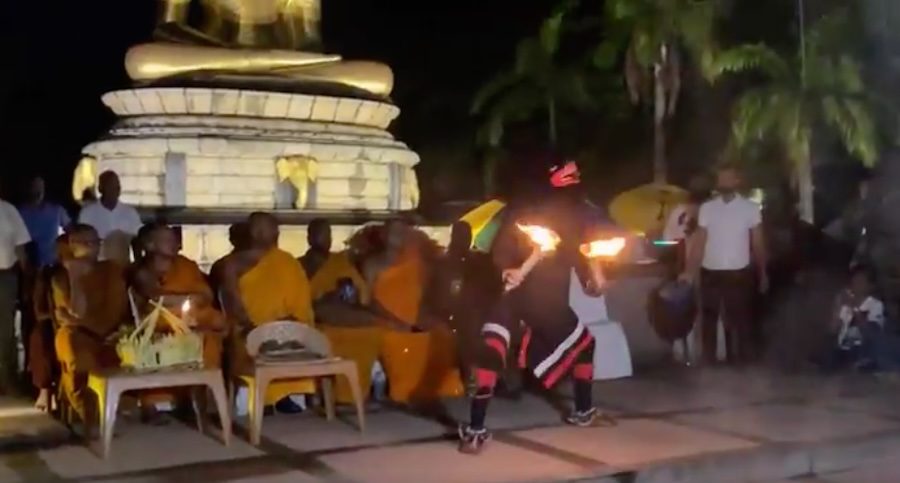
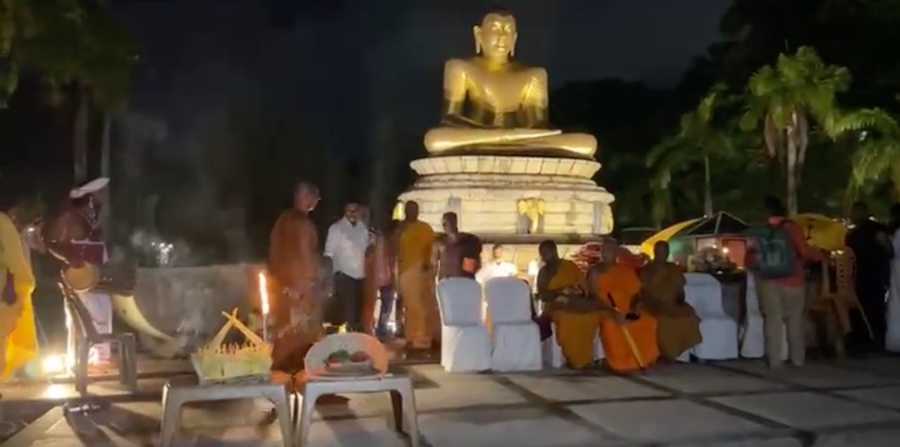
As I write this missive, it has degenerated into a sacrilegious theater—a ‘Saffron Circus’ orchestrated by a cabal of politicized priests and defeated opposition factions.
Choreographed by political manipulators, the often-rowdy lay participants are visibly emboldened by the unconcealed patronage of elements within established ecclesiastical bodies in Colombo. Meanwhile, the Kotte Sri Kalyani Samagri Dharma Maha Sangha Sabha is virtually walking on eggshells.
This exercise represents something far more sinister than a mere political protest. It is the systematic weaponization of blind piety, as attested to by the shocking performance of dark occult rituals like the Mahason Pideniya—an offering to the demon of death and disease. This ritual was led by infamous figures like Samantha Bhadra (formerly known as Pitiduwe Siridhamma), an absolute apostate wrapped in monastic robes.
How has Buddhism—specifically Ashokan Buddhism, a philosophy anchored in radical non-violence, mindfulness, and the eradication of the ego—been corrupted into a vehicle for political survival and public cursing? To find answers to this riddle, one must revisit the foundational texts of Sri Lankan political anthropology. The crisis we witness today is not an overnight aberration; it is the logical conclusion of historical processes that have systematically exchanged the ethical core of the Dhamma for the preservation of temporal power.
The Politically Buddhist State
The distinguished anthropologist H.L. Seneviratne, in his seminal work The Work of Kings, meticulously demonstrates that the modern “theory of the Buddhist state” in Sri Lanka is a relatively recent ideological construction. Seneviratne argues that this theory was formally articulated and institutionalized by nationalist scholars and monks only after the pivotal General Election of 1956.
Prior to 1956, the Buddhist revivalist movement focused largely on cultural reclamation and education in the face of colonial marginalization. However, the post-1956 political landscape fundamentally altered the monastic vocation. Ideological entrepreneurs engineered a modern narrative that fused the state, the ethnic identity of the majority, and the preservation of the Sasana into a single, indivisible unit.
Monks were no longer merely seekers of internal purification or community educators; they were transformed into the structural guardians of a majoritarian, unitary state polity. By establishing this framework, post-colonial political actors on both sides of the aisle created a monster. They invited the monkhood into the arena of partisan politics, setting a dangerous precedent where the robe could be traded for policy leverage, state patronage, and eventually, immunity from the law.
Two Buddhisms!
We seem to practice two kinds of Buddhism: the sublime compassion of Prince Siddhartha, and the capricious priestly vocation evident in the ongoing protest at the public park.
This structural division brings us directly to the profound observations of another towering scholar, S.J. Tambiah.
In his classic and controversial text Buddhism Betrayed?, Tambiah wrote extensively about what can be conceptualized as “Two Buddhisms” coexisting within the Sri Lankan consciousness.
The first is the Buddhism of the texts—a path of sublime compassion. This is the ethically elevated philosophy that preaches universal loving-kindness (Metta), psychological liberation, inner peace, and the transcendence of worldly attachments.
This is the Buddhism that inspired the moral imagination of millions and produced centuries of artistic and philosophical genius.
The second, however, is a Buddhism driven by a capricious priestly vocation. This version represents the dark underside of the institution: a caste-entrenched, politically hyperactive monastic hierarchy that manipulates religious sentiment for temporal security.
When Buddhism is reduced from a path of spiritual awakening to a protective guild for the clerical class, it sheds its ethical imperatives. Tambiah warned that when this capricious, defensive majoritarian complex takes over, the Sasana becomes an instrument of exclusion, division, and aggression. The “Saffron Circus” at Viharamahadevi Park is the ultimate manifestation of this dark underside, where spiritual duties are abandoned in favor of political grandstanding.
Yesterday’s Politics Fighting the Future
The strange alignment of varied actors at Viharamahadevi Park makes complete sense when viewed through the lens of recent electoral shifts, particularly the National People’s Power (NPP) gaining a two-thirds majority under President Anura Kumara Dissanayake.
Following these seismic democratic shifts and subsequent anti-corruption crackdowns, the old political guard has found itself utterly displaced.
The political architecture of patronage, nepotism, and systemic corruption that governed Sri Lanka for decades has been soundly rejected by an electorate demanding fundamental structural change.
Faced with this stark structural irrelevance and impending legal accountability for past follies, defeated opposition groups have resorted to the ultimate strategy for political survival: engineering a crisis of faith.
Deprived of a credible economic program or a visionary governance alternative, the fractured opposition has hitched its wagon to the oldest, most reliable populist anchor available.
They are exploiting the inherent anxieties of traditionalists by manufacturing a false narrative that the current state apparatus is bent on destroying the Sasana.
This voodoo stratagem has the hallmarks of the marketing wizards behind the Sarva Jana Balaya, and it seems to have seduced elements of the Samagi Jana Balawegaya (SJB) as well.
The strategy is transparent: hide behind the sacred robe to secure personal protection, evade judicial scrutiny, and derail progressive legislative or anti-corruption efforts.
It is transactional politics at its absolute worst. Politicians provide funds, logistical support, and media amplification; in return, rogue monastics provide a religious human shield, transforming what should be a criminal or political accountability process into a false defense of the faith.
Robed Charlatans Weaponizing Piety
What makes this mobilization particularly insidious is the collusion between discredited political forces and robed charlatans who weaponize the blind piety of ordinary lay devotees. Laymen, confusing the defense of an ordained hierarchy with the defense of the Buddha’s actual teachings, are cynically manipulated into joining these pseudo-religious agitations.
This institutional complicity should not be ignored. The silent or unconcealed support offered by influential chapters, such as the Kotte Samagri Sangha Sabha, provides these fringe elements with a veneer of institutional legitimacy.
When established Nikayas fail to discipline monastics who openly engage in political subversion and heresy, they degrade their own spiritual authority, reducing the Sangha to a mere factional interest group.
Nowhere is this decay more vividly captured than in the figure of Samantha Bhadra (formerly Pitiduwe Siridhamma). Emerging originally as a charismatic preacher who claimed advanced spiritual realizations, his trajectory has devolved into a grotesque caricature of monasticism.
His organization of the Mahason Pideniya in a public park under the guise of political protest is an act of absolute spiritual apostasy.
Mahasona is a demon of the graveyard—a symbol of fear, destruction, and delusion.
For a monk, who has taken vows to take refuge exclusively in the Buddha, Dhamma, and Sangha, to lead public supplications and occult offerings to a demon is a total renunciation of the primary tenets of Buddhism.
It is an explicit admission that this brand of political Buddhism has completely emptied itself of the Dhamma, replacing the quest for Nirvana with the invocation of dark forces to curse political adversaries.
Black Magic in Park
The tragedy of the Viharamahadevi Park spectacle is that it exploits a deeply held cultural identity to serve the narrow interests of an elite political class and its monastic allies.
When Buddhism is reduced to public black magic, political sit-ins, and the defense of individuals accused of secular crimes, it loses its universal moral authority.
If Sri Lanka is to emerge from this chronic crisis of faith and governance, we—the Buddhist laity—must learn to decouple the sublime ethical framework of the historical Buddha from the self-serving acrobatics of the “Saffron Circus.”
We must look back to the warnings of Seneviratne and Tambiah to recognize that the politicization of religion has brought nothing but moral and social bankruptcy.
It is time to reject the apostates who desecrate the robe for political theater and demand a return to a Buddhism defined not by majoritarian supremacy and occult curses, but by wisdom, intellectual rigor, and absolute compassion.
*The quote is from ‘The Book of the Middle Length Sayings’, English translation of the Majjhima Nikaya published in three volumes between 1954 and 1959 by the Pali Text Society.
Naman / October 23, 2026
“ The strategy is transparent: hide behind the sacred robe to secure personal protection, evade judicial scrutiny, and derail progressive legislative or anti-corruption efforts.”
This paragraph succinctly describes the aim of the Kandy to Colombo March by the politicised Buddhist clergy. The MEDIA that is trying to magnify/ giving too much publicity are doing harm to Mother Lanka’s progress economically politically and socially. The GoSL and the Media needs to get the Buddhist clergy who are following the teachings of Lord Buddha to repudiate the ACTIONS and BEHAVIOUR of these POLITICISED PRIESTS. I still wonder whether the Media ( TV + Newspaper) are being controlled by businessmen who had benefited during the Rajapaksas period
/
Naman / October 23, 2026
“ The tragedy of the Viharamahadevi Park spectacle is that it exploits a deeply held cultural identity to serve the narrow interests of an elite political class and its monastic allies.”
I will not call the politicians behind the Monks at the Park as elites. I sincerely hope their intentions to fail miserably
/
Naman / October 23, 2026
We welcome this article by Sarath de Alwis pointing out the ulterior motives of the past politicians hanging on to any threads/ropes will enable the failure of the government and to ESCAPE justice.
/
Naman / October 23, 2026
“ • Constitutional Interventions: On several occasions, the Karaka Sangha Sabhas have held formal assemblies to issue joint declarations opposing proposed constitutional reforms, devolution of power, or secular amendments. Critics argue that these declarations often align directly with the political rhetoric of nationalist opposition parties.
• Political Patronage: High-ranking politicians—including Presidents and Prime Ministers—traditionally visit these Sabhas immediately after taking office or during elections to seek blessings. Critics argue this dynamic gives the councils veto power over state policies, effectively creating a “Sangha State” dynamic behind the democratic government.”
Is it not the TIME to stop the ruling Politicians and those in the opposition stop their visits to these Sabhas
/
nimal fernando / October 23, 2026
If the Hoodoo Voodoo …….. fail to bring intended results …….. would it be still practiced for another 2500 years …….. like the Lankan version of Hoodoo Voodoo Buddhism?
–
–
Taking away the Hoodoo Voodoo ……… might give some room for ………. a little intelligence to finally rise to the surface/top.
/
old codger / October 23, 2026
“How has Buddhism—specifically Ashokan Buddhism, a philosophy anchored in radical non-violence, mindfulness, and the eradication of the ego—been corrupted into a vehicle for political survival and public cursing?”
Perhaps our Diplomat will write an explanation, not too long of course?
/
old codger / October 23, 2026
“”What makes this mobilization particularly insidious is the collusion between discredited political forces and robed charlatans who weaponize the blind piety of ordinary lay devotees”
Even more reprehensible is the way that some UNP and SJB figures have jumped on the Sinhala-Buddhist bandwagon, simply because it’s a tool to beat the government with? Nothing new, it was the UNP that created 1983, but they claimed to have changed.
/