

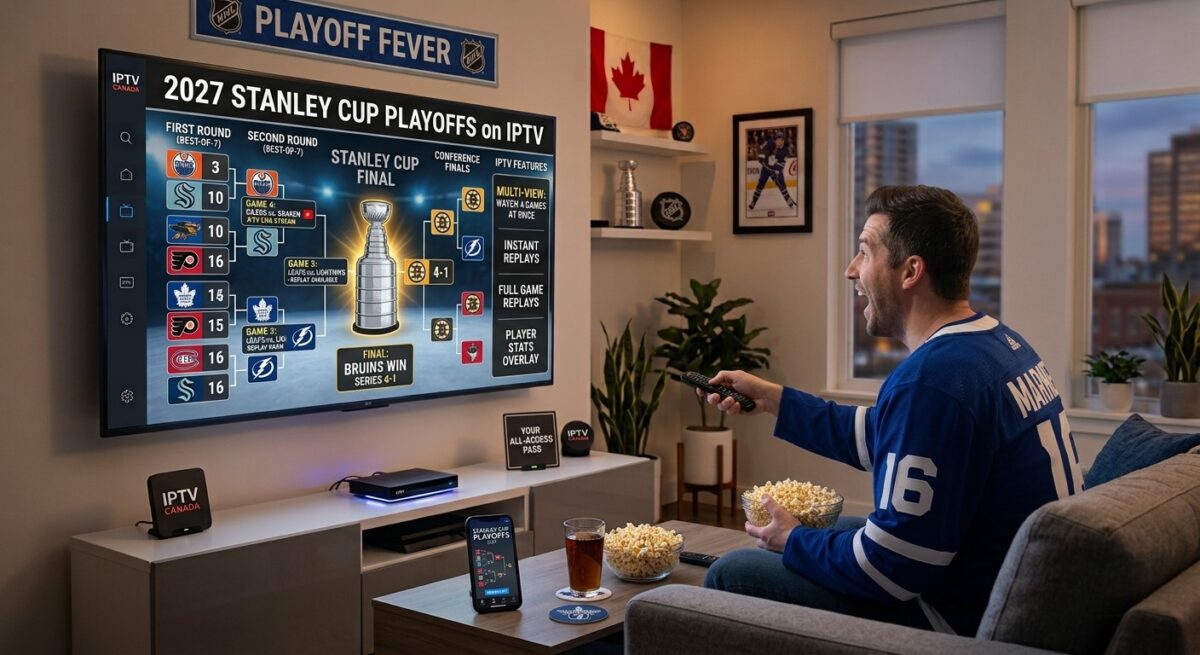

Television has never been as flexible as it is today.
For decades, watching television was relatively straightforward. A household would subscribe to a cable or satellite provider, receive a set-top box, and choose from the channels included in the package. The television itself was usually the centre of the experience.
That model has gradually changed.
Today, television is increasingly connected to the internet. Smart TVs, streaming devices, smartphones, tablets and computers have all become part of the modern viewing experience. People can watch live channels, movies, sports, news and other programming without necessarily depending on a traditional television connection.
Streaming has not completely replaced conventional television, but it has changed what viewers expect from it. People increasingly want flexibility, convenience and the ability to decide when and where they watch.
From Scheduled Television to On-Demand Viewing
One of the biggest changes has been the move away from fixed schedules.
Traditional television requires viewers to work around a broadcaster’s timetable. If a programme starts at 8 p.m., viewers either have to be available at 8 p.m. or find another way to watch it later.
Streaming introduced a different mindset.
People became accustomed to choosing a programme themselves and watching it whenever they wanted. This shift was particularly noticeable with movies and television series, but the same expectations are now influencing live television.
Viewers increasingly expect a television service to provide both live programming and some form of on-demand access.
This does not mean scheduled television has disappeared. Live news, sports, special events and other programmes still depend heavily on real-time broadcasting. What has changed is that viewers now have more options around those broadcasts.
The Rise of Internet-Based Television
Internet Protocol Television, commonly known as IPTV, is one part of this broader transformation.
Instead of delivering television programming through traditional broadcast, cable or satellite infrastructure, IPTV uses internet networks to deliver content to compatible devices.
The concept itself is not particularly new. Internet-based television has been developing for years, and telecommunications companies have already used IPTV technology as part of their television offerings.
What has changed is the number of devices and services capable of handling internet-delivered video.
A modern household may have several connected screens. A television in the living room can stream content while someone else watches a programme on a tablet or phone. This creates a much more personal viewing environment than the traditional idea of one television serving the entire household.
What Viewers Look for in an IPTV Subscription
As internet television becomes more common, viewers are also becoming more selective about the services they use.
Someone considering an IPTV subscription is likely to look at several factors before making a decision.
Channel selection is obviously important, but it is only one part of the equation. Streaming stability, video quality, device compatibility, ease of use and customer support can have an equally significant impact on the experience.
A service might advertise thousands of channels, but that number does not necessarily tell viewers whether the service will be useful to them.
A household interested primarily in Canadian news and sports, for example, may have completely different priorities from someone looking for international programming.
This is why comparing services based on actual viewing habits makes more sense than simply choosing the provider with the largest advertised channel list.
Smart TVs Have Changed the Living Room
The growth of Smart TVs has also helped accelerate the transition to internet-based entertainment.
A modern television is no longer simply a screen connected to a cable box. It can function as an internet-connected platform capable of running applications, accessing streaming services and communicating with other devices.
This has made streaming much easier for people who might previously have been uncomfortable with complicated technology.
Instead of connecting a computer to a television, viewers can often install an application directly on the television or use a small streaming device connected through HDMI.
The result is a viewing experience that feels much closer to traditional television while offering many of the advantages associated with internet services.
Sports Are Driving Demand for Live Streaming
Live sports remain one of the strongest reasons people continue to watch television in real time.
A recorded programme can usually wait. A major football match, hockey game, cricket match or other sporting event cannot.
This has made sports an important part of the streaming industry’s development.
Viewers increasingly expect reliable access to live events across different devices. A television may remain the preferred screen for a major match, but phones and tablets have become useful secondary screens when people are away from home.
The challenge for streaming providers is that live sports require consistent performance. A short interruption during a film may be annoying, but losing the crucial moment of a live event can be much more frustrating.
As a result, network capacity and streaming reliability are becoming increasingly important.
Canada Has a Diverse Television Audience
The Canadian television market is particularly interesting because of the country’s geographic size and diverse population.
Viewers across Canada have different interests and media habits. A household in Toronto may have different programming priorities from one in Vancouver, Montreal, Calgary or Ottawa.
There is also strong interest in international programming.
For people researching IPTV Canada services, the question is therefore not simply how many channels are available. They may want Canadian programming alongside content from the United States, Europe, Asia or other parts of the world.
This diversity creates an opportunity for internet-based television services that can provide a broader range of programming in a flexible format.
At the same time, viewers need to pay attention to the legitimacy of the content being offered and the terms of the service they choose.
Better Internet Has Made Streaming Easier
None of this would be possible without improvements in internet connectivity.
Video requires considerably more bandwidth than simple web browsing or email. As broadband connections have become faster and more reliable, streaming high-quality video has become practical for a much larger number of households.
Faster connections have also made higher-resolution video more accessible.
HD has become normal for many viewers, while 4K content is increasingly available on compatible televisions and streaming platforms.
However, having a fast internet plan does not automatically guarantee a perfect streaming experience.
Home network conditions matter too. Wi-Fi signal strength, router performance, network congestion and the number of devices using the connection can all affect video playback.
This is why a reliable streaming experience depends on both the service and the viewer’s own network.
Video Quality Is About More Than Resolution
The term “4K” has become an important part of streaming marketing, but resolution is only one element of picture quality.
The original video source, compression, bitrate, encoding technology and playback device can all influence what viewers see on screen.
A high-resolution stream with poor compression may look worse than a well-encoded lower-resolution stream.
This is another reason why consumers should test services when possible rather than relying entirely on specifications listed on a website.
Real-world performance is often a better indicator than a number in a promotional package.
Multiple Devices Are Becoming Normal
The idea of watching television on only one screen is becoming outdated.
A household may have a Smart TV in the living room, another television in a bedroom, several smartphones and a couple of tablets.
Streaming services have adapted to this behaviour by supporting multiple types of devices.
For viewers, this creates greater freedom.
Someone might start watching a programme on a television and later continue on a mobile device. Another person may use a tablet to follow a live event while the main television is being used for something else.
The television experience is becoming less tied to a particular physical device.
The Importance of Simple User Interfaces
As streaming services become more sophisticated, ease of use becomes increasingly important.
A service with an enormous amount of content can actually become frustrating if viewers cannot find what they want.
Good search functions, organized categories, favourites and electronic programme guides can make a significant difference.
This is especially important for live television. Viewers are familiar with traditional channel guides, so an internet-based television service that provides clear programme information can feel much more intuitive.
Technology is most useful when people don’t have to think about the technology itself.
What About Traditional Cable?
Despite the growth of streaming, traditional cable television is not disappearing overnight.
Cable still offers advantages for certain households. It can be simple to set up, familiar to older viewers and convenient for people who prefer a conventional television package.
The future is therefore unlikely to be a simple situation in which one technology completely replaces another.
Instead, viewers are likely to use a combination of services.
A household might maintain a traditional television subscription while also using streaming platforms for movies and series. Another household might rely almost entirely on internet-based television.
The important change is that consumers have more choices than they did in the past.
The Importance of Choosing Carefully
More choice can be positive, but it also creates a new problem: there are many services competing for consumers’ attention.
Not every IPTV or streaming service offers the same level of reliability.
Before signing up, consumers should look beyond advertisements and consider the practical details.
Does the service support the device they use? Does it offer the channels they actually watch? Is the picture quality acceptable? Is customer support available? Are the subscription and cancellation terms clear?
These questions can help prevent disappointment later.
It is also sensible to be cautious about services making unrealistic promises. Claims of unlimited content, perfect performance or guaranteed quality should be evaluated carefully.
The Future of Television Is More Flexible
The most important change brought by streaming technology may not be the disappearance of cable or the rise of IPTV.
It may simply be the fact that viewers have gained more control.
People can increasingly decide what they watch, where they watch it and which device they want to use. Television is becoming less of a fixed household activity and more of a flexible digital experience.
This shift is also changing expectations for broadcasters and content providers.
Audiences expect better picture quality, convenient applications, reliable streaming and access across multiple devices. Companies that fail to adapt to those expectations may find it increasingly difficult to compete for viewers’ attention.
At the same time, content remains the most important part of the equation. Technology can make television easier to access, but people ultimately watch because they care about the programmes, sports, films and stories being offered.
Final Thoughts
The television industry has come a long way from the days when viewers had a small number of channels and a fixed broadcasting schedule.
Streaming technology has introduced a different approach, giving people more control over their entertainment and allowing television content to follow them across different devices.
IPTV is part of that wider transformation. For Canadian viewers, the growing range of internet-based television options provides opportunities to find services that better match their interests, whether they are looking for local programming, international channels, live sports or on-demand entertainment.
At the same time, choosing a service requires some research. Channel numbers and low prices may attract attention, but reliability, picture quality, device compatibility, customer support and transparent terms are ultimately more important.
As broadband infrastructure continues to improve and connected devices become increasingly common, the distinction between “television” and “internet entertainment” will probably become less meaningful.
The screen in the living room is still there. What has changed is everything happening behind it.