

By Shavindra Fernando –
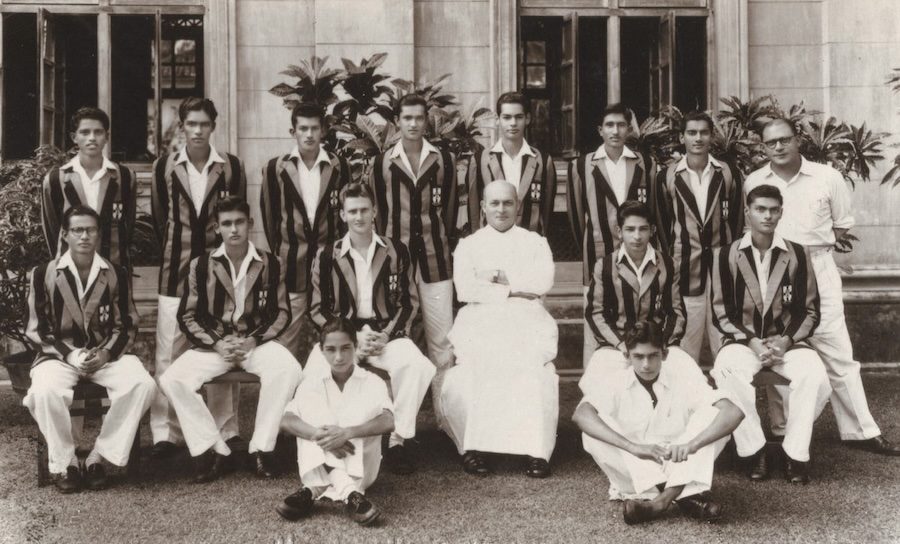
High drama at the fall of the 8th wicket for S.Thomas’. Thiru Kandiah a bowler and tailender walked to the middle nine down, to join an anxious Ronnie Reid, chasing Royal’s Norman Seibel’s 151 not out 1936 record. Kandiah had to ensure Reid’s survival at the wicket.
In a determined display of the legendry Thomian Grit, Kandiah the bowler defied the Royal bowling attack, and hung on with Reid. A partnership of 52 runs, in which Kandiah scored only five runs. When Kandiah kept the bridge for S.Thomas’, and Reid was almost on the threshold of history, he sacrificed his wicket to turn back and be run out instead of Reid.
S.Thomas’ First XI Cricket Team 1956 | Standing – third from the right : Thiru Kandiah. Seated – first from right: Ronnie Reid. (Seated – Second from left: Michael Tissera who captained Ceylon in 1964)
Reid escorted Kandiah to the ropes with gratitude, and watched Kandiah walking back to the Thomian dressing room, receiving a standing ovation from the crowds at the 1956 Royal-Thomian at the Colombo Oval. Reid walked back to the crease and broke Seibel’s record, to be 158 not out.
That was the hallmark of the man, in the long innings of his life. Thirulogendran Kandiah went on to become Professor of English at the University of Peradeniya. When the call of duty sounded, he answered clear for language and country.
Of Tamil, Sinhala and Scottish ethnic descent, he had a natural interest and an emotional make-up, of all three languages of newly independent Ceylon, as a part of his own inheritance and entitlement. He handled language fearlessly, to say what he had to say, in a country embroiled in linguistic and ethnic conflict. When the great scorer came to write against his name in far way Australia, he was just a week away from reaching 89.
When he entered the Department of English at the then University of Ceylon later that year, English had been officially dethroned, with Sinhala as the official language of the country in 1956. With it the “ambiguous” reasonable use of Tamil, had raised anxiety rather than creating an assurance about its future, and that of its people.
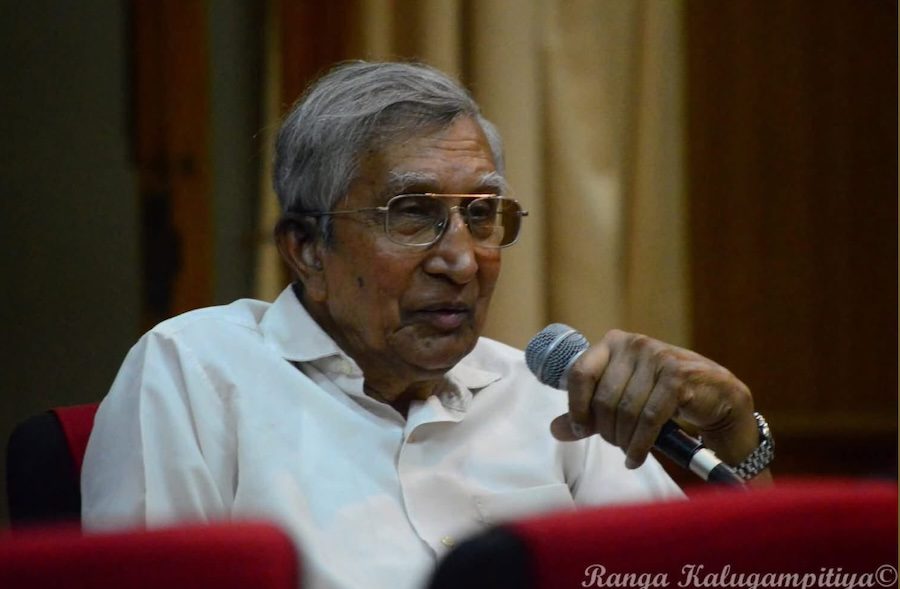
Professor Thiru Kandiah | Photo Credit Ranga Kalugampitiya
But in the little niche that was the university in the Kandyan highlands, the English and Classics Department at Peradeniya was pre-dominant, standing tall as the only full university department of English and Classics, East of the Suez and West of Seoul. Kandiah was a student of that famous English Department of Ceylon, of Professors Ludowyk, Passe and De Souza.
During his schooling at S.Thomas’ in Mount Lavinia with his brother, they grew up under the influence of Canon R.S. De Saram (Warden), Dick Hensman, L.A.H.Arndt, F.J.Senaratne, V.P.Cooke, C.R.Wise and Rev.Bowyer-Yin, a Chaplain from King’s College of the University of Cambridge. Yin came as Chaplain to S.Thomas’ to install and institute the famous Festival of Nine Lessons and Carols at King’s, at the S.Thomas’ Chapel of the Transfiguration. He spoke fondly of these teachers, as having had a profound impact in his upbringing.
At Peradeniya, as the Senior Treasurer of the Western Music Society and the Ceylon University Dramatic Society, Professor Thiru Kandiah played a long innings in some of the most adverse years, when the best of universal culture and learning was under siege at Sri Lankan universities, sadly misguided in the name “ethno-religious nationalism” and “leftist ideologies”.
They were to be the best years of his intellectual awakening, and the lotus bloomed from the muddy murky waters of linguistic and socio-cultural conflicts of the 1970’s.
With a PhD in linguistics (investigating “The syntax of the verb in Ceylon Tamil”) from the University of London, he embarked into the depths of the Westernized, Christianised, English-speaking psyche which had evolved within four and a half centuries of Western colonization at home. He explored the ethno-linguistic make up of an elite class, to which he belonged, which had been created at the height of Victorian rule of empire by the British, “to be like us in language, and attitude, only different in the colour of their skin”.
Among Kandiah’s main interests were sociolinguistics, new varieties of English, ideology in the postcolonial context in linguistics, new literatures in English, and the teaching of English as a second language.
Despite the waves of ethno-linguistic rhetoric and the torrents of Marxist- Leninist disruptions at Peradeniya, his belief in his Peradeniya was unique and steadfast. His sense of belonging in his university had many exciting facets, he often spoke about.
He was conscious of what he had in common with the very builder of the university within three hundred acres of a Kandyan royal parkland, architect Shirley De Alwis, who re-vitalised every aspect of traditional Kandyan Sinhalese and Anuradhapura classical architecture in that grand edifice.
He was conscious of what he had in common with the finest product of the university in the twentieth century, Ediriweera Sarachchandra, a Professor of Sinhala. He was the man who gave brave and beautiful expression to Sinhala, creating a modern Sinhala theatre with his epoch making Maname and Sinhabahu poetic dramas, and went on to define the standards of the Sri Lankan novel in English by writing the novels – Curfew and the Full Moon and With the Begging Bowl.
He was conscious that these men had also come to Peradeniya, having being raised at S.Thomas’, like two of his other colleagues, another Professor of English Kamal de Abrew, and the Professor of Classics Merlin Peiris.
When Emeritus Professor of Sinhala Ediriweera Sarachchandra’s nomination for the Nobel Prize for Literature was written by a Professor of Sinhala K.N.O. Dharmadasa and a Professor of English Thiru Kandiah at Peradeniya, it was to become a moment of truth for both men. It was just another instance of the virtual total Western bias of the Nobel committee, who did not even care to respond.
The case that was made, using the best Western critical standards, for the work of Sarachchandra’s Sinhala poetic dramas of Shakespearean proportions, presented by these two professors with doctorates from the University of London, was too much for the bias of the Swedish Nobel Committee. The case that was made to impress that the work had evolved from a language that had seen the ravages of Western colonialism for over four centuries was even more shattering to the Swedish nobel lords, who were intellectually at a loss, to respond in any meaningful way. So, silence was golden on that day.
Thiru Kandiah went on to his life work, and his major work in linguistics included “Kaduva: (කඩුව) – Power and the English Language Weapon in Sri Lanka”, which examined how English in Sri Lanka functions as a symbol and instrument of social power, often described metaphorically as a “sword” (kaduva) used to divide elites from nonelites. Kandiah uses the metaphor to examine how English in Sri Lanka became a weapon of social power and privilege.
His central arguments included social privilege: Proficiency in English gave people access to prestigious employment, education and positions of authority. He examined Class Divisions: Those who had access to English could gain advantages over people who did not, particularly those educated in Sinhala or Tamil.
Another aspect of inquiry was Colonial Legacy: The privileged position of how English continued to influence Sri Lankan society after independence, and Language and Power: English was not merely a means of communication; it could also function as an instrument of social exclusion and inequality.
Kandiah’s work offered a way of understanding the relationship between language, class and power in postcolonial Sri Lanka. The metaphor of the kaduva captures a paradox: English can be a weapon that reinforces privilege, but acquiring English can also empower people who were previously excluded. He also explored postcolonial language power dynamics in other countries to place in context, his studies on the place of English in Sri Lanka.
Some of us who were his students in the 1980’s during the July ethnic riots of 1983, to the run up to the 1988/89 uprising which eventually led to universities being closed for many years, witnessed his stature as a teacher in its finest sense. At a time when it was being argued “liberation first, education second”, he stood his ground, and taught us to stand our ground.
University education and student life had to continue as best as possible, in the life of the nation. Even in the face of adversity, the arts had a role in moulding the lives of young adults as undergraduates. The university theatre, as a forum of intellectual dialogue and the development of the aesthetic senses of students, had to go on.
His home at Peradeniya which was home to us who were his students, was in a most picturesque setting on the campus. It was a unique single house which had been traditionally occupied by the Professor of English. Nestled next to a perennial stream which flowed under a stone bridge, it overlooked the Faculty of Arts, the Senate and the Library that towered above them. They celebrated the best of Kandyan Sinhalese architecture and the classical Sinhalese architecture of the Anuradhapura kingdom.
When the universities were constantly closing in the 1980’s according to the dictates of Marxism, the English and Classics Department and the DramSoc never closed. When the faculty doors were forced to be closed, the lamps of learning were lit in the homes of our professors. However, “misunderstood” we may have been, as a “minority fraternity” we asserted to the best of our ability, that no one ideology only can prevail. At the University at Peradeniya, it is inscribed in stone, unveiled by Queen Elizabeth the Second and Prince Phillip, the Duke of Edinburgh in 1954, that it was a place “To Be More Open Than Usual”.
Within the classrooms of language and literature, Kandiah’s greater value as a teacher was in opening himself to a free dialogue with his students. He was a deeply committed socialist, but one who was not willing to go along with the hypocrisy of self-seeking opportunists hiding behind a wall of assorted leftist ideologies. His emotional make-up was that of a Protestant Christian, but he not willing to go along with the insincere walls of dogma of institutionalised religion. All this was a deeply involving experience for his students.
In 1983 Garcia Lorca’s Blood Wedding in Sinhala, and in 1984 William Shakespeare’s The Tempest went on the Boards in Peradeniya and Colombo. The Ceylon University Dramatic Society (DramSoc), the oldest student society of a Sri Lankan university, of which he was Senior Treasurer, stood its ground.
Those were some of the most memorable days for us in which students and staff were involved in the theatre productions. The wives of Professors Dharmadasa and Kandiah, Sumangalika Dharmadasa and Indranee (nee) Kannangara, along with Professor Hemamali Gunasingha who translated Blood Wedding into Sinhala, as a Professor in the US, were in the cast. Her husband was another giant in the Sinhala scene. Professor Siri Gunasingha, pioneer of Sinhala free verse and a pioneering Sinhala film-maker with Sathsamuduru (The Seven Seas) Sinhala film, did our make-up in the production. Pundit Amaradeva performed at the home of the Dharmadasa’s for us, and Professor. Ediriweera Sarachchandra was still visiting to discuss his English novels. The English Department Professor Ashley Halpe and his wife Bridget Halpe supported the productions, with their expertise in theatre production and music.
What we did not realise was that those were the “last days” and an “end of an era”. Soon the political killings were to infiltrate the campuses, which were indefinitely closed for many years. Many academics, the Kandiah’s among them were beginning to question their academic futures and the prospects of the future of their children, in a nation that was falling apart.
A major area of his other interests in the post 1983 July Riots which distressed him deeply, was on examining the role the Media and the Ethnic Conflict in Sri Lanka. He argued and examined how the media can influence and intensify ethnic conflict rather than simply report events neutrally.
His analysis highlighted several issues of selective reporting: News may be selected, omitted or presented in ways that favour particular political or ethnic interests. Ethnic bias: Media coverage can reinforce divisions between Sinhala and Tamil communities. Political influence: Newspapers and other media may reflect the interests of political groups, and Media and reconciliation: Responsible journalism can help challenge stereotypes, explain opposing viewpoints and contribute to peace.
Kandiah’s central insight is that the media can be an active participant in a conflict, shaping public perceptions and political attitudes, rather than merely serving as a passive channel for information.
Many years later when I was working as a reporter in Colombo, I met Professor Kandiah at his brother’s memorial service held at the S.Thomas’ College Chapel in Mount Lavinia. His brother was a medical doctor who had passed away in England. This chapel was a place where he and his brother had a sense of belonging.
Before he and his wife Indranee migrated to Australia, he called me. “There is something that I cannot throw away before I go, I want you to have it”, he said, and gave me his faded S.Thomas’ First Eleven colours blazer and cap of 1956, from our old school.