

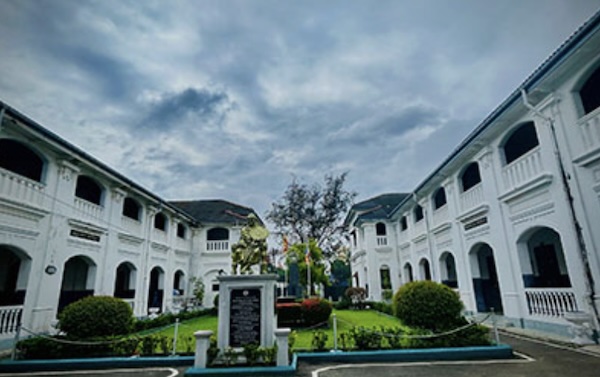
By Sarath Dissanayake –

Sarath Dissanayake
Nalandians reeling in utter shame and disgust
A generation of Nalandians would have had the biggest shock of their life yesterday, upon learning of the unprecedented illicit scandal ever, in their living memory. Aghast, they would never have imagined in their wildest dreams the utter humiliation befallen their alma-mater, amidst its centenary celebrations. Being a Nalandian myself, I feel ashamed, and so do with most others, of the appalling conduct of a student and few teachers with utter contempt.
Amid this halaboloo, a video clip is going viral on social media like wild-fire, in which a student could be seen in a compromised position with teachers. This video footage of obscene and graphic nature, doing the rounds, in fact has made a generation of students dumbfounded with utter shame, shock and revulsion. It’s most insane that our alma-mater, Nalanda, once held in highest esteem with honor, pride and respect, has all of a sudden become a laughing stock in the eyes of the public.
Nalandians who took utmost pride in the manner in which the school had stood by a generation of students thus far, feel completely let down by this infamous fiasco involving a student and teachers. Needless to say, Nalanda, is at the center of controversy today, amidst its centenary celebrations going forward with a sense of utter disbelief and shame.
Centenary celebrations marred by controversy
It’s an irony that Premier Dr Harini Amarasuriya was at Nalanda School on 26th January as the Chief Guest and declared open a new building to mark the centenary celebrations. Premier Amarasuriya herself would have been in shock and dismay in the wake of the sickening high drama yesterday. If Colonel Henry Steel Olcott, who founded the Nalanda college in 1925, were alive today, he would have been the most embarrassed, disappointed and humiliated upon learning such insane, despicable and diabolical act of disgrace.
Anybody with an iota of morality and decency would have never imagined the monumental fiasco our Alma mater has befallen, especially on its centenary year which would have been a turning point in the annals of Sri Lanka’s education sector. Come what may, does Nalanda deserve a such a pathetic and ignoble legacy to be left behind for the next generation of students, contrary to being one of the oldest Buddhist schools in Sri Lanka with a proud and impeccable history and unblemished track record of producing generations of worthy Sri Lankans with a sense of pride and purpose.
Betrayal of the highest degree
By all accounts, this is a betrayal of the highest degree and has shaken the very foundation of Buddhist values on which the school had been founded 100 years ago by Colonel Henry Steel Olcott in 1925. This bizarre let down is a clear reflection of the sheer erosion of ethics and morality of people as well as decline of the overall quality of our educational sector as a whole. Nalanda College, which hitherto enjoyed moral high grounds with an unshakable reputation throughout its history, will no doubt emerge once again with resilience and pride in a matter of months.
Proposed education reforms timely – Need of the hour
Teachers who are supposed to be the guardians of children have turned themselves maniacs, is an utter shame to a society reeling from similar misfortunes in recent times. At a time, Sri Lankan government has drawn up long awaited comprehensive educational reforms under the leadership of Premier, Dr Harini Amarasuriya, the pathetic situation our alma mater has fallen into is simply tragic and most appalling, to say the least. The need of the hour is to introduce much-sought-after education reforms and groom the students through a holistic process to help them build a future in an inclusive academic and spiritual setting with a right mindset of sharing and caring nature. In doing so, it is of paramount importance to rein in both the students and teachers alike, and enforcing decency and due decorum across all centers of learning by implementing a set of guidelines and codes of conduct on a priority basis. Meanwhile, the education authorities should conduct a thorough investigation to ascertain any lapses or dereliction of duties on the part of school staff tasked with disciplinary matters, with a view to ensuring proper coordination of prefects and their duties under the close supervision of administrative staff of schools.
Host of countries are to ban social media for students viz-a-viz options for Sri Lanka
In a move designed to prevent the under-aged students accessing social media, Australia enforced the world’s first ban in 2025, thus blocking those 16 and under, from social media. France is to follow suit, with a similar ban in May 2026 followed by a host of other nations, including the USA, the UK, Denmark, Malaysia, Norway, Ireland, Spain, the Netherlands, Malaysia, the EU, UN, Brazil etc. The US authorities have noted that social media restrictions are aimed at addressing mental health concerns. French has drafted a bill and will be in force in mid 2026, with two measures: a ban on social media for under-15s and a ban on mobile phones for aged 15 -18-year-olds. The US has proposed Kids Off Social Media Act (KOSMA) which inter-alia, proposes ban on social media access for kids under 13, eliminates personalized recommendation algorithms for users under 17, and restricts school networks.
The parents and community groups have welcomed the move, but teenagers view it as an imposition on their freedom and social separation from their online creative spaces and social networks. Proponents, argue that social media leads to mental health issues among children, to the detriment of their moral high grounds and behavioral manners, thus exposing to dangerous content, necessitating immediate protective action. The opponents however argue that a “blunt” ban could drive children to unregulated, less safe areas of the internet, reduce parental oversight. For some others, it provides their children with an essential line to friends, family, connection and support.
Sri Lankan authorities too, may weigh in options to follow suit in order to curtail or ban social media and mobile phones for under-aged children in particular and adult students at large, in order to curb growing menace of social media related activism, adverse and harmful effects on students and communities as a whole, with far reaching consequences. The risks and dangers posed by social media platforms cannot be understated.
As already pointed out and shared in my previous write-up titled ” Sri Lanka at Crossroads viz-a-viz : A Clarion Call for Course Correction“, the damage done by media activists and die-hard elements aligned with political and religious groups has been significant.
Contemporary role and emerging trends of Sri Lanka’s social media
The social media in Sri Lanka, by and large have been responsible in galvanizing public opinion and mindset, especially in times of social upheavals and political crises. The social media could be extremely critical in shaping trends and momentum among societies and communities to a certain degree as proved during Aragalaya in 2022. As clearly seen time and again, the public opinion could be influenced and swayed in a particular direction or for a given cause, with social media’s hyper active role across the board, as in the case of Bangladesh and Nepal in 2024 and 2025 respectively, resulting in chaos, instability, power dynamics and rivalry. The most recent case in point was the political unrest in Iran which saw masses taking to streets in hundreds and thousands, causing a massive uprising against the state. The fall out was catastrophic with countless number of deaths. In this age of advanced technology, social media has been a very powerful medium and tool for system change in which internet and apps go hand in hand among the youth and other socially active groups in times of political instability and social upheavals. Today the social media has become the order of the day, in shaping the public opinion amid contemporary socio-political culture across the globe.
Local social media ought to be self-regulated or state controlled
Social media such as FB, Twitter, Instagram, WhatsApp and Messenger, deserve some form of self-regulation in order to scrutinize its contents, before reaching the end-user and intended audience. In such a circumstance, the end-user-discretion will be of utmost importance in every step of the way which should be the norm rather than the exception. Accordingly, the legislative rights (legal power) and the enforcement of constitutional, statutory and regulatory processes, ought to be essentially vested with the relevant government authorities responsible for monitoring and control of social media at all times. Suffice it to say, the social media should never be a platform advocating and inciting hatred, violence, crimes and animosity whatsoever in keeping with media ethics and norms. On the other hand, social media must desist from engaging in or promoting partisan politics and propaganda inimical to peace, harmony, friendship and goodwill among people transcending ethnic, religious, faith, cultural and political divide. On the contrary, social media should strive to play its part for peaceful-coexistence in a spirit of unity and diversity, devoid of inciting tensions and divisions of any sort, for the sustenance of peace, understanding and rule of law among communities and societies at large.
A Case Study of social media in Sri Lanka
Consequent to a random research done by a local independent think tank on the impact of social media on the people of Sri Lanka, a well-documented publication is out in the public domain. According to this study (in which a cross section of Sri Lankan social media activists partaken), nearly half of those took part, alleged to be biased or leaned towards major political parties while others tend to be either overtly or covertly supportive of independent political entities. It is of greater concern to note that a good majority of social media entities seemingly in favor of backing political dogma or their ideologies at the risk of polarizing and antagonizing viewers based on their political identity and bias, program content, commentary, thereby unduly influencing public opinion and their mindset. Furthermore, the same research study found that a considerable number of social media platforms, allegedly sharing derogatory program contents of abusive, malicious and vicious nature, detrimental to peace and harmony among viewers of diverse backgrounds. In the same research, the emphasis has been laid on the impact of certain social media programs (of an extremely damaging, demeaning and harmful nature), especially on faith leaders, women and children as a whole, with no regard to viewer discretion, which should be subjected to strict regulation, supervision and scrutiny by the state on priority basis in the national interest.
Enactment of legal provisions for social media in Sri Lanka
The government proposes to regulate social media through the ongoing reform process in terms of the Online Safety Act No 9 of 2024 (OSA) aimed at addressing and combating gender-based harassment, hate speech, online bullying, threats of violence. This is timely, though it comes too little, too little; albeit damage is already done.
The proposed legislation comes in the wake of social media activists using online media platforms to target politicians, lawyers, academics, and people of stature with malicious allegations, fabricated charges, gossip, threats, intimidations, which tend to be of degrading and insinuating nature. In particular, some social media posts tend to be racially biased and of extremely prejudicial and provocative nature, inter-alia, creating a sense of anxiety and hatred to the detriment of peace and harmony of people. The proposed reforms reportedly are aimed at addressing gender-based harassment, hate speech, and online issues of concern. The draft bill, once reviewed and finalized, is to be forwarded for Cabinet approval. The Online Safety Act No.9 of 2024 is a legal framework that addresses harmful online communications including social media and other online platforms in regard to faked posts, malicious and fabricated allegations, gender biased harassment and abuses, hate speech inimical to peace, law & order, national security.
Key Takeways
1. There is a growing body of opinion and concerns expressed by old Nalandians of stature with alarm and caution. The authorities may wish to consult all stakeholders for an insightful and in-depth investigation on this unfortunate fiasco, which was lease expected.
2. The utterly insane conduct of the culprits has been sickening to say the least. The authorities ought to take this incident with the utmost seriousness it deserves and take corrective action to bring the situation to a semblance of normalcy
3. Damage is already done. For the sake of damage control, it is advised that the school should prevail upon the teachers and students alike to ensure such cases won’t recur henceforth.
4. This unprecedented fiasco would have to be addressed in earnest so as to build trust and confidence among parents and students in a holistic manner from a stand point of deterrence with adequate safeguards with due diligence on much sought after educational reforms to be introduced to school curriculum and schools
5. The ragging and other forms of mental and physical trauma inflicted on new entrants to universities too deserve a thorough scrutiny at the highest level of authority and prevail upon the need to ensure such demonizing, inhuman and degradable ragging would not recur in future.
6. The parents of students ought to have a closer attention of their children within and without all places of learning (schools, universities, tuition classes, centers of learning and training, temples and all places of religious worship) so as to ensure the wellbeing and moral character of all children and the youth. All such places of education should have close rapport and coordination with parents through PTAs’ OBAs’, OGAs’ student-parents councils, forums in addressing all issues of concern and interest of children and students alike.
7. There is an urgent necessity to monitor social media posts and mobile phones of children and students to prevent them in accessing and engaging in any immoral and obscene contents and untoward activities.
8. Schools must convene regular consultations and follow up any potential cases of concern with all parties involved and take appropriate disciplinary action in a spirit of upholding due decorum, deterrence and prevent recurrence of such episodes in future.
9. In the worst case scenario, the authorities may consider enforcing a total ban of social media and mobile phone for under-aged children in consultation with relevant authorities and parents as deemed appropriate, as is being done by like-minded countries
10. Should there be an urgency for course correction, the authorities should introduce new legislation and enforce legal action against those involved in and found guilty of any immoral misconduct and indecent acts, thereby institute legal action against such culprits.
“අපදාන සෝභිනී පඤ්ඤා“
True wisdom shines most brightly when it is rooted in good character and moral integrity – Nalanda Moto
*The writer is a retired Ambassador and Foreign Ministry Spokesman. He can be reached at schandrad@hotmail.com
Ajith / January 29, 2026
What happened in “Nalanda” may be happening in many other schools without our knowledge. This is not an incident to ignore it but it is the outcome of cultural disaster based on free flow of political, religious and cultural disaster that was developed over the decades. Our system allow Religious, political leaders to do anything including drugs, rape, murder under the cover of special status to those leaders.
/
schandrad@hotmail.com / January 29, 2026
Cannot agree more. In a recent write-up titled ” Sri Lanka at Crossroads viz-a-viz : Youth : A Clarion Call for Course Correction“ on 29th December 2025 , I have alluded to dangers posed by petty-minded social media activists and YouTubers in Sri Lanka (aligned with political parties, extremists and elements with vested interests), in spreading hatred and inciting divisions at the risk of inter-alia, polarizing communities and poisoning the minds of the youth and students alike. Unless we nip such negative trends in the bud before they get out of control, we are bound to go down the precipice of disaster and doom. As such, there will never be a better time than now, for the government to get its act together and put a stop this growing menace of social media activists and You Tubers taking the country on a dangerous path to the point of no return. You may read my write up ” Sri Lanka at Crossroads viz-a-viz Youth : A Clarion Call for Course Correction“, for more details on the catastrophic trends and tendencies I have dealt with.
/
malindian / January 29, 2026
A distinguished alumnus of Nalanda has given his two cents in defence of the College. But no one seems interested. Let me start the ball rolling, then.
“7. There is an urgent necessity to monitor social media posts and mobile phones of children and students to prevent them in accessing and engaging in any immoral and obscene contents and untoward activities.”
This seems to be an attempt to shoot the messenger instead of reading the message. The message is that Sri Lankan society itself is corrupt beyond redemption. Would it not be useful to check how many members of the Sangha are busy promoting hatred? How many Nalandian doctors are on strike at the GMOA?
I have nothing personally against Nalanda, but, like other big schools, it has produced its share of doubtful characters (like Mahinda Rajapaksa) . Is it significant that he chose to send his own sons to an Anglican private school (not that they turned out any better) ?
Let us stop worshipping our schools .
/
J.C. Lately / January 29, 2026
The school that “produced” MARA is Thurstan. Nalanda was rid of him in mid fifties. That was when Nalanda was fortunate; sadly not now.
/
schandrad@hotmail.com / January 30, 2026
Thank you for your comment. At the end of day, it’s worth noting that our Alma mater, Nalanda prides itself on being a reputed school built over more than a century of years by generation of students, teachers and past pupils who served this country with pride and distinction. After all, the lewd conduct of few individuals cannot bring Nalanda into disrepute overnight.and, that the legacy of a foremost school such as Nalanda should not be judged by the actions of few individuals. May long live Nalanda.
/
schandrad / January 29, 2026
Thank you for having guts to “call a spade a spade” which is hard to come by in this day and age. But, I am afraid, I beg to defer with your narrative “shooting the messenger is not the answer”, which does not seem fitting on this particular instance, on which I have a different take altogether. The person who had posted the “graphic” video clip on social media (without realizing the repercussions it entails) has done an irreparable damage, just not only for the sex maniacs (student and teachers) , but for the general public in particular. The youth and children who may not be privy to this sordid saga whatsoever, often tend to surf the web as a routine – just for the sake of “curiosity and temptation” in search of social media posts of “newsworthy and curiosity”. In such such a scenario, the children and youth would have taken this video clip by complete surprise and would have become the first and immediate casualties. That’s why the said narrative seems not at all appropriate for this particular saga which sounds a “recipe for disaster” to my mind. Otherwise, I am in complete agreement with all what you have shared on this matter with all the good intentions. Thanks for the comments.
/
leelagemalli / January 29, 2026
Sri Lanka is sliding into moral and social decay in plain sight. Social media has become a weapon—spreading hate, lies, and grotesque invasions of privacy, even dragging schoolteachers, students, and their families into public humiliation over indecent, fabricated, or sensationalized content. While experts urgently call for a clear code of ethics for digital platforms, the NPP government selectively shields hate-mongering YouTubers and online mobs, while swiftly targeting those who criticize the government. This is not equality before the law; it is political convenience masquerading as justice. The President speaks of equal law and order, yet the Right to Information Act is routinely violated, betraying the very promises that brought this government to power. The people must now ask: is this real change, or the same repression under a new mask?
/
schandrad / January 29, 2026
Couldn’t have said it better. In a recent write-up titled ” Sri Lanka at Crossroads viz-a-viz : Youth : A Clarion Call for Course Correction“ on 29th December 2025 , I have alluded to dangers posed by petty-minded social media activists and YouTubers in Sri Lanka (aligned with political parties, extremists and elements with vested interests), in spreading hatred and inciting divisions at the risk of inter-alia, polarizing communities and poisoning the minds of the youth and students alike. Unless we nip such negative trends in the bud before they get out of control, we are bound to go down the precipice of disaster and doom. As such, there will never be a better time than now, for the government to get its act together and put a stop this growing menace of social media activists and You Tubers taking the country on a dangerous path to the point of no return, Though I fully agree with your opinions and sentiments on the need to bring social media and YouTuber platforms under state control and scrutiny (for the sake of our youth and children), I have bonafide doubts on your criticism of NPP government’s “alleged indifference and selectivity” in applying the law and order to those openly abusing social media platforms in flagrant violation of the well established ethos and principles in Sri Lanka.
/
leelagemalli / January 29, 2026
People in Sri Lanka are increasingly alarmed by the spread of abusive YouTube videos exposing intimate and inappropriate exchanges involving school prefects and female teachers. Such content would not be freely accessible in many European countries, where strict laws and enforcement prevent arbitrary and harmful social media material from going viral.
Sri Lanka urgently needs clear regulations to control abusive online content without undermining freedom of speech. At present, anyone with a mobile phone appears to have unchecked authority to create and circulate unethical videos, posing a serious threat to social values and everyday life. Experts warn that rising youth crime rates—often linked to social media misuse and drug abuse—are worsening this crisis.
The use of vulgar language by certain government-supported YouTube channels further highlights the absence of a social media code of ethics. Introducing effective laws and ethical standards is essential to protect Sri Lanka’s youth and preserve the moral fabric of a traditionally conservative society.
/
schandrad@hotmail.com / January 30, 2026
Thanks. Your message is timely, loud and clear. I cannot agree more. As I said under item 9 of my write-up “Key Take-ways”, the authorities may consider enforcing a total ban of social media and mobile phones for under-aged children in consultation with relevant authorities and parents as deemed appropriate, as is being done by like-minded countries. Australia, France have already enforced such a ban in their countries while a host of other nations are expected to follow suit, as discussed under the subheadings “Host of countries are to ban social media for students viz-a-viz options for Sri Lanka” and “Enactment of legal provisions for social media in Sri Lanka”, appears to be the way forward in the short and meduim term.
/
old codger / January 30, 2026
LM,
“abusive YouTube videos exposing intimate and inappropriate exchanges involving school prefects and female teachers.”
It isn’t that easy. I tried googling and found only some commentaries. The videos might have been spread on WhatsApp groups . Unlike YouTube, WhatsApp doesn’t censor anything, because (according to them), even they can’t see what’s posted.
/
leelagemalli / January 31, 2026
“Unlike YouTube, WhatsApp doesn’t censor anything, because (according to them), even they can’t see what’s posted.”
–
What was meant to empower the people has slowly turned into a dangerous vulnerability.
–
Decades of unchecked openness, driven by political misuse of economic and digital freedoms, have left Sri Lanka exposed in ways many still fail to recognize.
Today, a single mobile phone is enough to spread falsehoods, incite fear, destroy reputations, and manipulate public opinion, while cybercrime grows faster than our ability to respond.
Unlike countries where digital rights and data are fiercely protected by law, Sri Lanka remains largely indifferent to accountability, ethics, and consequences. This carelessness comes at a high cost—lost trust, compromised privacy, financial harm, and social instability. Freedom without responsibility is not progress; it is a silent erosion of national security and public integrity.
/
ramona therese fernando / January 29, 2026
Whilst I agree that all this social media and AI is indeed contaminating the minds of our youth and also adults, this very AI and social media probably also created those videos. Hope there is a mechanism to separate fake videos from real ones.
/
Lester / January 30, 2026
Ramona,
Very good point. It’s very difficult to separate the fake from the real. Much of the content on YT is now AI-generated. A lot of it is fake . Can you tell its fake? https://www.youtube.com/watch?v=GtxsqwjVuUA. I could alter it further, e.g. change the accent, facial expression, etc. but you get the point.
The point is, you cannot ban this kind of technology. Anyone with a good GPU (RTX 3090/4090) can make their own LLM. That is what we have now, despite the “bans” on this content. EU restrictions on social media are a joke.
Regarding schools, I know Finland has banned smart devices in schools (grades 1-9). But children will still use these devices. It’s too easy. If you can order delivery, do you want to spend 2 hours cooking?
/
Lester / January 30, 2026
30 years ago, I was constantly frustrated because the computer program (at the highest levels) was very difficult to defeat in both chess and draughts. The best I could do was draw, though Kasparov had better luck with Deep Blue. Now, of course, the computational power of these programs has further increased with the advent of new technologies. The pattern is largely the same. A human can be trained to see a few dozen moves ahead, while the machine can consider several million variations. The only bright side is that humans can use these machines for self-training alongside a good book. An expensive coach is no longer necessary.
/
schandrad@hotmail.com / January 30, 2026
Thanks. Your points are well taken. Besides social media, AI too has the same impact regardless of its status (real or faked – does not make a difference). Social media platforms are inherently dangerous and designed to keep kids glued for long hours, often leading to anxiety, depression, and negatively impacting health, brain / mind development. (depending on the harmful effects of the contents and messages it generate). In my opinion, risks to kids could be mitigated by setting up parental controls, monitoring screen time, and fostering open dialogue about online safety. On its part, authorities can consider options, such as a partial ban on social media and mobile phone for kinds and students as is done by a host of countries (see para titled “Host of countries are to ban social media for students viz-a-viz options for Sri Lanka”
/
LankaScot / January 30, 2026
Hello Ramona,
“Hope there is a mechanism to separate fake videos from real ones.”
Yes it’s called a Brain.
Best regards
/
SJ / January 30, 2026
LS
The Brain
That is something that we began to sideline the day we allowed pocket calculators in schools.
One thing led to another and now AI is growing into a substitute for human intelligence.
/
LankaScot / January 30, 2026
Hello SJ,
When I first started studying Science we had Mechanical Calclulators that looked like this one but were Black – https://en.wikipedia.org/wiki/Mechanical_calculator#/media/File:Calculator_triumphator_hg.jpg
Quite a few in our class could calculate the answer on paper, quicker than the Calculators (if the numbers were not too large), however the machines were always correct. My relations here are mystified at my ability to multiply any 2 numbers up to 12 instantly; my nephew asked me 16 x 16 and when I gave the answer 256 immediately he had to use his phone calculator to check if I was right. I don’t think he did Binary at School
And the kids today wouldn’t believe you.
Best regards
/
SJ / January 30, 2026
Mental arithmetic was faster than the calculator since the mind could do certain things faster than human fingers.
/
SebastianSR / January 30, 2026
If I understand the write up and the comments correct, it seems that a true or fake picture (of some teachers of Nanalanda College presumably sexually assaulting a student) has been publiczed. This is a serious matter if the publicized content has some degree of truth. It is also a serious matter if it is a fake. However, the author of the article calls it a “fiasco”. This is by no means a “fisco”. What is a “fiasco” ? Here is an example of the use of that word: : Today, you hear fiasco used in situations that have gone so horribly awry that they are almost laughable, like the Thanksgiving dinner fiasco in which the turkey burnt to a crisp, the dog ate all the side dishes, and everyone had to eat frozen pizza instead. So, the sentence “Anybody with an iota of morality and decency would have never imagined the monumental fiasco our Alma mater has befallen, especially on its centenary year which would have been a turning point in the annals of Sri Lanka’s education sector”, indicates a misuse of the word “fiasco”. I think the authour meant “atrocity” rather than “fiasco”. A “fiasco” implies a ridiculous failure, a mess, or a blunder, whereas a sexual attack is a violent crime, a violation, and a profound atrocity.
/
schandrad / January 30, 2026
Sounds interesting to note how the word “fiasco “ has taken the centre stage while the Nalanda “saga” yet remains our core concern. By the way out of sheer curiosity, I did a search to verify the definition / meaning of “fiasco” and, according to Cambridge English Dictionary, there can be different connotations, of which the standard definition revolves around “something planned that goes wrong leading to a complete failure, usually in an embarrassing way”, which I believe best fits Nalanda incident. But please correct me if this sounds hilarious and out of context.
By the way, just wanted to refer to the following link in which an AI blunder of the highest degree has been exposed. This embarrassing saga has happened due to an AI blunder in which PM Modi’s response to his Maldivian counterpart’s greetings on India’s Republic Day has been erroneously translated by Grok platform from a message of goodwill to a political sensitive remark about the Maldives. Such AI blunders are commonplace now, often landing people in trouble for monumental failures on the part of AI apps.
Tap on the link to see the post 🔗 hindustantimes.com/india-news/ai-
/
SebastianSR / January 30, 2026
“something planned that goes wrong leading to a complete failure, usually in an embarrassing way”, which I believe best fits Nalanda incident
If it is mere embrassment, why is the author making such a fuss about it?
Teachers involved with students in a sexually compromizing state is not just embarassing, but an atrocity if true.
If it is a fake AI construction, it is a serious and slanderous assault on the character of the individuals. Eitherway, it is not a “Fiasco”.
Please don’t minimize it now and never use the word fiasco for this sort of thing.
/
schandrad / January 31, 2026
Indeed I felt the kind of langauge used in my write-up (if at all anyone feels that I should have toned down a bit) was essentially to harp / focus more on certain preventive measures dealt with in it, where more emphasis was laid on the urgency of introducing education reforms and banning / regulating social media and apps for under-aged children. .
Anyway, I take your point, the word” fiasco” seems a mismatch, albeit it has different connotations depending on the context it is being used.
/
SJ / January 30, 2026
“Such AI blunders are commonplace now, often landing people in trouble for monumental failures on the part of AI apps.”
Don’t they deserve what they get?
/
schandrad / January 31, 2026
Thanks. Certainly not in this particular instance (India – The Maldives context)
/
SebastianSR / January 31, 2026
Words to Avoid
Fiasco: (Implies a “botched situation” or “failure,” which trivializes the violence).
Incident/Affair: (Too neutral; downplays the severity).
Mistake: (Removes blame from the perpetrator).
The best approach is to use clear, direct language that places responsibility on the perpetrators and acknowledges the violation of the victim, as there are victims if the incident were real or faked.
/
schandrad / January 31, 2026
See this news report in the Daily Financial Times of today titled “Govt. goes for national assessment of impact of Social Media on children”,which is timely, for the sake of children and youth of Sri Lanka.
The link for the article is at https://www.ft.lk/news/Govt-goes-for-national-assessment-of-impact-of-Social-Media-on-children/56-787727
/
schandrad / January 31, 2026
The Editorial in the “Colombo Today” titled “Protecting Childhood in a Digital Age”, sounds great and is heart-warming.
The link is at https://ceylontoday.lk/2026/01/31/protecting-childhood-in-a-digital-age/
/
Jaffna Man / February 2, 2026
Without being pedantic, Vis-à-vis is a French loan phrase spelt with an s not z
/